
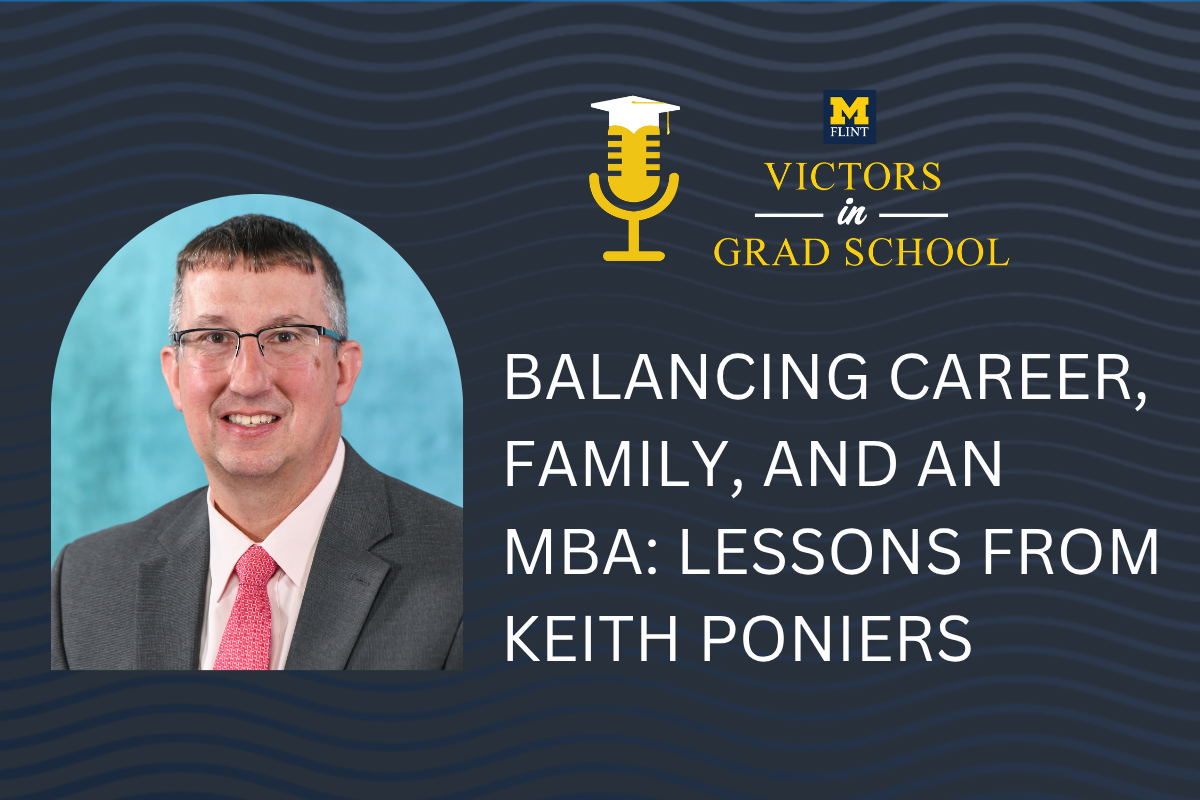
Are you contemplating a return to graduate school, or perhaps already in the thick of balancing higher education with work and family commitments? The latest episode of Victors in Grad School dives into the inspiring journey of Keith Poniers, Vice President and Chief Financial Officer at Hurley Medical Center, as he recounts what it truly takes to thrive in graduate school after years away from academia.
Hosted by Dr. Christopher Lewis, Director of Graduate Programs at the University of Michigan-Flint, this episode offers an honest, firsthand account of re-entering higher education more than two decades after earning an undergraduate degree. Keith Poniers reflects that it had been 26 years since he stepped into a classroom, and details how evolving career ambitions and executive opportunities motivated him to pursue an MBA (02:25). He candidly discusses the challenge of shaking off “school mode” and stepping into a new academic environment surrounded by both younger students and peers from diverse backgrounds (05:03).
A primary theme throughout the episode is the importance of resilience and adaptability. Keith Poniers openly shares the nerves that came with his first orientation, the adjustment to working alongside younger classmates, and the rapid pivot to online learning brought about by the pandemic (09:04). He credits supportive professors and a strong personal support system—including his wife—for helping him maintain balance and motivation during challenging times (07:28). Sacrificing leisure activities, managing work stress, and dedicating ample time to study were keys to his success, alongside the drive to meet his own high standards (08:37).
Listeners will find actionable advice woven throughout, especially for professionals considering graduate school. Keith Poniers emphasizes finding a program that fits your personal circumstances, preparing for a demanding time commitment, and being ready for collaborative, group-based learning environments (13:15). The episode is rich in reminders about the personal and professional rewards of graduate education, the value of maintaining motivation, and the necessity of adapting to new formats like online learning.
If you’re seeking relatable insights and practical encouragement on the road to an advanced degree, this episode is a must-listen. Tune in to hear Keith Poniers and Dr. Christopher Lewis explore the realities of balancing life, career, and education—proving that it’s never too late to become a victor in grad school.
Ready to take the next step? Listen to the full episode and let their stories inspire your graduate journey!
TRANSCRIPT
Dr. Christopher Lewis [00:00:01]:
Welcome to Victors in Grad School, where we have conversations with students, alumni, and experts about what it takes to find success in graduate school.
Dr. Christopher Lewis [00:00:11]:
Welcome back to Victors in Grad School. I’m your host, Dr. Christopher Lewis, Director of graduate programs at the University of Michigan, Flint. Really excited to have you back again this week. As always, every week we are on a journey together. This is a great opportunity for us to be able to take a look at this journey that you’ve decided to explore or maybe that you’re already on. Graduate school is definitely a journey. And no matter if you’re just starting off, you’re just starting to think about things, maybe you have applied, maybe you’ve been accepted, maybe you’re in graduate school.
Dr. Christopher Lewis [00:00:44]:
No matter where you are, this is a journey and it’s leading you down that. That proverbial path toward the light at the end of the tunnel. And every week, I love to be able to talk to you, to work with you, to help you, to provide you with some tools for your toolbox, to give you some sense of how can you find success in this journey that you’re on. That’s why every week, I truly enjoy being able to introduce you to new people with different experiences that can share the graduate journey that they went on. With you this week, we got another great guest. Keith Ponyers is with us today. And Keith is the vice president and chief financial officer at Hurley Medical center. And I am really excited to be able to have him here to talk to you about his own journey in education and to welcome him to the show.
Dr. Christopher Lewis [00:01:31]:
Keith, thank you so much for being here today.
Keith Poniers [00:01:33]:
Thank you. Thank you very much. I appreciate the time and look forward to sharing my experience.
Dr. Christopher Lewis [00:01:38]:
Well, I’m really excited to have you here, and I always love to start these conversations with a turn back in time. So I know that you did your undergraduate work at Indiana University and you went through that experience, you got your bachelor’s degree in accounting, and then you went off, you went off, you worked, and you got a lot of different experiences in different types of companies in you. At some point along the way, I’m going to say, quite a ways down the path, you made a decision to go back to school. Take me back to that point in time. And what made you decide that that was the time, that was the time that you wanted to start that graduate education journey for yourself?
Keith Poniers [00:02:25]:
Sure. So as you said, it was 26 years between the time I left. Graduated from Indiana way back in 93 until, you know, stepping foot on U of M. Flint’s campus in the fall of 2019. What got me to that point over those 26 years in my various jobs, I never thought there was a need for an MBA through the different companies that I worked for. It really wasn’t required, that kind of thing. But I got an opportunity to come work at Hurley here in Flint. And I’m a Genesee county born and raised.
Keith Poniers [00:03:03]:
Other than my four years at Indiana University, I’ve either lived or worked here in Genesee County. So coming to work at Hurley was a great opportunity for me. Really love the Flint community and like I said, it’s always been a part of my life. But I had an opportunity to come here at Hurley as working in the finance department, and then after a couple of years had another opportunity here at Hurley, and the current CFO was retiring. And they approached me of saying, if you’re interested in, you know, stepping up into that role, a master’s, an MBA would really go a long way to being you, to become a serious candidate. Nothing’s ever guaranteed. But again, if you want that opportunity, certain things to get to that executive level, you do need a master’s or B, a cpa, those kind of things. So that got me thinking, okay, where am I at? I was comfortable in my life, wife, daughter, grandkids.
Keith Poniers [00:03:56]:
But if I wanted to take that next step in my life and further my career, it was something that needed to be done. So I did some research. Different education opportunities. There’s obviously there were online MBAs that you could get. I looked at different ones around the state. But I was attracted to U of M Flint 1, being here right down the road from where I was currently working, great, you know, reputation. So that kind of was the avenue that led me to apply to U of M Flint and their MBA program.
Dr. Christopher Lewis [00:04:27]:
Now you just said that it was about 26 years between when you last left education to when you came back and you kind of get out of the mode of being in school mode, I’m going to say. So talk to me about that transition for yourself. Everybody goes through those transitions. And you had transitioned out of higher ed quite a ways in the past, and then you came back after many years in working. So what did you have to do for yourself to be able to transition back into school and find success as you transitioned in? And what did you have to do as you were going through that graduate education to be able to maintain that success?
Keith Poniers [00:05:03]:
It was a huge transition for me. Again, like you said, 26 years is a long time. I still to this day, you know, all these years later, remember going to the orientation, you know, at the School of Management building down the street here, and being very nervous. I’m walking into a room full of people. They’re professional people mostly. There are some that just continue right from undergrad into the MBA program. But I was for sure one of the older people in that room having that gap. So it was a challenge to become comfortable in that setting.
Keith Poniers [00:05:35]:
You start working with, meeting people a lot younger than you in all different professions. So definitely a challenge. I think I just needed to reset my mind that, okay, this is a new chapter of my life. I drew back on some of those experiences from Indiana. When I went to Indiana, I was the only one from my school to go there. So it was a new experience. So it was kind of like deja vu all over again. Stepping into a new world, not knowing anyone, you know, just like I did when I was a freshman at that point, 30 years ago, from when I started as a freshman at Indiana, to quote, being a freshman in the new world of education, too, that was the other thing that was.
Keith Poniers [00:06:15]:
It was when I went to Indiana, I took an electric typewriter with me. You know, it was, now I’ve come into college with a high tech laptop. So just kind of, like I said, just going back and understanding I can be successful in this new world of education. And it really took, you know, that first couple classes to really become comfortable and say, okay, look, I can fit in. And the professors there were great. My first class was in person with Dr. Lawrence, negotiation class. He made us all feel really comfortable.
Keith Poniers [00:06:47]:
He was still, I would say, that’s my favorite class of my mba. I draw on the experiences from that class and the lessons learned from Dr. Lawrence in the negotiation. I still have books from his class and a few others on my bookshelf behind me. But it really, again, the professors made it really comfortable for myself, being a little older, to fit in with the younger crowd and worked well with each other there.
Dr. Christopher Lewis [00:07:12]:
Now you were working full time while you were going through school, so you had to do some balancing along the way. Talk to me about balance and how were you able to find that balance for yourself as you were trying to wear the many hats that you had to wear while you were going through a graduate program.
Keith Poniers [00:07:28]:
Sure. I give a lot of credit to my wife. She was very supportive. The job at that point, I was controller at Hurley, you know, working my way, hopefully being to be considered for the. The CFO role. So. But it was a very challenging job, stressful as well. So Then you throw college classes on top of it and all the time commitments.
Keith Poniers [00:07:48]:
So again, like I said, a lot of thanks, kudos to my wife for allowing me to kind of step back from our marriage. And you have to have that kind of give and take with whoever you’re living with, your partnering with, whoever that they understand and they are supportive because it is an impact on your life. I kind of had to give up some of my other extracurricular activities I love to golf. I had to cut back and golf, fantasy football, fantasy baseball, those other things I had to scale back a little bit on. But ultimately you understand that there’s a goal while you are doing this. And so you sacrifice a little bit to reach that goal.
Dr. Christopher Lewis [00:08:23]:
You do have to do some of that. You do have to sacrifice at times. And you have to find ways to keep yourself motivated because it can be challenging along the way. How did you stay motivated through challenging semesters or coursework?
Keith Poniers [00:08:37]:
I hold myself to a very high standard. So for me, the motivation was doing the best I can, getting the best grade throughout. Like, I started in the fall of 2019. So my second semester was 2020, which is obviously Covid hit. So that was its own challenge in itself. Stepping back in the classroom after 26 years, thinking everything was going to be in person, and then all of a sudden Covid hits and the whole world changed. And so that really continued to make me be focused on, okay, I got to pay attention because now everything is online. It was kind of a different world that I’m used to in person meetings, talking face to face with people.
Keith Poniers [00:09:20]:
Now everything flipped to virtual meetings, virtual classes. That was a whole new learning experience in itself. But again, my drive to be successful, and I knew I needed to be successful if I wanted to reach the ultimate goal of being considered for a higher executive level here at the hospital, that was really important to me.
Dr. Christopher Lewis [00:09:41]:
Now, you said you, it sounded like you looked at only MBA programs because that was the path that you were looking at. And as you look back now, it’s been a couple of years since you got that degree. And you think back now to the things that you’re still pulling from. If you had to do it all over again, would you choose the same program or path? Why or why not?
Keith Poniers [00:09:59]:
I would absolutely choose the same program. Again, the convenience of being local here in the community was a big selling point to me. Again, at that point, I thought I would be more successful with an in person type of learning because that’s what I was used to way back in the day. Obviously didn’t know I was going to completely flip to an online class. I only had the first semester and then about two or three months of the second semester was actual in person before going to online. So in hindsight, knowing how more convenient online classes is, I may have considered something a little different. But again, that was kind of, that was what I was used to, so that’s why I chose it. But even now, understanding, you know, the online presence, I think, you know, U of M.
Keith Poniers [00:10:46]:
Flint did a great job making that transition. It was quick, seamless, really. No issues with the technology or anything like that. So I think knowing the university has those resources available that they can quickly, you know, pivot as well, they made it very easy transition as well.
Dr. Christopher Lewis [00:11:04]:
And I know earlier you mentioned Dr. Lawrence’s class, but. And you think, as you think about the courses that you went through, how did graduate school change the way you think or approach problems?
Keith Poniers [00:11:14]:
I mean, there were a handful of classes that I continue to draw back on. Organizational behavior was one. Again, one of my first classes. But as I stepped into more leadership roles throughout my career, being able to read, people understand you can’t treat everyone the same. Everyone is different. You know, those, those kind of lessons were and I felt like repeated in a lot of the classes. But sometimes you just need that drip, drip, drip to. To hear message over and over again.
Keith Poniers [00:11:43]:
You know, you have to be open. You have to be, you know, look at things differently through different lenses, whether it’s just dealing with people or other ideas kind of thing. So that’s something I continue to draw on throughout my career since I’ve graduated as well.
Dr. Christopher Lewis [00:11:58]:
What’s something that you wish that someone had told you before you started graduate school?
Keith Poniers [00:12:02]:
It required a little more time commitment than I expected. Again, I thank my wife and my family for being supportive. And you think, okay, I got all these life experiences, I should be able to handle it. But I’m also one that I like to be prepared. So I probably spent more time studying, reading, making sure, you know, I did everything on the syllabus so I could be successful. So again, just be prepared to spend and dedicate that time necessary if you want to be successful. You have to put in the time. So my one negative of the whole thing at the whole experience was the one A minus.
Keith Poniers [00:12:40]:
I got in one class that cost me a 4.0 GPA. And I think I go back to I prob. Probably didn’t spend enough time preparing for that one exam in that class that I didn’t do as well as I should have been. And I still kind of kick myself for not getting that perfect 4.0 class or GPA throughout my two years there.
Dr. Christopher Lewis [00:12:59]:
Now, as you think back to your graduate education and you think of others that are thinking about going to graduate school, whether it be in business or the health field or something else, what are some tips that you might offer others considering graduate education that would help them find success sooner?
Keith Poniers [00:13:15]:
I think you got to find the right environment for you to be successful again. Understand that there will be impact to your personal life, especially if you’re working. If you’re going to be working and doing this, gotta make sure your job understands okay. You know, you’re gonna have some other commitments you may have to take some time off for. For certain things that just getting your mind right, that’s going to impact your current life and your work life balance. You need to be prepared to adjust and pivot accordingly because if you want to be, you have to dedicate the time to it. You can’t just skirt by. Sometimes I think people in high school, they can, okay, you just got to do the work.
Keith Poniers [00:13:57]:
You can get by through in high school. When you get to college, you have to step up a little more. I think the MBA program, at least from my experience, and again I’m comparing to my undergrad a long time ago, but there was a lot more interaction, group work, those kind of things which I found really, I appreciated that back in my day, you know, we didn’t do as many group projects even at Indiana, but in this program, program every class had group work. You’re doing online comments, chats, working on projects. So it goes back to if you’re going to be successful, you have to be willing to work with other people. You have to be tolerant to that. Not everyone is going to have the same work ethic as you. So you have to accept that they might just be along for the ride while you’re striving to further your career.
Keith Poniers [00:14:45]:
You have to either one, call them out for that. Don’t be bashful if somebody’s not putting in the work. You got to call them out and make sure, hey, migrate on what you do as well on those group projects. That’s another thing where I would encourage, don’t be afraid to step up and say something as well.
Dr. Christopher Lewis [00:15:01]:
Well, Keith, I just want to say thank you. Thank you for sharing your journey today and I truly wish you all the best.
Keith Poniers [00:15:06]:
Thank you very much. I appreciate the time.
Dr. Christopher Lewis [00:15:08]:
The University of Michigan Flint has a full array of master’s and doctorate programs. If you are interested in continuing your education. Whether you’re looking for in person or online learning options, the University of Michigan Flint has programs that will meet your needs. For more information on any of our graduate programs, visit umflint.edu graduateprograms to find out more. Thanks again for spending time with me as you prepare to be a victor in grad school. I look forward to speaking with you again soon as we embark together on your graduate school journey. If you have any questions or want to reach out, email me at flintgrad officemflint. Eduardo.