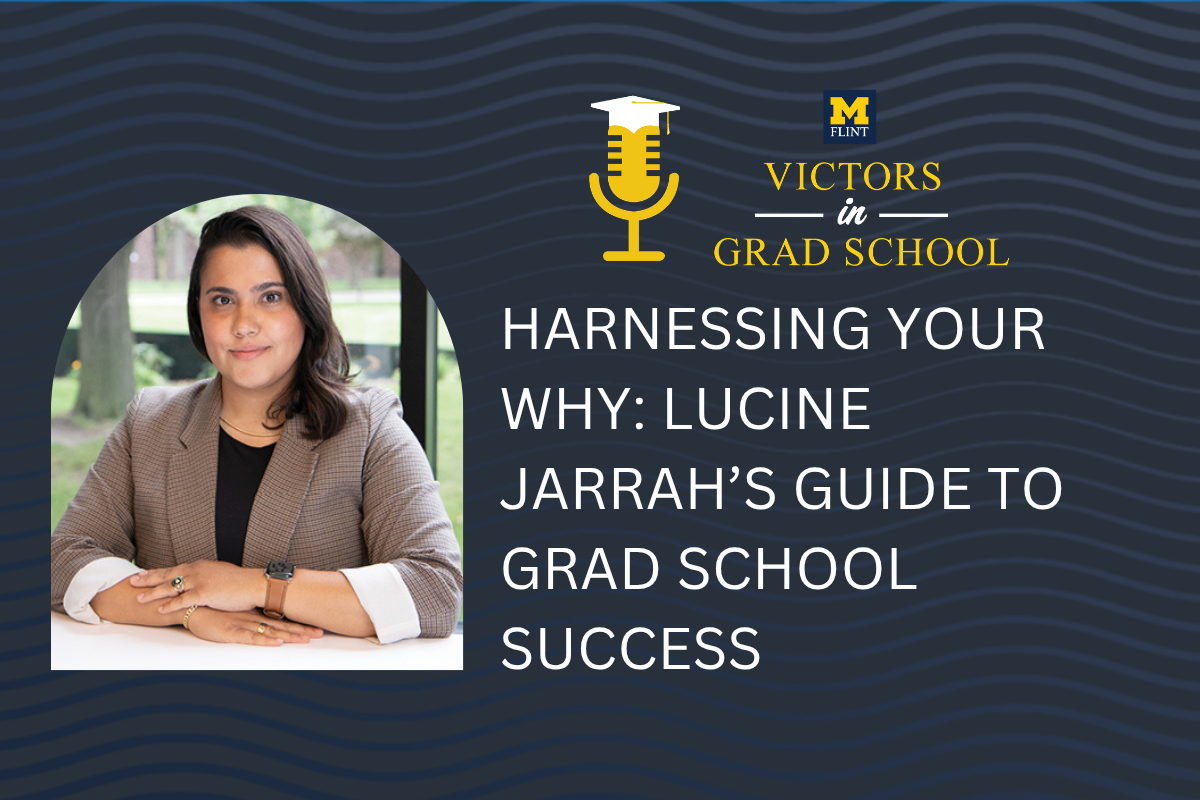
Are you considering graduate school, or searching for that extra spark of motivation to keep you moving forward on your academic journey? The latest episode of Victors in Grad School delivers a truly inspiring conversation between Dr. Christopher Lewis and Lucine Jarrah, a University of Michigan Flint alumna whose path from undergraduate studies to executive director shines a bright light on the power of purpose.
At the heart of this episode is Lucine Jarrah’s belief in making a difference through community work. As she recalls, her undergraduate years were marked by activism, organizing with nonprofits such as the Arab American Heritage Council, and building programs aimed at creating social impact. When the idea of graduate school first took root, it wasn’t about collecting another credential or checking a box. Lucine Jarrah sought deeper knowledge and tools to drive meaningful change: “I really wanted to understand how systems shape people’s lives. That’s why I specifically sought out the Master’s of Social Work with an emphasis in community change” (03:13).
Throughout their conversation, Dr. Christopher Lewis and Lucine Jarrah explore the transition from undergraduate to graduate life—a leap magnified by the isolation of the pandemic. Building community and camaraderie, even in digital or distanced formats, became a lifeline “[We had to find a way to sort of be in community with each other so that it was safe, but also figure out how we can continue to lean on each other, support each other, and get through this time together” (07:19).
One of the most powerful themes of the episode is learning to manage self-doubt. Like many graduate students, Lucine Jarrah faced imposter syndrome, intensified by the remote learning environment. Her advice? Seek mentors, stay involved, and never shy away from new opportunities—even if they feel intimidating at first. “Having wonderful people in the program… gave me the confidence, the mentorship, the guidance that I needed to ultimately feel like I could pursue all of the things that I wanted” (11:44).
Balance, too, is indispensable—Lucine Jarrah describes the challenge of juggling work, family, and studies, and stresses the importance of organizing, prioritizing, and giving yourself permission to rest.
If you’re searching for a graduate school guide grounded in real-world experience, listen to Lucine Jarrah’s story. The episode is filled with wisdom about growth, resilience, and the importance of knowing your “why.” Tune in, get inspired, and take the first step toward your own journey of purpose-driven success.
Ready to listen? Don’t miss this uplifting episode of Victors in Grad School. Your future self will thank you.
TRANSCRIPT
Dr. Christopher Lewis [00:00:01]:
Welcome to Victors in Grad School, where we have conversations with students, alumni, and experts about what it takes to find success in graduate school. Welcome back to Victors in Grad School. I’m your host, Dr. Christopher Lewis, Director of Graduate Programs at the University of Michigan Flint. Really excited to have you back again this week. And as always, every week we have a great opportunity to be able to work together and help you to be able to move forward in that graduate school journey that you’re on. I call it a journey because it truly is a journey. Every person that goes to graduate school has to go through an individualized journey for themselves to be able to get from where they are to where they want to be.
Dr. Christopher Lewis [00:00:43]:
And what’s important though, is that there are things that you can do, things that you could do right now that can help you to start thinking Like you’re going to graduate school, thinking like you should be to be able to prepare yourself for graduate school, but also doing other things to be able to prepare you for graduate school. And that’s why this podcast exists. Every week, I love being able to bring you different people with different experiences that can help you to be able to think in a different way, but also prepare yourself for graduate school in many different ways, because every person is going to have a little bit of a different experience in graduate school. And that’s why every week I love being able to bring you different people with those different experiences that can help you along the way. Today we got another great guest. Lucine Jarrah is with us today, and Lucine is a graduate of the University of Michigan Flint. She got her undergraduate degree here at the University of Michigan Flint, and then she went on to get her MSW. We’ll talk about that journey for herself as well.
Dr. Christopher Lewis [00:01:44]:
And I’m really excited to be able to have her here and to share some of her experiences with you. Lucine, thanks so much for being here today.
Lucine Jarrah [00:01:51]:
Thank you, Chris. Excited to—
Dr. Christopher Lewis [00:01:52]:
Well, I’m excited to have you here today and to be able to talk about your own journey. And I always love being able to start these interviews with an opportunity to turn the clock back in time. And I said you did your undergraduate work at the University of Michigan Flint. And at some point, at some point in that journey of getting that bachelor’s in social work, you made a decision. You made a decision, I’m not going to just stop with that BSW. I’m going to continue on. I’m going to keep going to get my master’s in social work. Bring me back to that moment.
Dr. Christopher Lewis [00:02:24]:
What was going through your head and why did you decide that graduate school was right for you?
Lucine Jarrah [00:02:29]:
Yeah, I mean, I had a really amazing undergraduate experience here at the University of Michigan Flint. And, you know, during my time, I was really involved on campus. I was organizing on and off campus, actually, and I was getting really excited about thinking, you know, where I wanted to take my career and I was getting involved with some local nonprofits in the area, like the Arab American Heritage Council, and worked on numerous other campaigns related to general GOTV, getting out the vote, and then also like the widely known campaign, the One University campaign, which was about getting more funding and resources to the University of Michigan-Flint. So my role in all of that work and wanting to be able to do more and have more tools at my disposal to do more, I think was the biggest motivating factor for me to start thinking about grad school in a really serious way. I had all this wealth of experience doing organizing work and helping build programs, working with communities, but I really wanted to understand how systems shape people’s lives. And that’s why I specifically sought out this program at U of M Ann Arbor, the Master’s of Social Work with an emphasis in community change. So for me, you know, it wasn’t, it didn’t feel like a random next step. It felt like something that was really connected to this question that I was having, which was, you know, how can I do more? How can I build my skills, improve my skills, improve my access to tools so that I can do better for my community?
Dr. Christopher Lewis [00:03:43]:
And really, you answered my next question, which really was, you did go to the University of Michigan for that MSW program. Great program, and definitely has opportunities for being able to delve into the community work research and being able to better understand the people around you. But one of the questions that I always ask is, there are many different master’s programs that are out there, and you kind of already explained, and you said that U of M’s program was the right fit for you, and maybe that was the only program that you applied to. But were there other things that you were looking at when you were thinking about graduate schools that really allowed for you to be able to whittle that list down? Or was it really that there was just one that you really wanted?
Lucine Jarrah [00:04:24]:
So what was appealing to me about this particular program was the community change pathway. I think there’s always been a very narrow view of social work. People tend to think of social work as very limited in scope when it’s actually very, very broad in scope. And so there was something really exciting to me about pursuing something like social work and being able to do work that was very much connected to community organizing and systems-level change and all of that. And so I think it— At the time, I was sort of just asking myself the question, what kind of work am I trying to do? What skills do I need to grow into that work? Am I choosing grad school because it aligns with those goals or because I feel pressured to do it, to check a box? I was really, you know, doing a deep dive into thinking about these questions very seriously. And ultimately, I decided that it was a good fit for me because it was going to allow me to better service my community, which was the ultimate goal for me, and bring that knowledge and expertise back into the community, which is exactly what I did after grad school.
Dr. Christopher Lewis [00:05:17]:
I moved back to Pakistan. Now, every person goes through transitions as they go from one academic program to the next, one level of academic program to the next. And the way you’re taught in undergrad is going to be very different than the way you’re educated at the graduate level. And the expectations are different. Faculty are going to be expecting different things of you as a learner yourself. Talk to me about the journey that you went on yourself. And you were successful in that journey. You got through, you got your master’s degree.
Dr. Christopher Lewis [00:05:45]:
Talk to me about the transitions that you had to go through. And what did you have to do at the beginning of your graduate school journey to to transition into graduate school? And what did you have to do throughout that graduate school experience to maintain that success?
Lucine Jarrah [00:06:01]:
That’s a good question. And honestly, I went into grad school at a really interesting time. I was— it was in the middle of the pandemic, actually. And so I was going into a field that really, for me, is all about community, right? It’s about interacting with people on a pretty regular basis. And so to be living through a time where we were all super disconnected and far away from each other physically was really different and something I had to sort of navigate in the program while I was moving to Ann Arbor and getting acclimated to this new grad school journey. And so that was really different and something that I didn’t necessarily expect. And I was really concerned about, you know, how it was going to impact my experience as a student and what I was going to be able to gain from the experience of doing the master’s program. Because for me, you know, I was really excited about being able to do my internship and being able to work off campus.
Lucine Jarrah [00:06:50]:
For me, it was at a place called the Center for Community Well-Being. And so I was really excited about the opportunity to be in person and work with colleagues and talk about programs and do all of that work, you know, in person in a collaborative way, in a way that I was used to doing. And so that was certainly a challenge for me, you know, going into grad school is very different than my undergrad years where I was constantly on campus. I practically lived on campus. And I was, you know, always doing after-school things and always attending community events. And so we had to find a way to sort of be in community with each other so that it was safe, of course, during the pandemic, but also, you know, figure out how we can continue to lean on each other, support each other, and get through this time together. So we, you know, we found ways. It was not without its challenges, but we found ways to get through it.
Lucine Jarrah [00:07:35]:
And I think the biggest credit I could give is just being able to surround myself with such incredible people who were willing to take that challenge very seriously and still find ways to connect and just be with each other even under difficult circumstances.
Dr. Christopher Lewis [00:07:47]:
Now, you mentioned a little bit earlier that after graduate school, you went back to your home community. You came back to Flint and you started working back at the Arab American Heritage Council and transitioned into that type of work again, after being involved with them as a younger individual working as an undergraduate student. And you have since transitioned into becoming the executive director of the Arab American Heritage Council. And I guess I would be interested to dig a little bit into the takeaways in the sense that you think back to your, your graduate school experience, and you learned a lot of different things. it relates to community work and relates to working with people. But talk to me about how you’re utilizing what you learned in that graduate work on a daily basis.
Lucine Jarrah [00:08:38]:
Yeah, I mean, it’s every day, right? So much of my graduate education was about learning to understand how systems and structures operate. I was in, you know, investigating systems and structures at a federal level. So how do agencies and institutions, organizations that we rely on, how do they operate? How do we ensure and hold them accountable so that they are actually effective and delivering delivering for community in a meaningful way. So a lot of these things I was exploring and unpacking in the classroom throughout my graduate school years. And so coming back into this job, I felt very much equipped with the knowledge and honestly with the advocacy framework to be able to then through the AHC do the work of fighting for that accountability, fighting for that oversight, and thinking more transformatively about how do we want systems to actually work for communities. How can we improve them? How can we imagine better for our communities and not just think in the ways that we’ve been sort of programmed to think about these systems and structures? So coming into the AHC right after grad school, I thought I was on top of the world and very excited about all of the ways that I was going to be able to utilize what I had learned in school and now actually be able to incorporate it into my work in the advocacy space, in the programming space, in all spaces through the Heritage Council to improve the mission and help advance the mission of the Heritage Council, but also help build the political power of our communities here in Flint and Genesee County so that we can again feel empowered in our ability to imagine better for our society, for our community.
Dr. Christopher Lewis [00:10:04]:
One of the things that I would be interested in hearing from you on is every person as they go on into graduate school at one point or another run up against that proverbial wall when it comes to whether or not they feel like they truly belong, whether or not they feel like they know enough, that they are enough, that they can be enough to be able to be successful in that graduate school experience that they’re going And many times they call it imposter syndrome, but there’s other pieces with self-esteem and other things like that that go into it when you’re entering into that new type of environment. Talk to me about how that impacted you and whether you did face imposter syndrome or self-doubt during graduate studies, and how did you handle it?
Lucine Jarrah [00:10:50]:
Oh yeah, I absolutely did. And I think it was exacerbated by the fact that we were all so disconnected and far away from each other physically, right? So I would say I leaned heavily on identifying mentors in grad school and And not really shying away from any opportunity to get involved in things, even if it felt a little bit nerve-wracking or something that I perhaps wasn’t used to doing or didn’t have the skill set as somebody else perhaps who was going into it. So really not shying away from the opportunity, but leaning on folks in that space to help guide me and feeling like I, I could build those relationships and lean on those relationships for support. And that helped me a lot. It helped me establish incredible mentors throughout my time in my grad school program. And it allowed me to feel more confident in my ability to take on new challenges. And so, it was certainly a process, and I did go through periods where it felt particularly challenging for me to show up in certain spaces because I didn’t necessarily feel like I was meant to be there. But I think having wonderful people in the program constantly in communication with me and working with me and so many other spaces, it gave me the confidence, it gave me the mentorship, the guidance that I needed to ultimately feel like I could pursue all of the things that I wanted to pursue.
Dr. Christopher Lewis [00:11:59]:
And how did you balance both school, work, family, personal responsibilities while going through graduate school?
Lucine Jarrah [00:12:06]:
Oh, I have no idea. I have no idea. It was hard. It was really, really hard. I, you know, I had to find a way to get organized. I had to make sure that I wasn’t burning myself out. I was still very much connected to the Heritage Council even throughout my grad school years. Actually, that’s sort of how I was able to ultimately pursue the executive director job afterwards was staying so connected to the council.
Lucine Jarrah [00:12:28]:
throughout undergrad and in grad school. So I was working full-time, I was in school, I, you know, I had family commitments. It was, it was very, very difficult. And I definitely went through periods where I, I had to sort of sit down with myself and reground and, and really think about, you know, you’re gonna burn yourself out if you don’t take a time to get organized, take time to rest, take time to prioritize things. So it was really a mix of that, right? It was really thinking about, okay, what are the things that I absolutely need to prioritize here and, and commit to? And what are some other things that I can maybe put on the back burner for a little bit? and come back to at a later time. And so again, I think this question is also connected to the last one, which is that having incredible mentors and guidance in grad school, whether that’s through faculty, staff, other students, or the relationships I was building with the community, they helped me along the way. They reminded me of the importance of taking time to rest and take breaks and not feel like I have to say yes to everything all the time. And also think about, you know, what does it mean to like meaningfully prioritize the things that I’m doing so that I can commit to them in the ways that I, I want to, right? Because that’s the other thing about me is I really want to give 100% commitment to everything that I do.
Lucine Jarrah [00:13:34]:
And of course, we’re all human. And so doing that for 4 or 5, 6 different things just means you’re gonna burn yourself out really fast. So yeah, I definitely give lots of credit to just the wonderful people in my life who continue and to this day continue to remind me to take time to talk about—
Dr. Christopher Lewis [00:13:49]:
You talked about the relationships and the mentors that you built and things like that. Talk to me about those relationships and what you had to do to be able to build those relationships with faculty or peers that helped you to find success in that journey.
Lucine Jarrah [00:14:06]:
Yeah, I think this is the other thing that can be, you know, nerve-wracking about grad school, going to a grad school that, of course, U of M is a little bigger than U of M Flint. And so the benefit of being at U of M Flint is it felt like you could end class and go up to your professor and talk to them and even walk them to their next class or meeting or go to their office hours. Having the smaller class sizes meant that you were building more intimate relationships with your faculty and professors, whereas going to a place like U of M Ann Arbor, it was a little bit more of a challenge to develop those relationships, but also I was going during the time of the pandemic, which made it even more of a challenge because we were all remote. And so I think what I, you know, ultimately did was I would send emails to faculty that I was, you know, I was really interested in their research or I really wanted to work with them, or I came across something that they were actively involved in in the community. A program they were helping to run, something like that. And so, I would send an email, I would reach out to them, and I would say, you know, I would love to have 5, 10 minutes of your time just to chat with you. And from there, you know, usually they, you know, would either, you know, be honest about their capacity to take on, uh, somebody like an intern or to have somebody shadow them, or they would connect me to another resource. And so, I think just taking that initial step to reach out and express, you know, my interest, express my excitement, my passion for what I want to do, and why I’m interested in working with them.
Lucine Jarrah [00:15:22]:
It definitely went a long way. And even if I didn’t end up working with that particular faculty member, I always felt like they were wonderful people who were always willing to connect me with others who aligned with my interest and my passion and my work. So it’s always just about that first step.
Dr. Christopher Lewis [00:15:37]:
And how do you find that graduate school changed the way you think, you work, or you approach problems?
Lucine Jarrah [00:15:45]:
I think it gave me more of a, I guess, a framework, a new perspective for how I engage in the work that I do. Like I said, I think for me, the appeal of this program, of Master of Social Work program and the Community Change Pathway, was that I was already doing work like this, but I wanted better— I wanted to improve my skills, and I wanted better tools at my disposal so that I can engage in the work in a more meaningful way. And so, you know, for me, it felt like walking away from the program, I felt like I did have a new perspective of looking at my work, a new framework for doing things like advocacy, new connections, new relationships. So it gave me a lot of the things that I obviously still tap into to this day in this work as a nonprofit leader, but also in my other work outside of the Heritage Council as well.
Dr. Christopher Lewis [00:16:40]:
No, Now, as you think about the journey that you went on and you think about other individuals that are thinking about going to graduate school themselves, what are some tips that you might offer others considering graduate education that would help them find success sooner?
Lucine Jarrah [00:16:56]:
I would say really think about your why. Graduate school is not just about earning another degree. For me, it was about building tools and relationships and the confidence to do the work that you feel called to do, right? For me, it was work in community and in the nonprofit sector. For others, it might be different. But being able to think about your why and have a good solid answer to fall back on is really important because there’s going to be numerous challenges that come your way throughout grad school. It’s not easy. And to be able to come back and think about, okay, what is my purpose? Why am I doing this? Why did I get myself into this? It’s going to be in a really important way to continue to motivate you and inspire you on your path. So I would say absolutely be really thoughtful about why you’re doing this, why you are picking the program that you are, and how it’s going to continue to inspire and motivate you down the line.
Lucine Jarrah [00:17:55]:
And also, I was just going to say, and you also don’t have to have all the answers figured out. That was something else I struggled with in grad school is I thought I had to have it all figured out all the time. But it’s, you know, it’s an opportunity for you to learn and grow, and you might change your mind about things, and that’s okay. So don’t feel like you have to have it all figured out. It’s definitely meant for you to be able to grow and explore new things and answer and find new answers to questions and all of that. So I would just say, be open to it.
Dr. Christopher Lewis [00:18:30]:
Well, Lucienne, I just want to say thank you. Thank you for sharing your journey today, for the great work that you’re doing in Flint and within your community. And I truly wish you all the best.
Lucine Jarrah [00:18:42]:
Thank you so much, Chris.
Dr. Christopher Lewis [00:18:43]:
The University of Michigan-Flint has a full array of master’s and doctorate programs if you are interested in continuing your education. Whether you’re looking for in-person or online learning options, the University of Michigan-Flint has programs that will meet your needs. For more information on any of our graduate programs, visit umflint.edu/graduateprograms to find out more. Thanks again for spending time with me as you prepare to be a Victor in grad school. I look forward to speaking with you again soon as we embark together on your graduate school journey. If you have any questions or want to reach out, email me at flintgradoffice@umflint.edu.