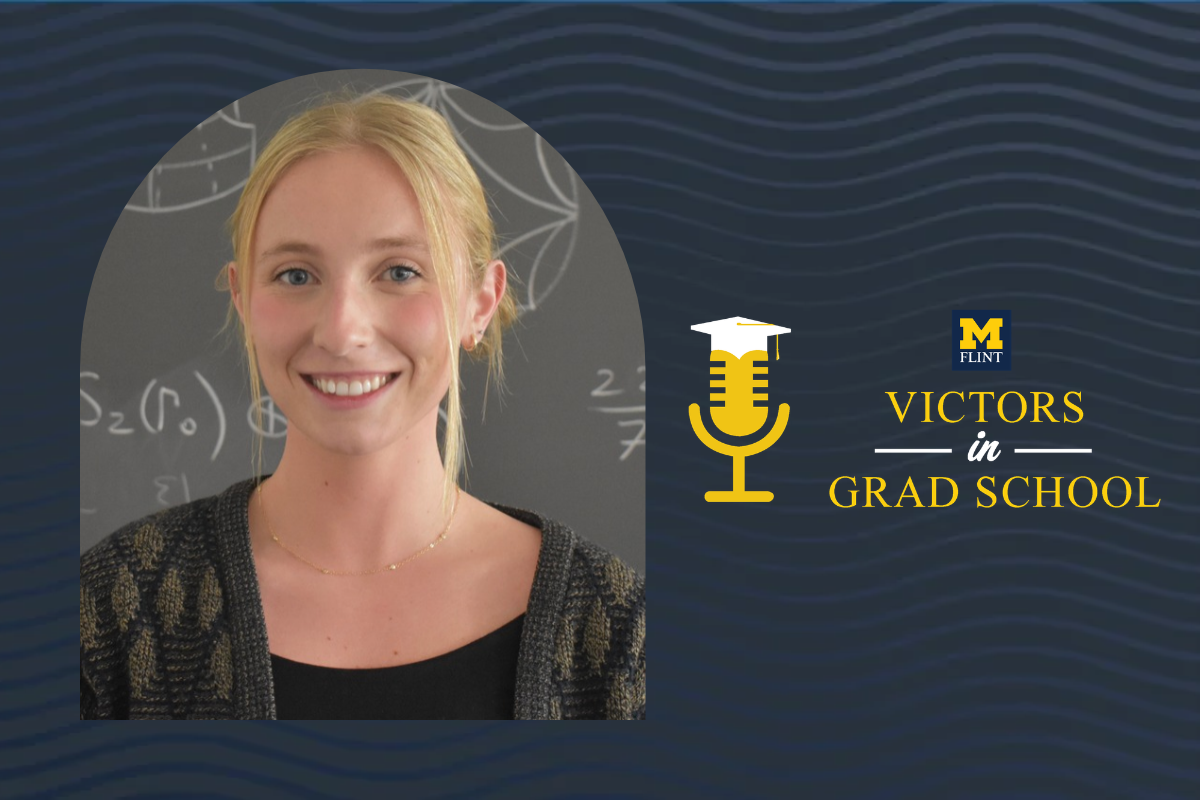
If you’re considering graduate school, or are currently navigating its unique challenges, you’ll find inspiration and practical guidance in the latest episode of “Victors in Grad School.” Host Dr. Christopher Lewis, Director of Graduate Programs at the University of Michigan-Flint, sits down with Eliza Hogan, a UM-Flint graduate now pursuing her PhD in mathematics at Wesleyan University. Their conversation unpacks not only how to choose the right program, but also how to thrive once you arrive.
A key theme that emerges from Eliza Hogan’s story is the importance of intentionality on your academic journey. From as early as high school, she set her sights on becoming a math professor, diving deep into career research and seeking out mentors. Her journey underscores the value of being proactive—interviewing those in your chosen field and participating in career-prep activities even before entering college.
Choosing a graduate program is a process itself. Eliza Hogan highlights the need for thorough research, weighing program size, funding opportunities, and the community atmosphere. Her experience demonstrates the significance of mentorship and peer advice: consulting professors and older students helped her refine her list and ultimately led her to discover Wesleyan, a place that fit her academic needs and personal aspirations.
Transitioning from undergraduate to graduate life can be daunting, and Eliza Hogan candidly discusses the increased demand for self-motivation and the need to build your own support systems. The episode touches on imposter syndrome, a common hurdle in academia, and how reaching out to mentors and supportive peers is critical for overcoming self-doubt.
Balance is another central topic. For Eliza Hogan, establishing a sustainable routine—including fitness, social time, and healthy eating—was essential to her wellbeing and academic success. She also shares how being a teaching assistant not only supported her education financially, but also enriched her preparation for a career in academia.
Whether you’re in STEM or another field, the advice to maintain passions outside your studies and build resilience resonates. Real, honest stories like Eliza Hogan’s make this episode a must-listen for anyone contemplating or living the graduate school experience.
Tune in to this insightful episode to gather practical strategies, hear firsthand experiences, and feel empowered to carve your own path to success in grad school!
TRANSCRIPT
Dr. Christopher Lewis [00:00:01]:
Welcome to Victors in Grad School, where we have conversations with students, alumni, and experts about what it takes to find success in graduate school.
Dr. Christopher Lewis [00:00:11]:
Welcome back to Victors in Grad School. I’m your host, Dr. Christopher Lewis, Director of Graduate Programs at the University of Michigan Flint. Really excited to have you back again this week. As always, every week, we have an opportunity to work together to work through this journey that you’re on, because it is a journey. Every person that is thinking about graduate school is going through their own personal journey. And I call it a journey because from no matter where you are, there are things that you can do to be able to not only prepare yourself, but really prepare yourself for success sooner. And a lot of people don’t think about that ahead of getting into a program.
Dr. Christopher Lewis [00:00:49]:
And sometimes you wait until you get in the program, and then you’re like, I wish I would have known. And that’s why this podcast exists. It exists to help you to be able to start thinking about graduate school sooner, or if you’re in graduate school, to jump right in and help you as you’re working toward that, that light at the end of the tunnel that’s going to help you to find that success that you want in that journey that you’re on. And every week, I love being able to introduce you to different people with different experiences that can share their own experiences with you. Sometimes they’re, they’re in graduate school. Sometimes they’ve been out of graduate school for a bit of time. And no matter what their journey has been, they are sharing their own experiences with you to help you define that success. And today we’ve got another great guest.
Dr. Christopher Lewis [00:01:37]:
Eliza Hogan is with us, and Eliza is a past University of Michigan Flint graduate, but she is currently working on her PhD in mathematics at at Wesleyan University. I’m really excited to be able to have her here and for her to share some of her own experiences with you. Eliza, thanks so much for being here.
Eliza Hogan [00:01:55]:
Of course. Thank you so much for having me. I’m very excited to talk today with you.
Dr. Christopher Lewis [00:02:00]:
Well, I’m really excited to have you here as well. And I said that you are in a PhD program at Wesleyan University. And I know that you finished off your bachelor’s degree in mathematics From the University of Michigan Flint back in 2024. And then you went on and you decided at some point in that journey while you were going through undergrad that you weren’t done. You wanted to continue on and work on the next step and moving to the next part of your journey. Bring me back to that moment where you said to yourself, I’m not done and I wanna move on. What was it that made you decide that graduate school was that next step for you?
Eliza Hogan [00:02:39]:
So honestly, we have to rewind a little bit more because all the way back when I was a freshman in high school, I went to the Genesee Early College High School. I don’t know if you’ve ever heard of that, but it’s actually a high school that’s based on the U of M Flint campus, an early college program. And back all the way in 9th grade in 2018, I think, I was doing a career readiness thing. You know how you do in high school, they tell you, okay, let’s figure out what type of career you might want, and you have to kind of do assignments. I think I had to write a paper about what career I wanted and all the steps you have to take for it. And at the time, I knew that I liked teaching math, and I knew I really liked math in general, but I kind of knew I maybe didn’t really want to teach like young kids, and even high school didn’t sound too appealing to me. So I just thought, okay, I’ll just become a math professor, you know, 14-year-old Eliza, how hard can it be to become a math professor? So in my research, I figured out, okay, I need a math PhD in order to become a professor of math. So, okay, that’s what I’m going to do.
Eliza Hogan [00:03:42]:
And actually, For part of that assignment, I was required to interview someone that was in the career field, and I actually was able to interview— my brother was a student at U of M Flint taking math classes, and he had Dr. Caulfield. He’s one of the math professors at U of M Flint. He’s amazing. And so I actually did an interview with him way, way back and got some answers about what it’s like to be a math professor. So all the way back in high school is when I decided I wanted to So you
Dr. Christopher Lewis [00:04:11]:
started way back then, and you’re going through your undergraduate work. You continue moving toward that goal. You’re getting toward the end of your degree, and you still are moving toward that goal. And just like when you’re trying to decide where you’re going to go for your undergraduate degree, you have to do your research. You have to look around and identify what program seems like the best fit for you. And there are PhDs in mathematics programs across the nation, and you probably could have chosen to go in many different directions. different directions. You chose to go to Wesleyan University.
Dr. Christopher Lewis [00:04:44]:
Talk to me about that search process for yourself and what you were looking for, but also what ultimately made you decide that Wesleyan was the right place for you.
Eliza Hogan [00:04:54]:
Yeah, so I started seriously doing research on which PhD programs I would apply to in my last year of undergrad, and I actually kind of just started— so there’s something called the AMS Groupings for Mathematics, and it’s basically a list of every single PhD/master’s programs offered in the United States, and they give a ranking. I mean, it’s— who knows how accurate that ranking is, but so they have like the top-ranked schools, maybe some middle-ranked schools, and I honestly just started there knowing that I didn’t want to go anywhere too far from home. I didn’t really want to go to the West Coast. That was a bit too far for me. So I’m kind of looking at Midwest, East Coast schools, and I think I had a list of, I don’t know, 15 or 20 schools, and I made a Google spreadsheet listing all the things, did research on what kind of professors are at certain schools, whether or not the programs are fully funded, all these things. Because I knew I needed to go to a program that guarantees funding for anyone that they accept because it wasn’t an option for me to not be funded financially. And so actually, I think the first pass I had of schools, Wesleyan was not on there because I had really never heard of it. And so what I did was I was working very closely with Dr.
Eliza Hogan [00:06:09]:
Cameron McLeeman, the head of the, you know, Natural Sciences Division. At the time, I think he was just like the head of the math department. He’s great. I worked with him a lot, and I showed him my list, and he was like, okay. He kind of helped me refine it— which ones of these are maybe too high of a reach, you know, maybe I won’t be getting into MIT, those sorts of things. And he kind of just off the hand was like, oh, you should add Wesleyan to your list, because he works really closely and does research with one of the professors here at Wesleyan. And he was like, oh, they have a really good program and I know one of the people there, you should add that to your list. And I had never heard of it.
Eliza Hogan [00:06:44]:
I did some research and I started to realize I kind of really like this program because the thing that I really liked about Wesleyan was that it’s kind of a medium size, I would say. Maybe to some people they’d say it was a small program, but coming from U of M Flint, my classes, especially in the math department, were pretty small. And I was used to having really close relationships, especially like with Dr. Cam, Dr. Caulfield, who I’ve mentioned. I had very close relationships with my professors, and I knew if I went to a big school that might not be able to be the case. And so Wesleyan was looking like the perfect size. It was looking great.
Eliza Hogan [00:07:16]:
So I applied, and, uh, it was one of the few schools that I was accepted to and just ended up being the winner of them all.
Dr. Christopher Lewis [00:07:24]:
Now, every person that makes that jump, leaving one school where you’re comfortable, you understand how you’re being educated, the— what the expectations are of faculty— when you move into a master’s or a doctorate program, the expectations are very different. The education is very different. What you’re being asked to do And not to do is very different as well. And you have to go through this process of being able to transition, and you make that transition from being an undergraduate student into a graduate student. So talk to me about that journey for yourself thus far, and what did you have to do as you were transitioning into your PhD program? And what have you had to do as you now are in your second year of the program? What have you had to do to continue to find success through both that transition in and through the graduate program thus far?
Eliza Hogan [00:08:18]:
Yeah, so I would say for me, the biggest difference between undergrad and graduate studies, aside from, you know, there’s obviously big life changes, okay, I had to move across the country and live on my own for the first time, that was obviously a big lifestyle transition. But as far as strictly academically, I would say the biggest difference is how self-motivated you have to be. In undergrad, you kind of experience that for the first time. I mean, your professors are working with you and you have advisors that help you, but it’s not like high school where, you know, you’re gonna get in trouble, your parents get to see your report card, obviously. Like, we all go through that transition, but in undergrad, it’s still— you’re still guided a little bit. And in graduate school, I would say it’s mostly completely on your own. Especially at my program at Wesleyan, there’s not a whole lot of resources online that lay out every single thing, every single requirement that you have to do. A lot of things you have to reach out to people yourself.
Eliza Hogan [00:09:16]:
You have to reach out to older grad students, you have to be brave and talk to professors who— it might seem scary. And I’m very fortunate at Wesleyan that the graduate student culture there, it’s not competitive in any sort of way. Everyone there was extremely nice, they want you to succeed. But I’ve noticed, especially the other people in my cohort even, I’ve seen them Maybe they’re not as social as I am, or maybe, you know, they’re not as proactive in trying to talk to other, other people, older grad students, that sort of thing. And a lot of the information about the program that I was able to figure out through talking to other people, they maybe had no idea about that, and I was the one having to tell them, oh yes, this is what has to happen. So the biggest transition I would say is you really have to motivate yourself, and when you are in a PhD program, you better want to be there. Like in undergrad, a lot of people may maybe change. I mean, for me, I knew that I wanted to do math, so it was different.
Eliza Hogan [00:10:07]:
But in undergrad, maybe you’re not sure what major you’re going to do. You’re kind of just going with the flow. It’s a little bit more relaxed. But with PhD program, you have to know that that’s what you want to do. So you have to be focused. It is all self-driven. No one’s going to be making sure you get your work done, making sure you’re eating enough food, making sure you’re getting enough exercise, all of those sorts of things. You really, you have to motivate yourself to do all of it.
Dr. Christopher Lewis [00:10:32]:
You know, when you’re jumping into something that is brand new, there’s always that possibility that you run into the situation that you kind of question your abilities. And a lot of times they call it imposter syndrome, but it’s really that self-doubt that creeps in when you’re doing something new, and especially when you go to graduate school, that happens to most people. So talk to me about your own experiences with imposter syndrome and how did you handle it?
Eliza Hogan [00:10:59]:
Yes, that’s a great question. I have dealt with a lot of imposter syndrome, especially last year when I was first coming into my program. So in my cohort, it was just a cohort of 3 people, so just me and 2 other guys, which a gender thing is a big issue in math and a lot of the STEM things— computer science, engineering— there’s a lot of gender issues there. So as a woman, being the only woman in my cohort, A, that was already— I was already feeling scared about that. Luckily, however, I will say the 2 people that were in my cohort, absolutely amazing. They, they— I am so grateful for them. But one of the guys my cohort already had a master’s degree in math, and the other one was an uber— one of those people you’re like, okay, you are an uber genius. Um, and I was feeling like, oh my gosh, I have— what did I get myself into? I have no idea what we’re talking about.
Eliza Hogan [00:11:51]:
Especially the first days of classes, the professors were opening their mouths and being like, okay, you guys already learned all this in undergrad, right? And then skimmed over a bunch of stuff, and I was like, oh man, what did I get myself into? I don’t know any of this. And honestly, it was a really, really big struggle. The first whole semester, I would say, I was really struggling with feeling like, I cannot do this, I need to go back home, I need to study more before I go get it— get myself into this PhD program mess. And honestly, the only reason I would think I was able to get through it was, A, okay, I was actually learning stuff, I was getting the homework done. And in hindsight, I can see that Okay, I learned so much. And when I was in it, maybe I didn’t realize how much I was learning and I really was feeling like I was behind. But the thing that pulled me through was talking to older grad students. I was able to make close friends with some 5th and 6th year students who were saying, hey, I was in your shoes.
Eliza Hogan [00:12:47]:
I felt like I had no idea what I was doing. I promise you, you will get through it. They were some of the only people in my— because I have a support system with family at home, right? But They are not in a PhD program and they’ve never done grad school. I’m the first in my family to go to grad school. And so they were a support system, but they also couldn’t really offer me the advice that these grad students at Wesleyan could. And also I actually was able to reach out to Dr. Cam McCleeman and say, hey, I feel so stupid. I don’t know what I’m doing.
Eliza Hogan [00:13:17]:
Can you help me? And we even got on some Zoom calls a couple of times and went over actual material to try and help me feel better. And he would say things like, oh, like, Eliza, come on, like, you know what you’re doing. You made it sound like you were super lost, but it seems like with talking to you, you know what you’re doing. So it’s hard to say whether or not I’ve ever actually overcome the imposter syndrome, but I don’t know, I like to think that— and I’ve heard a lot of people say this— the people who can succeed in grad school are the people who can push past the feeling of every day feeling like you’re stupid. You have a few wins, but for the most part in grad school, every day shows you how much you don’t know. And the people who can get through grad school are the people who are okay with feeling uncomfortable and feeling like they don’t know what’s going on.
Dr. Christopher Lewis [00:13:58]:
Now, you talked a little bit about that you have to be self-motivated and that you have to kind of find that balance for yourself so that you’re able to wear the many hats that you continue to wear, whether not only your academic hat, but all the other hats that you wear too. So talk to me about how did you find balance thus far in balancing school, work, family, or other personal responsibilities As you’ve been going through this graduate school experience?
Eliza Hogan [00:14:28]:
Yeah, so I knew for me going into this new program, this new lifestyle, you know, I had never lived on my own before because I stayed with my parents and commuted when I was going to U of M Flint for undergrad. So this is my first time ever living on my own, having my own apartment, having to cook my own food, that sort of thing. And the thing that I fortunately was able to identify before I even went to graduate school based on doing some summer programs and some Some preparation things that I had done before coming to Connecticut for my PhD program was that I need to have a gym schedule, basically. That was the thing that I knew that I needed because fitness is very important to me. And so coming to Wesleyan, I knew, okay, I need to figure out a way with my crazy schedule, my crazy class schedule, my TA duties, I need to find a way to be able to fit this gym schedule into my life because if I don’t, then I know that I will spiral and my life will go out of control. So that was one thing that I needed to figure out for myself, and fortunately I was able to figure that out. There were weeks, you know, where the homework schedule was harder and I wasn’t able to get that ritual that I intended to have, but it’s things like this you need to figure out for yourself. Okay, what do I need to do in order to be successful, like, at school? Well, I’m not going to be able to be successful if I’m not eating well or if I’m not getting enough exercise, for me personally.
Eliza Hogan [00:15:50]:
And for other people it could be, I really like to paint, or I really like to read, that sort of thing. For me it’s more of a hobby, so I prioritize making sure no matter what that I was able to get that routine that I needed. Um, so that was the thing that I’d say, I would say helped me transition the most. And learning how to cook for myself, learning how many groceries I need to buy for the week to be able, you know, not buying too much food but not buying too little, learning how to prioritize time for social activities with friends. I would say probably could have used a little bit more time towards that my first semester especially, but over the summer I’ve gotten better at prioritizing I know
Dr. Christopher Lewis [00:16:33]:
earlier you mentioned that you were looking for programs that were 100% funded, and not every graduate program is 100% funded, but a lot of times with PhD programs, that is a possibility and something that people can look into. And you said that you are a TA, which means a teaching assistant. So talk to me about, one, how did you identify those programs for yourself that were offering that type of funding? But two, what was it like to be a TA? to talk about that ex— this experience that you’ve been having as a TA and what that means to you as a graduate student, but also for other people that are thinking about teaching assistants, research assistants, or some other type of work on campus like that, what they should be thinking about in that journey for themselves.
Eliza Hogan [00:17:21]:
Yeah, so with the math PhD specifically, I would say it is more common than not to be fully funded. So as far as finding the programs, honestly, it’s just based off looking at the website. Hopefully the school that you’re interested in has that information available on their website. If they don’t, most of the time I would say the website will have some sort of graduate program email that you could email to, whether it’s like a general email or the email of a specific person who runs— is a dean of graduate studies or something like that. So maybe you could reach out in that way, but As far as from my experience, all of that information was mostly on the school website. And I don’t know if I did a great job with this actually, because one of the schools I did get accepted to, they did not offer me funding, which I didn’t think was possible because I thought that I only applied to schools that had funding. So it does happen. In that school though that I did get accepted to, they weren’t guaranteeing me funding, but they said, you’re accepted into our PhD program, although we don’t have a TA teaching assistantship available for you, but you can apply to these grants that we have.
Eliza Hogan [00:18:29]:
So there are a couple things you can do. Obviously my experience is only for math, but at this school there was some grants or kind of like scholarships. The name of what it specifically is is slipping my mind at the moment, but there are these things that you can apply to that require you not to do a TAship, or you can apply to be like a research assistant for a professor through the actual school. So I know those are options. And then I know there are some government-funded like NSF research scholarships that you can apply to to get funding without having to— if the school that you have been accepted to doesn’t have a TAship available for you, there are other options to get funding. And as far as the TA duties go, it really does vary what program you’re at. I know I have some friends who at different schools that have to work upwards of 20 hours a week on grading homeworks and exams and stuff like that. At my school at Wesleyan, the standard is to try and keep it to 10 hours a week.
Eliza Hogan [00:19:25]:
on your TAship. So what that looks like depends on what professor you’re assigned to, to be honest. So for me, my first semester last year, I had to help a professor with 2 of his classes, and fortunately there were also undergraduate TAs working on that class, so I didn’t have to grade any of the homework. But I did have to host a few weekly TA sessions as well as grade exams and quizzes. So for me, what that looked like was making sure each week that I knew what the material was being covered in class was, because I think I could have technically attended the classes if I wanted to, but with my busy schedule I was not able to. So it looked like, okay, before I have my TA session, which for depending on what your— what school you’re at, for me a TA session was basically like an office hours essentially. I would book a classroom and then just have kind of an open office hours type of vibe going on. Students can come ask me questions about their homework assignments, that sort of thing, or they can say, hey, I was confused about this in lecture, can we go over this topic? But obviously that means I need to know what the topic is So depending on what class you’re TAing for, it depends on how much work it might be.
Eliza Hogan [00:20:33]:
I was TAing for Calc 1 and for vectors and matrices classes, which are pretty lower-level classes for math. So these are concepts that I knew pretty well. But if I was TAing— one of my friends had to TA for a higher-level class that wasn’t material that’s like the back of the hand for them. So I knew that that probably required a bit more preparation on their end. But I would say for people who are looking to go to grad school and are kind of maybe worried about the TAing aspect of it, or maybe the research aspect of it, it depends what you want to do, obviously. Like I mentioned, I want to become a professor, so the idea of TAing is great for me. I want to come out of this program learning how to be a good teacher, learning how to be a good professor, learning how to, you know, be efficient with grading homework, that sort of thing. Super useful for me.
Eliza Hogan [00:21:17]:
So I’m excited at the prospect, or, you know, at the opportunity to be able to TA. I don’t really think of it as a job necessarily. For me, I like to think of it as part of my training, as being— I want to become a professor, so I can think of this as part of learning how to do that. So I guess it really depends on what your goal is after your PhD program. If you are interested in more research, then maybe looking into getting a research assistantship rather than a TAship. But like I said, it really depends what program you’re at. So I would look at the website, look at the requirements, and see what type of information you can get based off what school you’re applying to.
Dr. Christopher Lewis [00:21:53]:
You know, as you think back to yourself back in your undergraduate days, as you were looking at school prior to starting your graduate degree. What do you wish that someone had told you before you started graduate school that would have helped you find success sooner?
Eliza Hogan [00:22:09]:
Honestly, I think my answer is that what I wish someone had told me actually already was told to me. I don’t know if that’s a valid answer to this question, but if I can maybe rephrase the question in my own way, what would I tell to someone is stuff that was already told to me. So especially if you’re going into math or STEM— it’s harder for me to speak on experiences for other, other types of programs— but for math and STEM-related programs, I know that for me, I did an REU, which stands for Research Experience for Undergraduates. And basically what that is, it’s a summer research program that, that many universities across the country hold. I did one at the University of Michigan-Dearborn, actually. That That is one of, if not the most important and influential experience I had in my undergraduate career. I was able to meet students from all across the country going to different programs who all, for the most part, were looking towards getting into a math PhD program. And I learned at this REU what I needed to do to prepare myself for— and I did this in the summer of my junior year.
Eliza Hogan [00:23:18]:
So right before I was getting into my last year of undergrad. I learned so much from the students there and from the professors that we worked with. Not only actual math, obviously I was doing research so I learned actual math, but I also learned what I need to do to prepare, whether or not I want to take the GRE. I didn’t even know what the GRE was or that that existed before I did this. And if you don’t know, that’s basically a graduate readiness exam that some schools require you to take in order to apply to their program. I had no idea that that existed. One of the things that I would never have known about if I hadn’t done this REU. And then the other thing that I would say specifically for math as well, or computer science, that type of thing— so this is after I already had gotten accepted into a PhD program, but one of the other things that prepared me the best was last summer I did a summer program also.
Eliza Hogan [00:24:10]:
It’s called the EDGE Summer Program, and that is a program for women and non-men who are either about to start a math PhD master’s program or are in the summer after their first year, and it is basically a crash course in the material that you will learn in graduate school. So it’s— you take courses for 4 weeks at a university, and you— the idea is to prepare you for the intensity of grad school. And so my biggest piece of advice to people looking to do grad school or about to start grad school would be to do research on these types of programs. So if you’re in undergrad and you know you want to become a PhD, or you want to get into a PhD, maybe you’re even just questioning whether or not you want to do research. I would first of all see if there’s any research opportunities at your university. So I actually also did a UROP here at U of M Flint, one of the opportunities for undergraduate research. See if you can do that at your, at your school. See if you even like doing research.
Eliza Hogan [00:25:09]:
And then if you do, maybe look to apply to an REU at a different university because not only does this actually give you experience in researching, but it also makes you a better candidate for applications. You can get a letter of recommendation from someone outside of your university. That will go a really long way, as well as meeting people who are, you know, peers who are going to be mathematicians or computer scientists or whatever in the future. And then once you are accepted into a PhD program, look and see if there’s things like— apply to the EDGE program! And also if there’s other things like this that are specifically geared for preparing you for graduate school. That is one of the most valuable things that I did. I don’t think I would have been able to handle the intensity of graduate school if I had not done the
Dr. Christopher Lewis [00:25:51]:
Finally, as you think back to your own graduate school experience, and I know you just offered some thoughts right here, but what other tips would you offer to other individuals, whether it’s in a STEM career or other career, that would help them find success sooner?
Eliza Hogan [00:26:07]:
I would say kind of like what I was talking about earlier with how to manage my transition, I would say find the thing that you know you need to do in order to basically stay sane. So for me, I knew if I wasn’t forcing myself to get exercise in, that my mental health would slip. So whether that’s exercise for you, or maybe it’s a certain hobby that you like to do, or maybe you have been so busy lately with undergrad that you don’t really have a hobby, I think you should find something that gives you peace that has absolutely nothing to do with whatever program you’re going into, whatever field you’re going into. Because when you’re in a really intense program like mine, in any grad school program, you can start to lose yourself in whatever it is that you’re studying. You don’t want to just have every single waking moment of your life be dedicated to this thing that you’re studying. Because at the end of the day, you’re a person. You— if that’s— that’s the hardest thing to remember when you’re in grad school, is you are actually a real human being. You’re not just a math proof writing machine.
Eliza Hogan [00:27:07]:
Ask yourself, who am I without this? What if for some reason I woke up tomorrow and couldn’t write proofs anymore for whatever reason? Or what if I had to move back home and I wasn’t able to finish this program? I mean, you don’t want your life to be over. You want to have something that brings meaning to you other than whatever it is that you’re studying. So that would be my biggest piece of advice, is to make sure you have things that you are passionate about outside of whatever it is that you are studying. Make sure you make friends, prioritize— maybe if you’re religious, do that type of thing. Go experience life outside of your schooling because it’s very easy to lose yourself in it and to lose who you are.
Dr. Christopher Lewis [00:27:45]:
Well, Eliza, I just want to say thank you. Thank you for sharing your journey today. I know it’s not done. You still have some years left in this program that you’re in. And I’m looking forward to hearing more about the success that you find in that journey and where you end up teaching. Maybe it’s going to be back here at the University of Michigan Flint. You never know. But I truly want to say thank you for your time today.
Dr. Christopher Lewis [00:28:06]:
And I wish you the best in your continued success through your PhD program. And—
Eliza Hogan [00:28:12]:
Awesome. Thank you so much.
Dr. Christopher Lewis [00:28:14]:
The University of Michigan Flint has a full array of master’s and doctorate programs if you are interested in continuing Whether you’re looking for in-person or online learning options, the University of Michigan-Flint has programs that will meet your needs. For more information on any of our graduate programs, visit umflint.edu/graduateprograms to find out more. Thanks again for spending time with me as you prepare to be a Victor in grad school. I look forward to speaking with you again soon as we embark together on your graduate journey. Thank you. on your graduate school journey. If you have any questions or want to reach out, email me at flintgradoffice@umflint.edu.