Are you considering graduate school but not quite sure if it’s the right step? Or maybe you’re simply curious how others have navigated the transition from undergraduate life or the workforce into advanced study. The latest episode of “Victors in Grad School” is a must-listen for anyone embarking on or contemplating this journey.
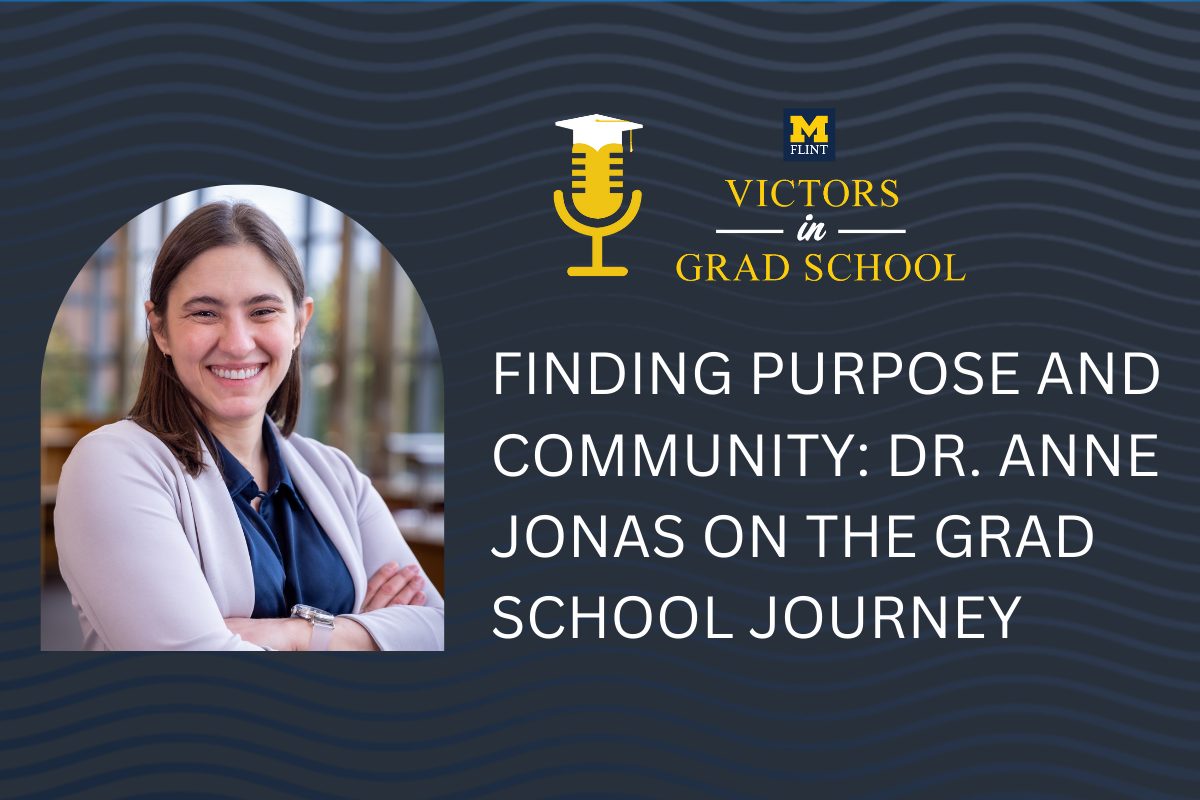
Host Dr. Christopher Lewis, Director of Graduate Programs at the University of Michigan, Flint, sits down with Dr. Anne Jonas, assistant professor in human-centered design and human-computer interactions, to unravel the twists and turns of her academic journey. Their conversation is packed with practical wisdom, honest reflections, and encouragement for prospective and current grad students alike.
Key Takeaways from the Conversation
One of the key themes that emerges from this episode is the importance of intentionality. Dr. Anne Jonas didn’t go straight from college to graduate school. Instead, she gained valuable experience in the nonprofit sector, which helped her identify why she wanted to return for further study and what she hoped to achieve. She encourages prospective students to “really know why you’re going to graduate school”—not just to continue the routine of education, but because you have a true purpose and passion to pursue.
Another significant focus of the discussion is finding the right fit. Dr. Anne Jonas shares how she evaluated potential programs based on faculty interests, curriculum, and the kind of research being done. She emphasizes the value of looking for communities—both academic and personal—that will support you, reminding listeners that “no one person can provide all the support and mentorship” you’ll need.
The episode also tackles the challenges of transitioning back into academia, particularly the self-management and independence required at the graduate level. Dr. Anne Jonas describes how she learned to balance work, study, and life, and the critical role her supportive community played in her success.
Why Listen?
Whether you’re worried about finances, choosing between programs, or simply need reassurance that there’s no single path to grad school success, this episode offers grounded, relatable advice. It’s a reminder that with intentional choices, strong support networks, and flexibility, your grad school journey can be deeply rewarding.
Tune into this episode of “Victors in Grad School” for a conversation that just might help you find your own path forward.
TRANSCRIPT
Dr. Christopher Lewis [00:00:01]:
Welcome to Victors in Grad School, where we have conversations with students, alumni, and experts about what it takes to find success in graduate school.
Dr. Christopher Lewis [00:00:11]:
Welcome back to Victors in Grad School. I’m your host, Dr. Christopher Lewis, Director of Graduate programs at the University of Michigan, Flint. Really excited to have you back again this week. Every week we are on a journey together. And I know I say that every week, but it really is true. The journey that you are on as a graduate student is truly that it is a journey. It is not always going to be a linear path.
Dr. Christopher Lewis [00:00:32]:
There are going to be sometimes some circuitous routes to get you to where you want to be and to get you to being able to meet the goals that you have set for yourself. And this podcast is here to help you on that journey every week. I love being able to introduce you to different people with different experiences that can share their own experiences in going through graduate school to help you find success sooner. This week we’ve got another great guest. Dr. Ann Jonas is with us today, and Ann is a faculty member here at the University of Michigan, Flint. She’s an assistant professor and working in human centered design and human computer interactions. And I’m really excited to be able to learn more about her as well as more about her own experience in going through graduate school and all of this that will help you in your own journey.
Dr. Christopher Lewis [00:01:26]:
Anne, thanks so much for joining us today.
Dr. Anne Jonas [00:01:27]:
Of course. Thanks for having me.
Dr. Christopher Lewis [00:01:29]:
It is my pleasure having you here today. And I always start these opportunities really turning the clock back in time. And what I would love to do is I want to go back in time, back to your days at Brown University, or maybe a little bit after Brown University, because I know you did your undergraduate work at Brown University. And then at some point after going out working, doing research, you know, working at a number of different places, you made a choice, you made a decision, and there was a point in time where you said, said it’s time and I’m ready to move to the next phase of my education. Bring me back to that point. And what made you decide that graduate school was the right time? What that graduate school was the. Was that it was the right time for you to go to graduate school. And that led you forward.
Dr. Anne Jonas [00:02:16]:
Sure. So I will say, when I was in college, I didn’t really, even though I had many wonderful teachers who were graduate students, I didn’t have a clear sense that graduate school was an option outside of kind of the professionalized paths of pre law, medical school, et cetera. And so I didn’t really see that as something that I would do. And so I went out and worked in nonprofits for quite some time. And I think in that process I. I knew some people who went to graduate school and so I learned a little bit more about it, but I never really was ready to take that step. Early on, I think I was concerned about kind of job security and job availability and cost even. I had learned that many PhD programs and some master’s programs provide funding.
Dr. Anne Jonas [00:03:07]:
I still wanted to make sure that it was something that was going to be financially viable choice for me. And so it was really important to me to kind of get some work experience under my belt before I went to graduate school and to really know like, why I was going to graduate school and not just kind of rely on that as like someone who’d always been at school and always done well at school. I wanted to kind of push myself to do something else and to only go to graduate school if it really, really made sense with kind of what I wanted for my future. So I was very happy in non profits for quite some time. And then I guess about four or five years after I graduated from college, I worked the Barnard center for Research on Women, Barnard College in New York. And being there, a big part of my job was bringing academics to speak at the college and organizing different events, as well as kind of facilitating communication and other kind of programming between scholars and practitioners, artists in all different sorts of fields. And so I was really at that time being exposed to all of these wonderful people doing all of these amazing things, many of whom had taken the graduate school path. And because I was working at a university, I was also lucky enough in combination with some of my prior experiences, to be able to take graduate classes at the Teachers College of New York at Columbia University, because Barnard and Teachers College and Columbia are all part of one university.
Dr. Anne Jonas [00:04:37]:
And so once I started doing that, then I really was like, okay, there’s something really interesting to me here. I had always been interested in the Internet, particularly the social side of the Internet. I had done some classes in what we call modern culture and media when I was in college, but more from that kind of media studies humanities perspective. And take the classes at Teachers College really allowed me to get a little bit more of the social sciences perspective and really realize, okay, this is an area that I would be interested in doing research on. And that was the point where I was like, okay, I think I have a reason to go to graduate school. There’s something that I would like to study. I have enough work experience that I feel comfortable that if I come out of graduate school and I’m not taking an academic path that I can continue the kind of work that I had been doing. And so that was when I kind of decided to set about looking into different programs and taking the leap of applying to graduate school.
Dr. Christopher Lewis [00:05:33]:
So let’s continue unpacking that because you spent many years is on the east coast and I know where you ended up. You ended up out on the west coast at the University of California, Berkeley. But I guess talk to me about that. You said you started a process of trying to identify where you might want it to be and you ended up at the far other side of the country. So talk to me about that decision making process for yourself and what ultimately led you to UC Berkeley. And what was it about that that really stood out and made you decide that that was the right fit for you?
Dr. Anne Jonas [00:06:06]:
Yeah, I think my top priority in looking into graduate school programs were first the program, what am I going to be expected to do and is that going to align with kind of the goals that I have for what I want to research and kind of why I want to go to graduate school. And then there were some just like practical limitations. I’m very unfortunately monolingual. I don’t speak another language. Many programs require that you have proficiency or fluency in another language. Similarly with like computer programming, I didn’t have those skills. And so I was looking for programs that matched both the skills that I had and where I could do the kind of work that I wanted to do. And so that was important to me.
Dr. Anne Jonas [00:06:46]:
But I think the thing that was most important to me was looking into the faculty in different programs and saying, okay, who’s doing the kind of research that I want to do in the areas that I want to do it and are they accepting new students? And then is the program in alignment? So those were kind of the big things for me is like the faculty and then the program structure. I looked all over the country and a little bit outside the country, you know, and just kind of did my research on the programs, on the people. I think I ended up applying to like eight PhD programs, something like that. I loved being in New York and love. But I didn’t find a program in New York that felt like it was the right fit for me. So I didn’t end up applying to any there that I can recall. So yeah, and with Berkeley in particular, I had a friend who was in that program. So I had been exposed to it and there was a scholar that I really admired, whose work I’d followed for, for a long time, who had graduated from that program.
Dr. Anne Jonas [00:07:44]:
And so that was familiar to me in those ways. Yeah. And I think that was kind of most of how I went about it more generally. And I was deciding between maybe we’ll get to this. But for me, I applied to a mixture of programs in education departments, American Studies department, Anthropology department, and then Schools of Information, which is where I ended up, which is a more interdisciplinary program. But I was kind of looking, I knew I wanted to do some sort of more interdisciplinary research, but those were kind of the options that I was considering to take kind of a different angle on things.
Dr. Christopher Lewis [00:08:20]:
Let’s definitely talk about that. Because when you’re looking at different programs, some people might automatically assume they’re all going to be in the same type of college with the same type of requirements, with the same type of curriculum. And as you said, your specific discipline definitely is not. It can be found in different areas with different expectations. So talk to me about that and what you had to really look at to figure out for yourself what was going to be that best fit for you.
Dr. Anne Jonas [00:08:46]:
Yeah. So I think again, I would look at program structure, so I looked at what kind of courses are required, and then I would look at like, what kind of research are students and faculty putting out, what kind of venues are they publishing in, and again, what kind of skills are required either beforehand or once you’re there. And I think that that curriculum piece was really important for me. I think like, interdisciplinarity is like very attractive to a lot of people because there’s just so much out there. And it’s really exciting to be able to pull from different areas. But I always say like, one of the, the trade offs that you have to consider is I think in a, a disciplinary program you really are given a foundation, you know, you’re disciplined into a particular subset of knowledge and kind of given a very clear framework in which you’re interacting and which you’re contributing to. With interdisciplinary programs and research, you’re much more going to be for putting that together and figuring out like, what kind of intervention are you making, who are you speaking to, what are you building on, and how are you going to hold yourself accountable to a different research community. So I think there’s kind of a trade off of like depth and breadth there.
Dr. Anne Jonas [00:10:01]:
And then whichever I knew, whichever way I went, I was going to need to like supplement the other side. So if I went into a kind of more traditional disciplinary program like anthropology, then I knew I would have to make an effort to kind of bring in other fields and connect with work outside of that. And I knew if I went into a more interdisciplinary program, then I was going to have to be responsible for kind of finding out what kind of foundation I wanted to build upon for, for my research. So it was just kind of thinking about, about those trade offs. And I think ultimately I really decided that who I wanted to be in conversation with were people who were in kind of the tech world broadly. And that to me meant people coming at it from a technical perspective of computer science, as well as an arts and design perspective and a law and policy perspective. And then people like me who are more grounded in kind of social science research. But I wanted to be engaging with people from all of those different aspects.
Dr. Anne Jonas [00:11:07]:
And looking at some of the other programs, I think I was, you know, I thought they were really great, really exciting. But I realized I didn’t want to spend two semesters learning about like the foundational literature of anthropology. I wanted instead to kind of focus, focus more on that cross disciplinary conversation.
Dr. Christopher Lewis [00:11:24]:
Now for every student there is a transition that they go through. When they go from being an undergraduate student, they transition potentially into the workforce like you did. They then going from the workforce back into school is another transition. But even going from undergraduate in the way that you’re educated there to how you’re educated in a PhD program is also a transition. So talk to me about that transition for you. And as you think back to your graduate school education, what did you have to do as you transitioned into program and what did you have to do throughout the program to be able to find success?
Dr. Anne Jonas [00:11:58]:
I mean, I think one of the differences for me between to some extent at least between working outside of academia and then going back to school was I think I tried pretty hard when I was working outside of academia to kind of keep work at work. Like I kept very particular hours and unless there was a big project or something like that, at the end of the day I would go home and not really have to worry about work. I think with going back to school, being back in a PhD program, I had to adjust that somewhat. And everyone’s different, like you said, with their schedules and their kind of routines and ways of doing things. But it’s very much there will always be more work to be done. And so kind of figuring out how to prioritize that work and maybe be take advantage of the flexibility that I think a grad school schedule can offer in terms of meeting up with people, going to Events, but then also doing reading or writing into the night, things like that. I think I had to kind of of recalibrate myself for that, for that situation. I mean, I think that project management, I think especially again being in an interdisciplinary program really required a lot of self management in terms of figuring out prioritization and projects and kind of the other thing about particularly the kind of graduate school program that I went to is it’s very independent.
Dr. Anne Jonas [00:13:21]:
So really setting my course, you know, with feedback from advisors and, and from peers. But setting a course and kind of stick sticking to it and finding the path required a lot of being proactive and figuring things out kind of on my own. And so I think that was really helpful for me throughout the process once I kind of got the hang of it, always still learning.
Dr. Christopher Lewis [00:13:42]:
As you think back to your graduate education, what’s something that you wish that someone would have told you before you had started that would have helped you along the way?
Dr. Anne Jonas [00:13:52]:
I think that I got pretty good advice from people. So I think that, that things that I was told that I try to share with others is to like be very cognizant of like just logistically practically of the financial trade offs and decisions and what that’s going to mean in your life and like for your family, your goals, your stability. I think having that match with faculty is really essential and really important in terms of like finding people that you align with, kind of in terms of what work you want to do, what style of work you want to do. And then I think the other thing that I really tell people that was communicated to me is that PhD programs in particular are really about research. And so unless that is like the primary thing that you want to do, then a PhD might not be the right answer. I think a lot, there are a lot of people out there who really enjoy learning and you know, so they think, oh well, maybe graduate school or a PhD in particular is the, the way to go. And I think there’s so many different ways to kind of go about pursuing a love of learning. And one just needs to be aware that with a PhD in particular, there is really that research component that is at the forefront.
Dr. Christopher Lewis [00:15:11]:
Every graduate student has to find that balance for themselves, that balance of school, work, family, other commitments. And sometimes that can be difficult because you’re trying to figure out that, that perfect spot for yourself, that sweet spot for yourself. So how did you find balance for yourself in looking at all of those different responsibilities? And what are some things either that you put in place or things that helped you to find success in balancing things while going through graduate school.
Dr. Anne Jonas [00:15:43]:
I think that it was always really important for me to have a support system and kind of a community both within and outside of graduate school. And I know people who really wanted to keep those worlds separate. And I think that’s a totally valid approach. Your graduate school does not need to be your social community. For me, it often was. And for me that was really wonderful and supportive that I was able to have people who understood that wild kind of world of academia and were in a similar position. I was lucky in that there were only two other people in my cohort in my year in my graduate program. And we were all kind of doing pretty different things, but also had some overarching overlapping interests so that we were really able to like, understand and respect and connect on each other’s work, but also that we were working on different enough things.
Dr. Anne Jonas [00:16:39]:
And I also think just our personalities, that it never felt like competitive because I think that can be something that’s really hard for some people during the graduate school process. And so, yeah, for me, one of the best parts of graduate school was my peers. I was very close to the other students in my graduate program and in the master’s program that was attached to the same department that I was in. And that was, I think, just a huge benefit to me in getting through graduate school both like socially and professionally. But again, I don’t think it needs to be that way. I think it’s different for everybody. It was also useful certainly to have people in my life who were outside of that world so that I wasn’t only kind of tunnel vision on that one perspective. And I also, I had some friends who, you know, I started running, I would run with my friends.
Dr. Anne Jonas [00:17:28]:
That was, you know, a very important practice practice for me and kind of promoting like my overall wellness like while being in graduate school. I think it’s nice, it’s good to like have those other pieces in your life, whatever it is, for one, that helps have a more holistic experience because it certainly can feel all consuming if you let it.
Dr. Christopher Lewis [00:17:48]:
And talk to me about the research process for yourself because not everybody is going to do a research oriented degree, but a PhD definitely is. So talk to me about, about the research process yourself and how you sustained yourself through that process because especially in a PhD program, it can be a long haul and having to keep moving forward to meet those milestones. So talk to me about that and what you had to do to be able to set yourself up to being able to finish in the End it.
Dr. Anne Jonas [00:18:17]:
Is so different for everyone. You know, I mean, I think the, the research process, but for me, I was in a model that was again, much more independent. So I really had to figure out, like, is this project going to look like. And that changed very much just based on, honestly, like, logistics and practicality access, the sort of projects that I thought I was going to do early on in my PhD, I couldn’t find a good place to do them. And so I had to pivot and kind of figure out other ways of going about it, which I think eventually was for the best, but, you know, required some flexibility and curiosity about, like, okay, how might I get at different parts of these research questions if what I expected is not available to me? I also was lucky to be able to participate in some other projects, research projects that were not. I knew from entering my PhD program what I wanted to focus on in my research, but I think it was really beneficial for me to be in on some other projects that were on separate topics, but with kind of connective tissue where I could explore different research techniques, collaborate with people and try different things out and kind of see what worked. So it will. It wasn’t just my, my project.
Dr. Anne Jonas [00:19:32]:
And I think, like, throughout, from the beginning of graduate school through to now, the big thing with research is that just like, resiliency and like, recognizing that everybody hits extreme roadblocks. I’m sure many people do. The classic story of I had just scheduled an really amazing field work about my, I believe, my fourth year of my PhD. It was basically what I had wanted to do in many ways since the beginning. I was gonna travel to do ethnographic research in a particular community. I was very excited. I felt like, you know, I’d done research, but I was like, this is really gonna change my whole trajectory. And then that was in March of 2020, and, you know, the whole thing got shut down due to the COVID pandemic.
Dr. Anne Jonas [00:20:14]:
So I think it’s just that ability to be flexible, be committed enough to a project that you’re interested in seeing it through for a long time, and that it has, like, a few different pieces that you can really dig into, but also being flexible enough that you can kind of adjust based on real world conditions, your own interest, interest. Things change in the field, especially in something like technology, so quickly that I think combination of, like, commitment and flexibility is really essential.
Dr. Christopher Lewis [00:20:41]:
And finally today, looking back at your own graduate school experience, what are some tips that you might offer others considering graduate education, whether it be in computer science, business or whatever degree that would help them find success sooner.
Dr. Anne Jonas [00:20:56]:
I’m a big believer in community support. You know, I think that definitely it’s really important to find, like I mentioned, faculty advisors who are a good fit. But I also think that no one person is going to be able to provide all of the support and mentorship you need in going through something like graduate school. And so I think it’s really essential to build connections with a range of faculty and peers and kind of people in the community who you can kind of get different kinds of support and advice from. You know, like maybe you have the one friend who you see at conferences who is going to be someone who you can exchange paper drafts with, and maybe you have someone who is going to be really good at brainstorming and someone else who really knows a particular method. I think just having that kind of community is really valuable. And it doesn’t have to be within your program. It can be.
Dr. Anne Jonas [00:21:57]:
It doesn’t have to be within your field. It can be. But I think finding that arrangement of people who can offer you support and who you can offer support to, that is like, I think the biggest piece to me in terms of like finding success in graduate school.
Dr. Christopher Lewis [00:22:13]:
Well, Anne, I just want to say thank you. Thank you so much for joining us today, for sharing your own journey and for helping others to be able to think about graduate school in a little bit different way. And I wish you all the best, of course.
Dr. Anne Jonas [00:22:25]:
Thanks so much. I really appreciate the invitation.
Dr. Christopher Lewis [00:22:27]:
The University of Michigan Flint has a full array of master’s and doctorate programs if you are interested in continuing your education. Whether you’re looking for in person or online learning options, the University of Michigan Flint has programs that will meet your needs. For more information on any of our graduate programs, visit umflint.edu/graduateprograms to find out more.
Dr. Christopher Lewis [00:22:49]:
Thanks again for spending time with me.
Dr. Christopher Lewis [00:22:52]:
As you prepare to be a victor in grad school. I look forward to speaking with you again soon as we embark together together on your graduate school journey. If you have any questions or want to reach out, email me at flintgradoffice@umflint.edu.