Supply chain to the rescue
A scenario-based robust optimization approach for social cost vehicle routing problem in disaster response
Azadeh Sadeghi, assistant professor of supply chain management, University of Michigan-Flint School of Management
What is the routing challenge in disaster response?
When a disaster disrupts roads, relief agencies must decide how to route vehicles before actual travel conditions are fully known. This scenario is referred to as a vehicle routing problem (VRP): deciding the sequence in which vehicles visit communities, or “demand nodes,” while respecting limits, such as delivery time, vehicle capacity, and available resources. In this study, demand nodes represent population centers that need water. As the number of nodes increases, possible routes grow rapidly, making the problem difficult to solve.
Why is lowest-cost routing not enough?
Routing choices involve more than transportation cost. In disaster response, a route with low logistics cost may still be a poor choice if it delivers water too late and increases survivors’ suffering. A similar trade-off exists in commercial logistics: a plan may reduce fuel use, driver time, or vehicle use, but late deliveries can lead to dissatisfied customers, unfulfilled promises, stockouts (i.e., no inventory), or extra recovery costs.
How does the research address robust routings under uncertainty?
The paper develops an optimization model that chooses routing strategies while considering both logistics costs and the consequences of late delivery. Because VRPs become more complex as the number of locations grows, the paper also introduces an algorithm. The algorithm’s purpose is to solve VRPs efficiently and compare routing strategies under uncertainty.
The key idea is robustness. A robust routing plan is not designed only for the average situation. Instead, it is tested across multiple scenarios, such as normal travel, delays, heavy congestion, and road disruptions.
In this study:
- Solution robustness means the plan performs consistently across travel-time scenarios.
- Model robustness means the plan is more likely to meet delivery time targets, even if conditions change.
- Equity means reducing service disparities, so some communities do not consistently receive worse service than others.
These principles transfer naturally to commercial logistics. Robustness reduces missed delivery windows when conditions change. Equity reduces late-delivery pockets across stores, regions, or customer zones, especially for customers who are farther away, demand lower volume, or are harder to serve.
What can decision makers learn?
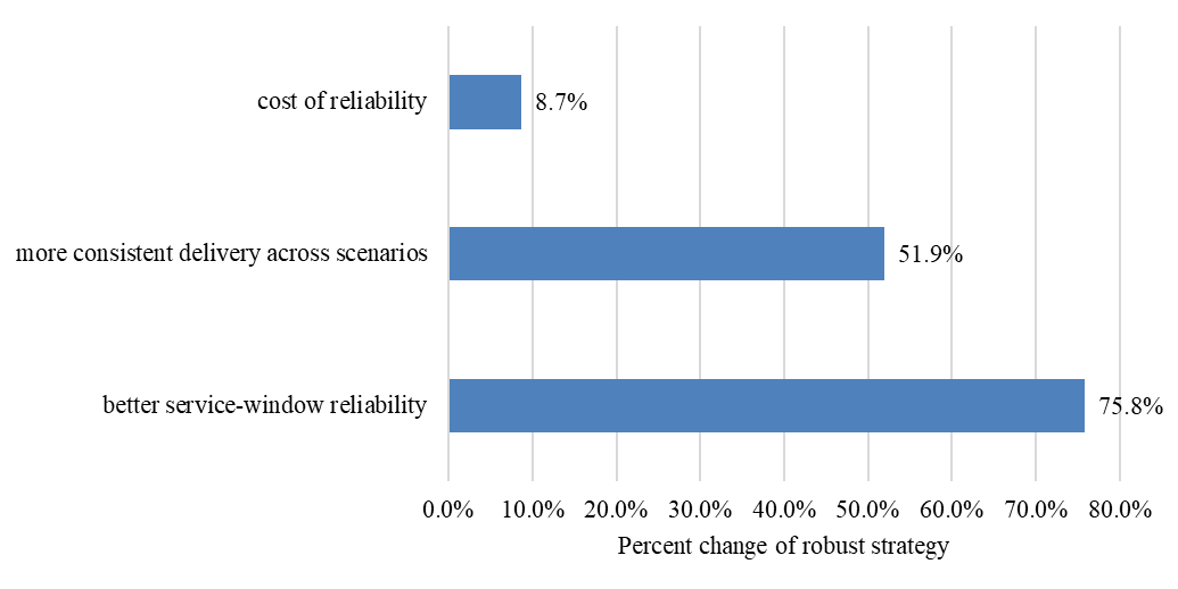
The model helps decision-makers evaluate a practical trade-off: if they accept a modest increase in the overall routing costs, how much do they gain in service consistency and timely delivery? The overall routing costs include logistics expenses and penalties related to unreliable or late service.
Figure 1 illustrates this trade-off based on the implementation of the proposed framework in a case study involving Hurricane Maria. The robust routing approach increased the overall routing cost by 8.7% but resulted in 51.9% more consistent delivery across scenarios and 75.8% higher service-window reliability. These results show how the framework helps decision-makers quantify the trade-off between slightly higher routing costs and significant gains in delivery reliability and consistency.
Overall, the study shows that routing decisions should not be evaluated on expected logistics costs alone. Leaders should also evaluate them based on:
- Consistency
- Timeliness
- The risk of uneven service
In both disaster relief and commercial logistics, robust routing helps protect service performance, customer trust, and operational resilience.
To inquire about Azadeh Sadeghi’s research, please email her at sadeghia@umich.edu.
Reference
Sadeghi, A., Mosadegh, H., Younessinaki, R., & Aros-Vera, F. (2026). A scenario-based robust optimisation approach for social cost vehicle routing problem in disaster response. International Journal of Production Research, 1-23. https://doi.org/10.1080/00207543.2026.2651396