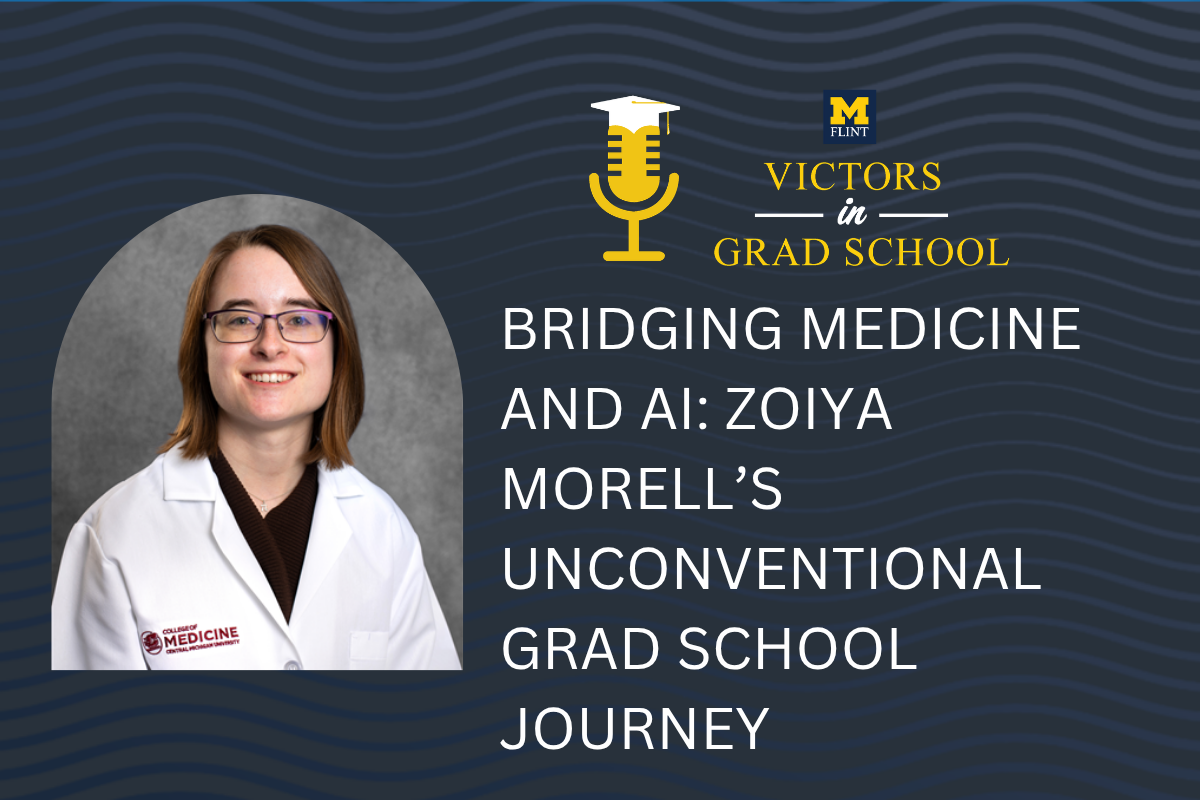
In a standout episode of the “Victors in Grad School” podcast, Dr. Christopher Lewis sits down with Zoiya Morell, a trailblazing University of Michigan Flint graduate who boldly charted a course from biology to artificial intelligence (AI) and is now pursuing her MD at Central Michigan University. This conversation not only chronicles Zoiya Morell’s unique academic path but also offers invaluable guidance for anyone contemplating graduate studies or navigating career pivots.
The episode is rich with themes of curiosity, courage, and the power of following your passion—even when it leads to uncharted territory. Zoiya Morell candidly shares how she noticed the rapid rise of AI in medicine during her undergraduate pre-med studies. Lacking a coding background didn’t stop her; instead, she recognized a learning opportunity and jumped headfirst into a challenging master’s program in AI. Her experience proves that you don’t need to fit the mold to shape a meaningful and impactful career.
A major highlight is Zoiya Morell’s emphasis on embracing the unknown and the unexpected. She openly discusses facing setbacks, such as initially not being accepted into medical school, but demonstrates how taking a year to pursue her interest in AI not only made her a stronger applicant but also gave her skills that medicine increasingly needs. Her advice for grad school hopefuls is refreshingly honest: don’t just tick boxes—find areas that truly excite you, because that passion will fuel your motivation and help you stand out.
The conversation also addresses the ever-present challenge of imposter syndrome. Zoiya Morell reveals how she overcame doubts by focusing on progress, experimenting fearlessly, and realizing that even experts are often still figuring things out—especially in fast-evolving fields like AI.
Another core theme is the significance of building relationships. From creating a thriving AI interest group to forging research collaborations that bridge medicine and technology, Zoiya Morell demonstrates how supportive connections with peers and professors can open doors and enrich your graduate journey.
Throughout the episode, listeners gain practical tips on time management, self-care, and leveraging unique skills. If you’re curious about how to blend seemingly disparate fields, overcome obstacles, or make the most of graduate school, this episode is a must-listen.
Tune in to hear an authentic story of resilience and innovation, and discover how you can carve your own extraordinary path in graduate education.
TRANSCRIPT
Dr. Christopher Lewis [00:00:02]:
Welcome to Victors in Grad School, where we have conversations with students, alumni, and experts about what it takes to find success in graduate school. Welcome back to Victors in Grad School. I’m your host, Dr. Christopher Lewis, Director of Graduate Programs at the University of Michigan Flint. Really excited to have you back again this week. And as always, every week, we have a great opportunity to be able to work together as you are planning your own journey to graduate education. And I call it a journey because it truly is a journey. Every person that is thinking about graduate school goes through a personal journey of reflection, of exploration, of just a deep dive into who they are and who they want to be.
Dr. Christopher Lewis [00:00:47]:
And as you go through that, there are things that you can do, things that you can do right now to start to prepare yourself to have success in this journey, whether you’re at the very beginning, just starting to think about this, whether you’ve already applied and maybe gotten accepted to a graduate program, maybe you’re even in a graduate program right now. No matter where you are, there are things that you can do to be able to find that success. And that’s why this show exists. Every week, I love being able to talk to different people with different experiences and share them with you. All of the people that have been on this show in the past and in the future, have gone to graduate school or are going through graduate school and are sharing their own journey with you. And you can learn from that journey that they’ve been on. Why? Why? Because they’ve made mistakes, they’ve done things right, and they’ve been able to figure things out along the way, things that might be able to help you, things you can add to your own toolbox and be able to push you in the right direction. Today we got another great guest.
Dr. Christopher Lewis [00:01:51]:
Zoya Morel is with us today, and Zoya is a graduate of the University of Michigan Flint. She did both a bachelor’s and a master’s degree at the University of Michigan Flint, and we’ll talk about that journey. But now she’s actually a current doctor of medicine student at Central Michigan University, so we’ll talk about that as well. I’m really excited to have her here, to be able to have her tell more about her own experience. Zoya, thanks so much for being here today.
Zoiya Morell [00:02:21]:
Yeah, thanks so much for inviting me.
Dr. Christopher Lewis [00:02:22]:
I am really excited to be able to have you here and to learn a little bit more about your own journey. And I always start these opportunities with an opportunity to turn the clock back in time. I said you did your undergraduate work at the University of Michigan, Flint. While you were here as an undergraduate student, you were doing a biology degree in pre-med and focusing on that. And at some point, at some point you said to yourself, I’m not done. I’m not done. I want to keep going. And one of the interesting parts is that you chose a field that I would not have expected.
Dr. Christopher Lewis [00:02:58]:
And I want you to talk a little bit about this. So bring me back to that point where you said to yourself, I’m not done. I want to keep going. What was going through your head?
Zoiya Morell [00:03:05]:
I actually get this question a lot, and it sounds kind of weird. Like, how did I go from biology, no computer background, to, oh, I’m going to get a master’s degree in AI? Which huge learning curve, by the way, jumping into it. I did not have a coding background. I knew nothing. So a lot of people wonder what made you make that jump? And they seem unconnected, but they’re not. So for one, while I was in the biology program, I kept noticing AI come up as this is what doctors are going to be using. This is how we’re doing research. It was everywhere.
Zoiya Morell [00:03:38]:
And anyone who knows me knows I hate not understanding. understanding something and I kept seeing AI come up and be like, oh, why don’t I understand this yet? Why is it everywhere? So when I, for my thesis, I went to the Rogel Cancer Center for a symposium and I asked every single professor there, hey, how are you using AI in medicine today? And almost every single one of them said, I know we’re using it. I don’t know why or how. I was like, okay, we need to investigate this more. I was applying to med schools and I only applied to a handful. It’s really expensive, so I just did the ones in Michigan cuz that’s really where I wanted to be. And while I was doing that, I got one interview and didn’t hear anything back from the handful I applied to. So I was thinking at this point, I’m probably not getting in.
Zoiya Morell [00:04:54]:
I have to change my strategy of how I’m gonna do things. What can I do in the meantime? At the same time, I found out I had earned a Scholarship from the Maize and Blue Award, which was amazing. That was kind of everything aligned because this was the first year they offered scholarships for that, and that would’ve given money towards the master’s program and a GSRA position. I didn’t know what that was, but I was like, hey, let’s apply. So I decided I might be able to get a master’s degree done in a year if I speedrun it. Then, hey, by some miracle, if I get accepted into med school, I’ll get it done before med school. Yeah. Crazy idea there.
Zoiya Morell [00:05:33]:
It was, I didn’t think both would happen at the same time. So I looked into the different master’s programs and I had seen a lot of really scammy emails that were like, get a master’s in public health. And I found they were really doing nothing for medicine. Everyone was getting them. No one was using them. So I looked into it more and I thought, what’s the thing I see coming up everywhere that I’m just fascinated by? that I feel like I need to understand. And that was AI. If I had looked back to my 5-year-old self, I would’ve noticed these threads all along.
Zoiya Morell [00:06:05]:
I used to play a computer game called Creatures that was both based on biology where, you know, you raise these little creatures, you control their neurons and their hormones and all these things. So I was learning biology, but it was also one of the world’s first neural networks. So it turns out I had been doing this stuff and fiddling with computers as well as biology for as long as I could remember. It was being able to bring them together that was like, oh, this is where I need to be. So I applied to the master’s degree and got in. That was excellent. And I was really able to— and surprised by how much I was able to bring medicine into AI. It’s like the 2 fields are meant for each other, but there’s not a lot of people that can bridge that gap.
Zoiya Morell [00:06:49]:
So. That was my thought process there.
Dr. Christopher Lewis [00:06:52]:
Now, you mentioned the fact that in that journey through your master’s degree, you didn’t come in with any background and you had to really jump in with both feet and learn a lot along the way. And I would say that most individuals thinking about a graduate degree probably feel like they have at least some understanding of what they’re applying for. and what they’re getting themselves into. And with the fact that you didn’t, I’m sure that there was a lot of learning, but also a lot of transition that you had to go through to be able to prepare yourself for getting into and getting through that program with success. And you did very well in that program. You graduated with a 4.0. I mean, you, you did very well in that program. So talk to me a little bit about in that program alone, And jumping into a completely unfamiliar field, what did you have to do as you transitioned into that graduate program? And what did you have to do as you went through that program to maintain that success for yourself?
Zoiya Morell [00:07:57]:
So the first thing I would say is just stubbornness, because I needed a 4.0, or I convinced myself that I needed one for med school. I didn’t know if that applied to the master’s degree, but I was like, well, Let’s find out. I better aim for a 4.0. A little bit of undue stress on myself there. But so that was my goal all along was I need to be good enough to maintain my grades in case it does apply to med school. But besides that stubbornness jumping in, I was terrified. I was like, I’m not good enough. I know nothing.
Zoiya Morell [00:08:31]:
Uh, so I did a lot of self-study. I did a lot of, um, like, hey, how are people programming? today versus, you know, 10 years ago. Where do I start? There was a lot of AI teaching me how to do something and then me trying to do it on my own later. I picked up a lot of little projects that ended up being really helpful later, like the ability to— like, hey, this used to take me forever to do a literature review. What if I can code a thing that just scrapes the web and does it for me? So I started challenging myself to I know I need to know this. How can I use it right now? And this really helped me even more than the classes, which helped a lot as well. Just forcing myself to use it as much as possible, kind of like learning a new language. So that helped a lot.
Zoiya Morell [00:09:16]:
And then the biggest thing was just, there was this massive shock for me when I went into classes and I realized I actually have an advantage by not knowing things because I know how much I don’t know. A lot of students, data scientists come in and they figure they have a good foundation for this. But the thing is with AI is nobody knows anything. And once you realize that, you’re in a good position to grow. So I was really shocked by how well I was able to do and figure things out because I didn’t have that foundation of this is how things have to be done. I was able to kind of think outside the box. That meant I got things wrong a lot, but it also meant I was able to grow from that and not be stuck in how the way things had to be.
Dr. Christopher Lewis [00:10:00]:
So you did a lot of preparation in your undergrad to go right to med school. Like you said, you went through that med school process at first, and it may not have gone the exact way you wanted, but you decided to pivot and go in a little bit different direction. You made the comment that a lot of people talk about public health or some other area. I know there’s post-bac type programs and things that will talk to students about ways in which to kind of bridge between the undergrad and med school. Now that you’ve done what you did, and you went in a little bit different direction in that regard, and you look back on what you decided to do, if you were talking to other pre-med students as they are going through that process, whether it be through the MCATs or the application process, or they’re thinking about, do I need to take a gap year? What kind of advice would you give to them?
Zoiya Morell [00:10:51]:
First of all, I’d say that med students are some of the most perfectionistic people out there. Don’t get on Reddit for advice. You’re just gonna see the people that scored perfect MCATs and have thousands of clinical hours and all these impossible goals. Don’t check off a checkbox. Just figure out the things that excite you, that you wanna learn about, and pursue that. You could think, oh, it has nothing to do with medicine. It could be anything from fashion design to coding. And if that’s what excites you as well as medicine, it’s not an either/or, it’s a both.
Zoiya Morell [00:11:26]:
And I promise you, there will be a field where you can bring those together. I’ve seen so many weird little things, like I’m using AI in medicine constantly. So that would be my advice is if you’re looking for a secondary degree before medicine, Don’t just go for the same 5 that every med student chooses, because I’ve talked to a lot of med students and they’re not really using their degrees. I don’t think it helped them get into med school. It would be good for a separate degree, but don’t get it if it doesn’t excite you.
Dr. Christopher Lewis [00:11:57]:
So you did decide to go to med school and you did finish that master’s degree in 1 year, which is still a feat in itself and being able to get through that. But you went through that year of jumping into AI getting that master’s degree, but at the same time going through again the application process. And you applied, like you said, to some programs within the state of Michigan. You ultimately decided to go to Central Michigan University. Talk to me about that search process for yourself and what ultimately made you decide that Central was the right program for you.
Zoiya Morell [00:12:33]:
So I actually only ever had 2 interviews, uh, with Oakland and with Central, uh, which is not surprising knowing the stats, but also, uh, application processes are kind of rigged. I had nearly perfect everything, like really high MCAT, high GPA. I had research, I had some clinical, but where I was struggling was I didn’t have the super sparkly, oh, I went to Africa and, you know, built a hospital from scratch in a year. I didn’t have those things that make me sound superhuman. So when I was applying, I was of course gonna get beaten out by the students that had all those things. So between Oakland and Central, when I interviewed, Oakland said, hey, we noticed you updated your application to say you’re pursuing a master’s degree in AI. Tell us about that. So I talked about that a little bit and they said, you think medicine is going to be replaced by AI, don’t you? You think we’re not needed anymore.
Zoiya Morell [00:13:25]:
You know, why do you even want to become a doctor? So negative about it. And I could tell from that instant, oh, I’m not going to get accepted here. They see my master’s degree as a really bad thing. Then Central asked the same question. I was like, okay, here we go. This is gonna be the question that they kick me out now. And instead it was, how are you going to use AI in medicine? Hold up, wait, that’s way different. And we were able to discuss it and I could tell that the faculty were just as excited as I was about how to bring ethics and humanity into AI and medicine.
Zoiya Morell [00:13:56]:
We were able to talk about that and to the point where now I’m doing med school research on AI in clinics. So it’s really been cool just to see that perspective there. So between their interest in AI and also they shared my interest in rural health, I was like, yes, this is exactly the place for me. Like I could tell the instant I walked in on that interview.
Dr. Christopher Lewis [00:14:17]:
And I mentioned the fact when you go into a program like AI that you had no background in to then Joining a medical program, again, different ways of learning, different expectations. You’re being pushed in completely different directions. Yes, you’re going to be able to pull from your biology background and your AI background to be able to help you in that journey. But there’s still going to be another big transition that you have to go through. So talk to me about that transition of moving from— the master’s and from the undergraduate institution that you came to know and really love to moving to a completely new academic environment and a new type of educational environment. What did you have to do as you transitioned into medical school to find that success and continue that success thus far?
Zoiya Morell [00:15:09]:
Yes, so I’ve never been good at rote memorization, which is kind of a shocker. Part of what I loved about the AI degree was it was all based on What can you dream up? What can you fiddle with and create? Whereas med school is completely the opposite. It’s, here is a PowerPoint that’s 90 slides long. You better have it memorized by the next hour. So that was a massive change in learning environment and types. I will say the first 2 or 3 weeks I was studying over 15 hours a day, I would say, barely sleeping, barely eating. I just Convinced I didn’t have the time, and then I had to rework the way I learned because I was realizing I don’t learn the same way other people do. Everyone’s different.
Zoiya Morell [00:15:53]:
You know, everyone was saying use Anki flashcards. Turns out flashcards make me want to die inside, so I cannot use them. I had to figure out other ways, and that meant, for instance, how I learn now is I kind of tell myself stories and figure out ways to really understand the information rather than memorizing it. And once I can relate it to specific patients and specific events, then it’s much easier for me to recall. We’ll see how that applies when I get to the STEP exam. That’ll be next year. But it was a different way to learn, and yet I was using a lot of the same tactics as in the AI degree, such as if I don’t understand something, I am going to find resources and sit here until I do. A lot of that same stubbornness, and I even use AI a lot to teach myself things and create quizzes for me.
Zoiya Morell [00:16:43]:
It’s not perfectly accurate. You have to do a lot of self-study and checking, but the two have definitely gone hand in hand and it’s changed the way I study to the point where at least this past year I was able to have quite a bit of free time. In fact, more than the master’s degree.
Dr. Christopher Lewis [00:16:56]:
Now, one of the things that a lot of times people fight against when it comes to a master’s degree, a doctorate degree, no matter what degree it is, is they inevitably run up against a point in time where they run up against that imposter syndrome where they feel that self-doubt during their graduate studies. Talk to me about how that impacted you and how did you handle it?
Zoiya Morell [00:17:21]:
Oh, that’s been there this whole time. I will say I am like the worst test taker ever, so I chose a great degree for that. So even back to the ACT, like, my math score was abysmal because as soon as I see numbers on a page, they start to swim and I panic. So it, it came from a place of challenging myself and saying to myself, I don’t want to be limited by what scares me and what I feel I’m not capable of. There was a lot of pushing through the things that scared me. I kind of had a motto of, pick the one thing that scares you today and do it, get it done. And that really helped was the, the little motivations like that. So that worked through bachelor’s degree, of course.
Zoiya Morell [00:18:03]:
And then MCAT comes along and I’m like, oh no. Another hurdle I can’t overcome. I was struggling with that too, cuz I’m just not a great test taker. And during the master’s degree, that was probably when imposter syndrome reared its head the most because I didn’t have the background in it. So when doing my research, I was like, there is no way I’m putting forward anything useful here. I must be making stuff up. And what actually convinced me and helped me through that was I read massive amounts of AI research, and the more I read, the more I realized none of us know what we’re doing. That’s kind of the whole point of AI, to the point where I was trying to replicate other people’s experiments and finding out some of them were just flat out wrong.
Zoiya Morell [00:18:48]:
Like a lot of AI experiments, they feed it the test results, they otherwise rig the results. They don’t report accuracy or some other measurement, or they don’t even report things like cost or performance. So because of that, because we don’t have a set definition of success in AI, I was like, okay, I don’t need a set definition of success for myself either. That means I can just have fun with this experiment, do what I want. Sometimes that meant that I did things a little differently in class and I felt like, oh, I don’t have that data science background that I need. But other times that was really helpful, was to be able to think a little differently. I will say imposter syndrome doesn’t completely go away. Here in med school, I’m still like, maybe I should pick up Anki.
Zoiya Morell [00:19:33]:
I’m doing this all wrong. I need to pull out some flashcards. But just picking those little things that you’re curious about learning and proving to yourself that you can do it every little step along the way is really valuable.
Dr. Christopher Lewis [00:19:45]:
Definitely great advice. Now, as you think about that connection between AI and what you’re doing right now, talk to me about how you’re noticing the overlap as you’re going through your medical program? I know you’ve been there one year, you’re moving into your second year now, and talk to me about those connections.
Zoiya Morell [00:20:03]:
Yes, so students are using AI to learn, and they’re also teaching AI medical things. Professors are using AI to create quizzes or PowerPoints sometimes. And also, the amount of research between AI and medicine is astounding. So it’s actually really hard to do a literature review on the two because there’s so, so much out there right now. And a lot of it is either medical people that don’t understand AI and are trying to use it, or AI people that are trying to do something in medicine. So both of those are like the super impactful research right now, but the fields don’t really understand each other and they have difficulties kind of bridging the gap and communicating between them. So as I have been reading a lot of this research, I’m finding out the AI people are getting the medical stuff wrong. The medical people are getting the AI stuff wrong.
Zoiya Morell [00:20:56]:
And what they really need is more research that is focused on ethics and understandability and repeatability in AI. So I’m seeing it pretty much everywhere from, an example would be like radiology is using it to pick which imaging should go first or to highlight details. You’ve got Ultrasound that’s using it. You’ve got teachers using it. You’ve got pretty much everything I can think of is using AI to some extent. Even the study tools like UpToDate, for example, that’s what doctors use when they’re searching for what conditions a patient might have. It’s an invaluable resource that now has its own AI that you can use to look for conditions. So it’s absolutely everywhere.
Zoiya Morell [00:21:39]:
There’s no escaping it.
Dr. Christopher Lewis [00:21:40]:
Now, as you go through a graduate program, not only is it important to be able to learn what you’ve got to learn, but it’s also important to make connections and to build those relationships with not only your faculty but also your peers. Talk to me about the relationships that you were able to build either through your master’s or now in your, in your doctorate degree, and how did you find that those relationships were especially impactful?
Zoiya Morell [00:22:04]:
So both my peers and my professors have all been amazing. I have made some of the best connections through the master’s program. Kind of started during my first couple AI classes. I was like, hey, we’re all interested in the same thing, and we are some of the first people to ever get a degree in AI. So because of that, I didn’t wanna lose that connection. So I started a Discord server for anyone interested in AI, and every class I invited that class of students to join. It’s gotten pretty big. And then also I’ve formed great relationships with several of my professors as well.
Zoiya Morell [00:22:36]:
We still chat all the time. There’s been some continued research there. I’m finally getting one of my research articles published just recently. I found out about that. It’s been a year-long process through med school. There was some rough times when they needed a revision, but also I had an exam and I had to balance that. But then in med school, you’re already a very tight-knit group cuz it kind of feels like you’re all going to war and you’re in this together. And what has happened in this past semester?
Dr. Christopher Lewis [00:23:03]:
Yeah.
Zoiya Morell [00:23:03]:
is I’ve formed a little research group. So our group is doing research in AI and medicine. And then on top of that, I was made leader of the Technology and Medicine student interest group. So my goal, my dream here, we’ll see if it plays out, is to hook up the med students from Technology and Medicine, get them in touch with the AI interest group at U of M. And just be able to have them chat, have them, you know, bridge the gap there, because that really is where I see— that’s where research needs to go.
Dr. Christopher Lewis [00:23:38]:
As you think about the journey that you’ve been on, there is definitely things that you have to do to be able to find a balance, a balance between pushing yourself through a 1-year master’s degree and getting through all of those courses and such to being in med school that’s going to be pushing you in many different directions, like you said, to be able to memorize and learn and and to prepare yourself for the clinical portions of the degree itself. Talk to me about what you have had to do to be able to find balance, find balance in school and work and family and personal responsibilities while going through these very distinct graduate programs.
Zoiya Morell [00:24:25]:
And in the master’s degree, sometimes that meant I was running a piece of code at night for multiple nights, falling asleep to my computer choking and dying. But I mean, part of that was fun as well. I chose to do that because it was so exciting to me. But also that means having family and friends that are like, hey, you need to actually eat. And what has come of that, and I’ve realized from med school, especially especially, is it’s not sustainable or healthy to push yourself to the point of getting things done every single time immediately. Like, you have to be able to take time for yourself. So I’ve kind of gotten better at scheduling. I am not a schedule person.
Zoiya Morell [00:25:06]:
Don’t show me a calendar, it will overwhelm me. But what I’ve kind of had to do is set aside certain blocks of time, and if I don’t get enough done within that block of time, That’s okay. That’s the time I’ve set for myself and it, it’s helped me a lot. So like for example, last semester in med school, wake up at 8:00 AM, study till like 12, have our lunch break, go to class until 5, watch the lectures for the next day until about 7. And then after 7:00 PM it was pretty much, I’m done for the day. I’m gonna play video games with my family, chat with my friends, take walks, that sort of thing. And I actually, from that, sometimes I’d get done early and I would tell myself, That doesn’t mean you get to do extra. You’re done early.
Zoiya Morell [00:25:45]:
That means you’re done. So I’ve found quite a bit of free time. I’ve been able to keep up with reading novels, writing novels, playing video games, all sorts of things. So I’m actually doing a lot more of my hobbies now than I did during undergrad, cuz undergrad there was that you have to get a 4.0, you have to be perfect all the time. And now in med school I’m like, hey, I just need to pass. So a lot more relaxed.
Dr. Christopher Lewis [00:26:07]:
Now, as you think back to your master’s degree, but also what you’re doing right now in your medical degree that you’re working on, and you think about other people that are thinking about going to graduate school, whether it be a degree in AI, a degree in medical school, a degree in whatever it may be, what are some tips that you might offer others considering graduate education that would help them find success sooner?
Zoiya Morell [00:26:32]:
Oh my goodness. If I could just tell people to reach out to their professors, the number of times I’ll get a student that will say, How do I get research? How do I do this? How do I, you know, find scholarships? How do I know which classes to take, what programs I will like, that sort of thing? I just tell people, reach out to your professors. The things and the opportunities you will get just because you talk to them about your interests is incredible. I got my first ever research in undergrad. This was on DNA sequencing with Dr. Sanders, just because he heard me talking in class about my interest in Computers and biology. He was like, hey, I heard you like computers. Wanna join this research? I was like, sure.
Zoiya Morell [00:27:11]:
So it’s little things like that. Just reach out to people. Don’t be afraid. They’re there to help you. And also the number of opportunities you can get from that is just astounding. And don’t be afraid to say when you don’t understand something. There are no dumb questions. If there are, then I’m the queen of them.
Zoiya Morell [00:27:29]:
So it, it’s totally okay to just go up to your professor and be like, Hey, this thing that everyone else in class seems to understand, I don’t get it. Can you break it down like I’m a 5-year-old? And most of the time they’ll say something like, hey, no one really understands this. Or yes, it is actually kind of complicated and no one gets it as well as they think they do. It’s really good that you are trying to understand this. So ask questions, reach out to people, and I guarantee it will be so much easier.
Dr. Christopher Lewis [00:27:55]:
Well, Zoe, I just want to say thank you. Thank you for sharing your journey today. I know it’s not done, so I’m excited to be able to hear about your continued journey as you go through the rest of medical degree and learn more about those connections between AI and medicine and be able to work to help your patients to be able to make the profession even stronger. And I truly wish you all the best.
Zoiya Morell [00:28:19]:
Yeah, thanks so much for inviting me. This was great.
Dr. Christopher Lewis [00:28:21]:
The University of Michigan Flint has a full array of master’s and doctorate programs if you are interested in continuing your education, whether you’re looking for in-person or online Online learning options, the University of Michigan-Flint has programs that will meet your needs. For more information on any of our graduate programs, visit umflint.edu/graduateprograms to find out more. Thanks again for spending time with me as you prepare to be a victor in grad school. I look forward to speaking with you again soon as we embark together on your graduate school journey. If you have any questions or want to reach out, email me at flintgradoffice@umflint.edu.