
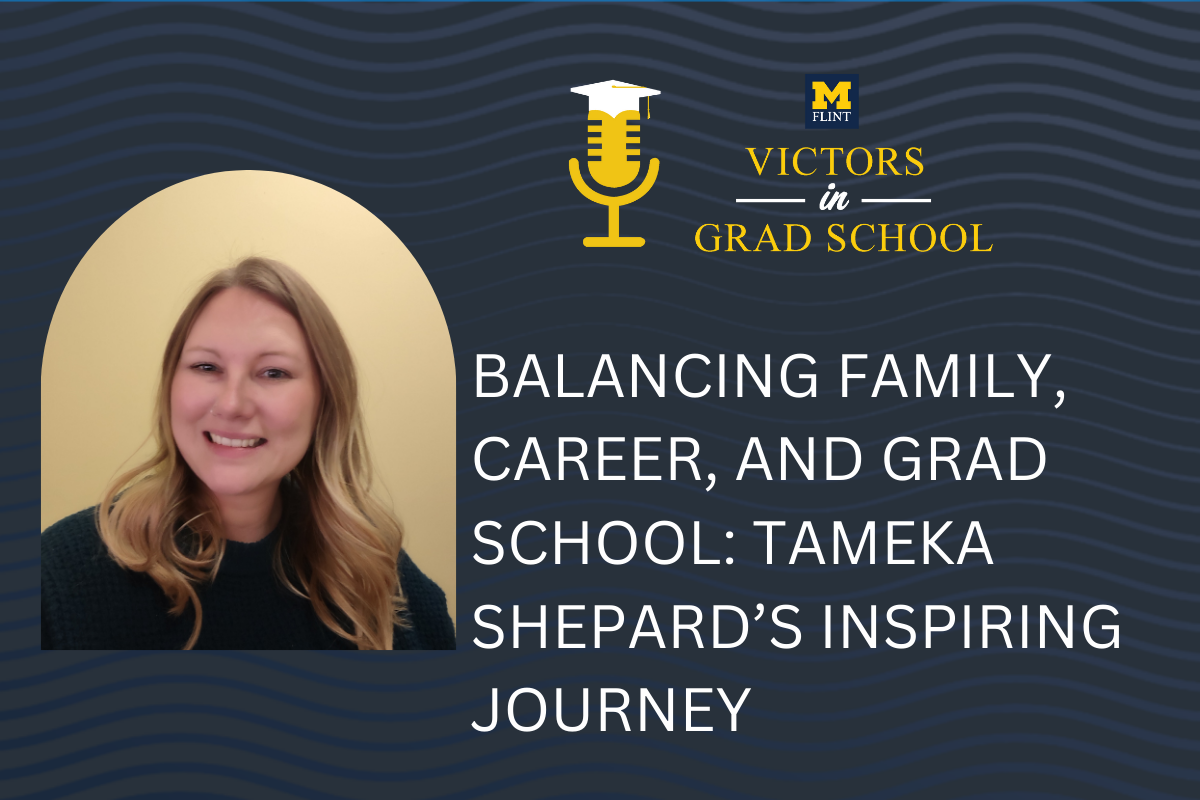
Are you thinking about taking the leap into graduate school, or are you already on that journey and looking for reassurance and advice? In the latest episode of the “Victors in Grad School” podcast, host Dr. Christopher Lewis sits down with Tameka Shepard, Academic Advisor and Business Programs Recruiter at the University of Michigan-Flint, to explore her powerful story of balancing family, career, and her pursuit of an MBA.
From the start, Tameka Shepard is candid about her motivations: a desire to give her children an example of lifelong learning, and a vision to one day open her own coffee shop. With a background in social work, she offers a unique perspective on how diverse educational experiences can complement each other—highlighting the value of understanding people in the business world. When it came to picking her MBA program, Tameka Shepard describes how flexibility was key. Western Governors University’s online, self-paced structure made it possible for her to manage graduate school alongside raising kids, working full-time, and supporting a traveling spouse.
Time management and setting boundaries were crucial tools for her success. Tameka Shepard shares how she carved out early mornings and late nights for study, and how open conversations with her family helped them support her goals—reminding listeners that prioritizing your education sometimes means missing out on other events, but the long-term benefits are worth it.
The episode doesn’t shy away from the challenges of grad school. Tameka Shepard bravely discusses facing imposter syndrome and struggling through a difficult class, ultimately persisting to show her children (and herself) the importance of not quitting. She highlights the freedom to take breaks to avoid burnout, and encourages others to listen to themselves—reminding us that there’s no one “right” timeline for finishing a degree.
Perhaps most valuable are Tameka Shepard’s reflections on what she wishes she’d known: the importance of networking, communicating effectively, and not feeling guilty about progressing at your own pace. Her story is a compelling mix of practical advice, honest emotion, and hope for others who are considering or pursuing graduate education.
Ready to be inspired by real-life experiences and actionable tips for success? Listen to the full episode with Tameka Shepard and let her journey motivate you to take the next step in yours.
TRANSCRIPT
Dr. Christopher Lewis [00:00:01]:
Welcome to Victors in Grad School, where we have conversations with students, alumni and experts about what it takes to find success in graduate school. Welcome back to Victors in Grad School. I’m your host, Dr. Christopher Lewis, Director of Graduate programs at the University of Michigan, Flint. Really excited to have you back again this week. As always, every week we are on a journey together. And I call it a journey because it truly is a journey. Every person, every individual that is thinking about graduate school goes through a journey that is very unique to themselves, depending on the program, depending on who they are, where they are in their life.
Dr. Christopher Lewis [00:00:40]:
And no matter if you are just at the very beginning, just starting to think about graduate school, or if you have already applied or if maybe you’ve been accepted or you’re in graduate school, doesn’t matter, you’re still on that journey. And we’re on that journey together. That’s why this podcast exists every week. I love being able to talk to you about ways in which you can find success in this graduate school journey that you’re on. And I love introducing you to new people that have gone to graduate school before you that can give you some perspectives and some thoughts about what they had to do in that time in their own life. So today we have another great guest. Tameka shepherd is with us today, and Tameka is an academic advisor and business programs recruiter for the University of Michigan, Flint’s School of Management. He’s.
Dr. Christopher Lewis [00:01:28]:
And I am really excited to be able to have her here and to talk to her about her own journey in graduate school and to welcome her to the show. Thanks so much for being here, Tamika.
Tameka Shepard [00:01:37]:
Thank you for having me.
Dr. Christopher Lewis [00:01:38]:
It is my pleasure. I really appreciate that you are here today and I always love starting the show by taking you back in time. So I know that you did your undergraduate work at Spring Arbor University and then you graduated, you graduated, you went, you started work. And at some point between that time an undergraduate student and as you were going and working, you made a decision. You made a decision that you weren’t done going to college, you wanted to continue your education and you decided to go back and get a graduate degree. Take me back to that point where you were starting that process for yourself. What made you decide that that was the right time in your life to go back to graduate school?
Tameka Shepard [00:02:24]:
So at that time, I just knew that I wasn’t done with my education. I knew that as a full time, working, solo parenting mom at home, my husband traveled, that I wanted something more. I wanted to be able to give my kids a little something extra. I wanted them to see how important education is. And so it was just, it was good timing. I was pregnant and so I was working full time. I was working from home. And I just thought, you know, I’m not getting any younger.
Tameka Shepard [00:03:00]:
I was already in my 30s and I just decided, decided I’m just gonna do it. Now.
Dr. Christopher Lewis [00:03:05]:
Every student has the ability to pick any program. Now. You could have, you could have studied anything that you had wanted. You made a decision to study a mba. You decided to go and get a master’s in Business Administration. And I guess first and foremost, before we even talk about where you decided to go, why an mba?
Tameka Shepard [00:03:23]:
So my ultimate goal is to. This is kind of like a retirement dream is to own a coffee shop. And so my undergrad degree is in social work. Very. From a business degree. But in every aspect of business, it, I think it, it helps to know how to kind of work with individuals, especially individuals who may have mental health issues, things like that. So I do think that they kind of go hand in hand. However.
Tameka Shepard [00:03:50]:
So again, my ultimate goal is to own my own business. And I wanted to have at least a foundation behind me and not kind of jumping into it blind when I’m older. And I’ve just always been surrounded by business minded individuals. And so I just really felt like that was kind of where my calling was.
Dr. Christopher Lewis [00:04:10]:
And I know that you chose to attend Western Governor’s University, and there are many MBA programs across the nation. We have one right here at the University of Michigan, Flint. So there’s a lot of different options in a lot of programs that you could have chose. Talk to me about that thought process, that decision process that you went through and how you whittled that down for yourself to decide that Western Governors was the right fit for you.
Tameka Shepard [00:04:37]:
So I decided on Western Governors because it is an entirely online university. And although U of M Flint has completely online MBA program at that point in time, I had a friend who was also attending Western Governors and she loved it. And the way that they structure the program is where you work on one course at a time and you can move through the course at your own pace. And that was really what kind of made me choose that program specifically. I knew that I was having a baby soon. I also had other kids at home and I needed something that was going to fit my schedule and that I could kind of work on on my own time. And nothing that was super structured with.
Dr. Christopher Lewis [00:05:19]:
Kids at home, with having another child on the way at the time you had A lot to balance. Especially you said having a partner, a spouse that traveled a lot. So you’re balancing a lot of different things and then you’re adding another thing into the mix. And a lot of graduate students are also balancing life, work, family, personal responsibilities, lots of different things. So talk to me about that balance for yourself. And how did you do that? How were you able to do that and do it well so that you could still find success in that graduate school journey?
Tameka Shepard [00:05:53]:
A lot of it was managing my time and finding little bits of time throughout every day where I could read out of the textbook, watch recorded lectures, submit assignments, things like that. So sometimes, sometimes that looked like early mornings, three, four o’clock in the morning and carving out some time in the morning, sometimes it was late night. Really just kind of depended on the kids and their needs and things like that. There were a lot of family events that I had to not attend, so birthday parties for nieces and nephews. I just really made my education a priority and I managed my time in a way that I knew that if I just got it done, spend a year graduate, get my mba, that I would have the rest of my life to attend birthday parties and things like that.
Dr. Christopher Lewis [00:06:40]:
And every graduate student goes through a transition because the way you’re educated as a undergraduate student is different than the way you’re educated as a master’s student is different than the way that you’re educated as a doctoral student. So at every level of education, there’s different expectations in regards to what your faculty expect of you, what you expect of yourself, and more so as you were going through that transition for yourself and you did find success, what did you have to do to truly set yourself up for success as you transitioned into your graduate program? And what did you have to do to maintain that success throughout the entirety of your graduate degree?
Tameka Shepard [00:07:20]:
A good piece of it was talking to my kids about the importance of education and why I was choosing to go back to school and get my master’s degree. And we just kind of set up boundaries about if mom is in her office, in the door is shut, that means she is working on school. That’s like focus time. So no interruptions. Carving out dedicated amounts of time every day to be able to do that, but really just setting boundaries within the family so that they kind of knew what to expect.
Dr. Christopher Lewis [00:07:53]:
A lot of times I hear from graduate students that there’s a point in time in a graduate degree where they sometimes feel imposter syndrome, or sometimes it’s self doubt regarding being a graduate student, the studies that they’re in, etc. Talk to me about that for yourself and how that may have reared its head for you and how did you handle it?
Tameka Shepard [00:08:16]:
So one class in particular I really struggled with and each of the classes were competency based, so you didn’t necessarily earn a grade for the course itself. The average was, was a B. You had to have a 3.0 or better in the class to be able to pass it. And I could not pass this class’ final exam. And they allow you to meet with a professor, go over the work, things like that. But it took multiple tries for me to understand the content. And I really struggled with that because learning has always came pretty easy to me. And so to have this one class that is just like impossible to pass, it seemed like.
Tameka Shepard [00:08:57]:
And so just trying over and over and putting in all of the effort that I absolutely had, meeting with the professor multiple times to go over content, it was really a struggle. And there was a time where I thought maybe I am just not cut out for grad school. Maybe I need to just throw in the towel. But I was halfway through and I knew that I had my kids watching me and I didn’t want them to see me quit. When you start something, you finish it. It’s kind of what I’ve always taught them. And so that’s what I did. I just powered through and got it done.
Dr. Christopher Lewis [00:09:29]:
So I mentioned the fact that you chose an MBA and you talked about your dream of owning that coffee shop down the road and having that dream for yourself. Now as you look back at what you degree you got, if you had to do it all over again, would you choose the same program or path? And if so, why? Or why not?
Tameka Shepard [00:09:48]:
I would. And only because it gives a good foundation for all of the different aspects of business. That’s not to say that I wouldn’t maybe someday go back and get another degree or even certificates or something like that to kind of help in other areas. But the MBA really gives you kind of a well rounded foundation of all of the things that you need to be successful in a business, business or as a business owner. That’s not to say that I could have a business and do all of the accounting for the business. I would not be able to do that, but I would be able to know kind of a starting point for marketing and the supply chain aspect and just all of those different areas.
Dr. Christopher Lewis [00:10:28]:
Another thing that I hear from students as they’re going through, and we talked about balance earlier, but sometimes students are also impacted by Burnout. And you get to that point in whether it’s the midway point, whether it’s your first term, it doesn’t really matter. But a lot of times some students will feel burnout. How did you avoid burnout or recover when you felt overwhelmed?
Tameka Shepard [00:10:52]:
So I was able to take a break in between classes if I needed to because I took them one at a time and kind of did them at my own pace. If I was able to push through six classes in a semester, great. But if I only did one, that was okay as well. So if I got to a point where I was starting to feel burnt out, I would just take a little bit of a break and not start another class until I felt like I was ready to do that. My biggest piece of advice for people when they’re feeling burnt out is to take a break. That’s okay. This doesn’t have to be a sprint, it can be a marathon. And if you need to take your time getting the degree, that’s okay.
Dr. Christopher Lewis [00:11:30]:
How do you feel that graduate school changed the way that you think, work, or approach problems?
Tameka Shepard [00:11:36]:
It definitely helps with critical thinking and being more familiar, being more aware of how other people think as well. And so I, I feel like it helps with problem solving. It definitely help with my critical thinking skills. It helps with communicating with like minded individuals. It helps with communicating with my colleagues here at the university. I think communication probably is the biggest piece. It really helps teach you how to communicate effectively.
Dr. Christopher Lewis [00:12:04]:
And as you think back to when you started your graduate program, what’s something that you wish someone had told you before you started graduate school?
Tameka Shepard [00:12:15]:
I think the one thing that I wish somebody would have told me when I started was that it’s okay to take your time and you don’t have to finish in the typical allotted time that a master’s degree takes. It is okay to take a break. If you need to take a break, it is okay to take one class a semester. If you can only handle one class a semester, you don’t have to rush through the program. It doesn’t matter how old you are when you get the degree. It age is not a factor in your success in a grad program.
Dr. Christopher Lewis [00:12:49]:
And finally, as you think back to your graduate school experience, what are some tips beyond what you’ve already shared that you might offer others considering graduate education that would help them find success sooner?
Tameka Shepard [00:13:02]:
Networking, talking with your fellow students Talking to and getting to know your professors Taking advantage of networking opportunities when they’re being presented to you. If you’re not able to attend, you know on campus networking opportunities, that’s okay. But virtual networking opportunities, an internship, if that is something that you are able to do, take advantage of an. Of an internship, I think that that provides a lot of success later in life. One of the things that I wish that I would have had access to in my specific graduate program was networking and I didn’t get to do that. So I feel like I missed out on that big piece of grad school. So that is probably my one big takeaway that I. That I would wish all grad students to take advantage of.
Dr. Christopher Lewis [00:13:49]:
Definitely. Networking is an important factor and something that you need to be. Networking with the students in your class, networking with the faculty members, finding ways to identify alumnus from the program that you’ve graduated from, connections with industry, doing what you can to set yourself up for meeting the goals that you’ve set for yourself. Just like what Tamika was just saying. But. But the other thing that I would throw out there is take advantage of opportunities that are thrown at you while you’re going through your graduate program as well. I know that our school of management brings in alumni to speak and programs do that. They will bring alumnus in and these are distinguished individuals in their field and you have the opportunity then to learn from them.
Dr. Christopher Lewis [00:14:38]:
But then also a lot of times there’s opportunities afterwards to go and talk to them and to pick their brain or meet other people that are at the same event. Connect, build those connections and you never know what doors will open. Tamika, I just want to say thank you. Thank you for sharing your journey today. And it definitely sounds like your journey is not over, that you might have some more education down the road in your path. And I know that you are continuously talking to students that want to do graduate school about these different topics. So I appreciate you doing that as well. But I truly thank you for your time today and I wish you all the best.
Tameka Shepard [00:15:15]:
Been a pleasure. Thank you.
Dr. Christopher Lewis [00:15:16]:
The University of Michigan Flint has a full array of master’s and doctorate programs. If you are interested in continuing your education. Whether you’re looking for in person or online learning options, the University of Michigan Flint has programs that will meet your needs. For more information on any of our graduate programs, visit umflint.edu/graduateprograms to find out more. Thanks again for spending time with me as you prepare to be a victor in grad school. I look forward to speaking with you again soon as we embark together on your graduate school journey. If you have any questions or want to reach out, email me at flintgradoffice.umflint.edu.