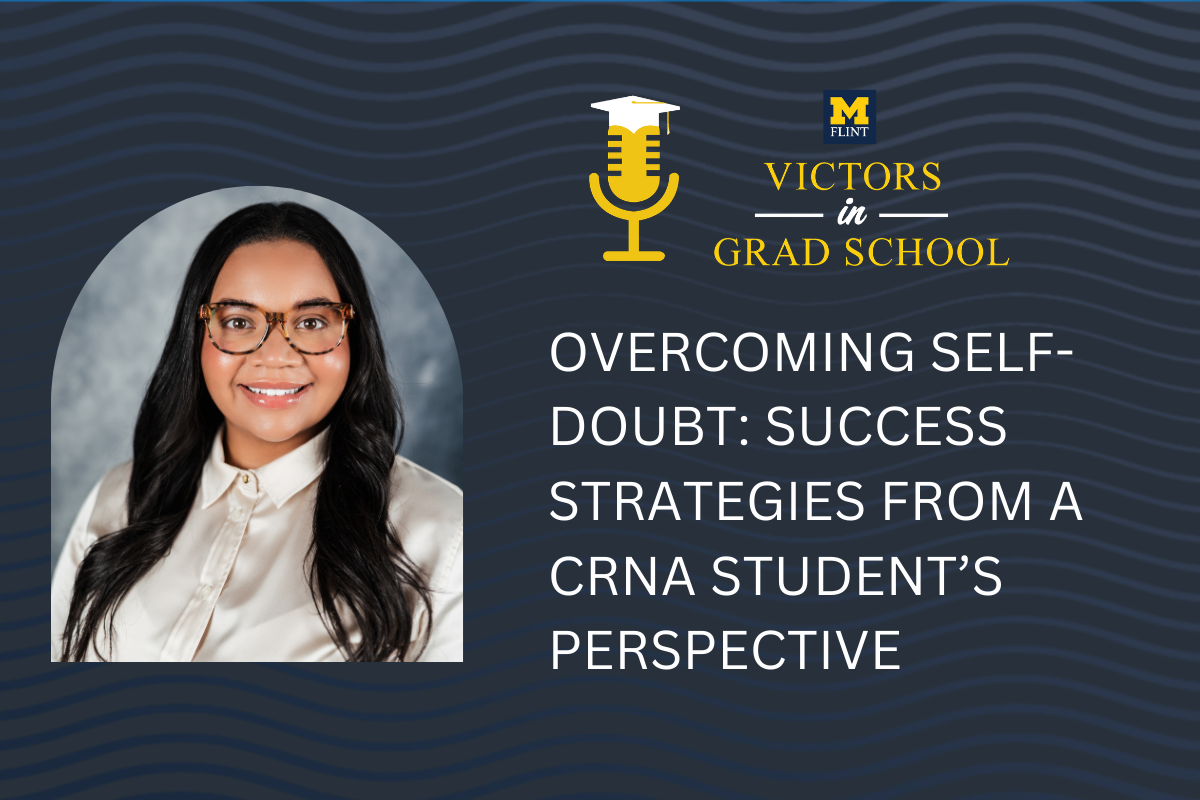
Embarking on the journey of graduate school can feel both exhilarating and overwhelming. On this week’s episode of the “Victors in Grad School” podcast, host Dr. Christopher Lewis sits down with Marissa Charles, a current student in the Nurse Anesthetist (CRNA) program at the University of Michigan Flint, to explore the heart, grit, and strategies needed to thrive in grad school.
Marissa Charles shares a story that many prospective students will find deeply relatable. After completing her Bachelor’s in Nursing and working for several years—including through the COVID-19 pandemic—she initially dismissed the idea of returning to school. “I always said I’d never be smart enough to be a CRNA,” Marissa admits, pointing to the self-doubt that can plague even high-achievers. Her journey is a powerful testament to the idea that growth comes not just from academic readiness, but personal readiness. Sometimes, it’s about timing and gaining confidence in oneself, rather than inherent capability.
A central theme throughout the episode is the importance of mentorship and community. Marissa credits much of her success to the robust support network within her program. From the moment students are accepted, they’re paired with mentors who guide them not just academically, but through the personal transitions essential to thriving in an intensive program. Extra-curricular opportunities, like mixers with students from other universities, further broaden the sense of camaraderie.
Grad school is no easy path. Marissa emphasizes the necessity of balance, self-advocacy, and strong communication. She reflects on strategies for managing bumps in the road—whether it’s an unexpected personal crisis or the all-too-familiar imposter syndrome. Her advice is universal: don’t be afraid to reach out for help, and remember that setbacks are a normal part of the journey. Faculty, family, and peers are eager to support—you just have to take the first step.
Whether you are considering grad school, in the midst of a program, or mentoring others, this episode offers inspiration and practical advice. Marissa’s narrative proves that with determination, support, and clear priorities, pursuing an advanced degree is not only possible, but rewarding.
Ready to find encouragement and actionable tips on your own grad school path? Tune in to this episode of “Victors in Grad School” and join a community invested in your success.
TRANSCRIPT
Dr. Christopher Lewis [00:00:01]:
Welcome to Victors in Grad School, where we have conversations with students, alumni, and experts about what it takes to find success in graduate school. Welcome back to Victors in Grad School. I’m your host, Dr. Christopher Lewis, Director of Graduate Programs at the University of Michigan Flint. So excited to have you back again this week. As always, we are on a journey together. I say it’s a journey, and I know every week I say this, but it is so true that you are on a journey. You’ve made a decision.
Dr. Christopher Lewis [00:00:32]:
Whether you are just the very beginning and you’re just starting to think about graduate school, or maybe you’ve applied, maybe you’ve gotten accepted, maybe you’re in a graduate program. No matter where you are, this is a journey from start to end of that graduate degree, and there are things that you can do right now, today, to be able to find success sooner. And that’s what this podcast is all about. I love meeting with you every week to be able to provide you some things to think about, some perspectives, some thoughts, and especially to bring you others that have gone before you that are either in graduate school now, they’ve gone to graduate school in the past, and they are excited to be able to share their own journey with you so that you can learn from it and maybe repeat some things, maybe not repeat some things, to be able to help you to make your journey as smooth as it can be. Today we got another great guest. Marissa Charles is with us, and Marissa is a student within the Nurse Anesthetist program at the University of Michigan Flint. Really excited to be able to talk to her and to learn more about her journey in and through graduate school. Marissa, thanks so much for being here today.
Marissa Charles [00:01:45]:
Thank you, it is my sincere pleasure.
Dr. Christopher Lewis [00:01:47]:
I am really excited to be able to have you here today, and I think first and foremost, I know you did your undergraduate work at the University of Michigan Flint. You got a bachelor’s degree in nursing at the University of Michigan Flint, and then you went off, you went off, you worked and started in your career, and at some point you made the decision for that you wanted to continue that education. Bring me back to that point, that point in your life where you said, “It’s time.” Why was it the time to make that jump? And what made you decide to go all in?
Marissa Charles [00:02:21]:
100%. So I graduated December of 2020, definitely a crazy time in the world. I became a nurse. I started working. I never said, “Go back to school, Dr. Lewis.” I said I’d never go back. My bachelor’s degree was enough. There’s no way I’m doing it again.
Marissa Charles [00:02:37]:
I graduated when I was 23, so I was working for a few years and I always said I’d never be smart enough to be a CRNA. And looking back at that is like, it makes me laugh because it shows just how you grow as a person truly through life. Because here I am, it’s 2026 now. Um, in 2023, I finally made that decision where, hold on, it’s not that I wasn’t smart enough, it just was that I wasn’t ready. I was a new nurse. I was coming outta nursing school, COVID was happening. We were seeing the sickest patients ever during that time. It was scary.
Marissa Charles [00:03:14]:
And it’s not that it wasn’t smart enough, I just wasn’t ready. So 3 years or 2, 2 and a half years into my nursing experience, I was looking around and I just felt as though I’m missing something, like something— I wanna do more. I want to advance my education. I feel as though I’m at a point in my clinical experience where I have truly become a clinician that was an expert within my critical care standards. So in 2023, I was like, I think it’s time. I don’t know what I wanna do yet, but it’s something. And that’s when I started looking at graduate programs around the state of Michigan, what was out there for nurses. There’s a lot of different paths you can take.
Marissa Charles [00:03:59]:
You can become a nurse practitioner. There is— perfusion, there’s PAs, there’s a lot you can do in graduate programs right now. And CRNA, I still felt like I wasn’t smart enough for. So it took me about another year. In 2024 is when I finally was like, why not bite the bullet? Why not go for the hard road of what this program is? Because with a hard road comes a lot of feeling super good about yourself and confident and getting the most out of your education. So I decided in 2024 that I would start applying. And this process takes a long time. It’s 2020, I started fall of 2025.
Marissa Charles [00:04:41]:
So it does take a little bit of time to go from deciding you want to go back to school, getting your application in, getting an acceptance and starting. But here we are, you know, 2 years, January of ’24 to January— February of 2026 to being in it. So that’s a little bit of my story.
Dr. Christopher Lewis [00:04:59]:
And I, I’ve said that you are in the University of Michigan Flint’s nurse anesthetist program, the CRNA program.
Marissa Charles [00:05:07]:
CRNA program.
Dr. Christopher Lewis [00:05:08]:
And as you said, you did some research, you looked around, and I know that there are other CRNA programs in the state of Michigan that you could have chosen, and outside of the state of Michigan as well. So talk to me about that and what made you decide to not only apply to the CRNA program at the University of Michigan Flint, but also that once you got that acceptance, that, that was the program that was right for you.
Marissa Charles [00:05:33]:
So, uh, there’s 5 programs in Michigan, so you have a lot to choose from. And there’s so many different reasons that you can look into different programs. Obviously I’m a little biased ’cause I spent my undergraduate program at the University of Michigan Flint. So I looked back and when I was in my undergraduate program, I was working alongside of anesthesia students. They were there with me during my undergrad. So I got to see a little bit of kind of what they did on a semi-day-to-day basis. But it really still wasn’t a level playing field because it’s been 4 or 5 years since I went to undergrad. I’ve been kind of all over the state of Michigan, but really the biggest thing that brought me back to Michigan, which is kind of what I love so much about my undergrad program, is truly the relationship that the faculty has with their students and how much importance we put on student-to-student relationships.
Marissa Charles [00:06:27]:
And I’m gonna mention mentor, mentor, mentor probably a million times in the next 20 minutes that we talk, but our program, even before you start, they offer webinars, open houses, opportunities for you to meet the faculty to get an idea of who they are because you’re applying to be in the program. It’s just as much backwards. They want the best of the best to be in a program. And so it’s just as much as me choosing them as it is they’re choosing us. So I really, really love that about our program is the relationships that we build and then just how much importance we put on building relationships, mentorships, and then wellness is super huge. So after literally you got your acceptance letter, and then right before we start the program, they pair you up with a mentor and start building that relationship on how can we help you get through this next 3 years. And here’s this person that’s doing the same thing you’re doing, but they’re a little bit ahead of you, so they have a little bit of insight on how to get you through the program, which is super huge for me.
Dr. Christopher Lewis [00:07:31]:
You’ve been successful. You made that transition in, you’re going through the program right now. You’re mentoring other students as well and helping other people in the program. So you’ve been able to find success thus far. But I also know that there is a transition. You went through a nursing degree, but just because you went through a nursing degree as an undergraduate student doesn’t mean that the way you’re being educated, the, the expectations of the faculty are going to be the same at the graduate level. And usually they’re heightened to a much greater degree. So talk to me about that transition for yourself and what did you have to do as you transitioned into graduate school and what have you had to do along the way as you’ve been going through this graduate program to help you find success?
Marissa Charles [00:08:17]:
I think half of, like, our student success is a tad bit about our director, is our director has basically taught every single class in our program. So one thing that created such a success for us as a cohort is that the way that our classes are built and the way they’re structured is to allow for that transition to happen. And I don’t know if there’s many other programs that can say that they have faculty that have truly taught everything and have reworked all of these classes to create student success. That first semester, most of us have been out of school for 3, 4, 5 years. And so building a first semester where you’re learning how to be a graduate student again, learning how to stop working again, learning how to facilitate your life around being a student, but also you’re still a partner or a mother or a dog mom. You’re still the person you are outside of school, but being a student is 100% that first semester and what that looks like. So I’d say the biggest thing is providing us with support in that first semester and building a class list that is doable was super big. And then really the biggest thing is I am super crazy about looking ahead really far, just like mentally prepare yourself.
Marissa Charles [00:09:35]:
Like right now I’m in my second semester and I’m looking at third already. I mean, we just started 5 weeks ago, but in order to be successful as a graduate student, you have to focus on what you’re doing right now, but you have to be 3 or 4 steps ahead. So looking at— I’m starting clinicals in April. May, and knowing that I need to start mentally preparing myself for what does clinicals look like? What does creating lunches and being outside of the house a lot more, driving a lot more distances, things like that, to create a better, smoother transition for a student instead of it being very abrupt. So I’d say like, definitely, I love that our faculty have created a streamline of courses that really kind of ramp up just in the perfect amount each semester, but also being a productive student more than you were in your nursing program, where a lot of this is independent. They’re not going to tell you exactly what you need to be doing at home and kind of figuring that out for yourself to be successful.
Dr. Christopher Lewis [00:10:35]:
You also mentioned the fact that it was so important for you to have a mentor and that your program aligned you specifically with a student mentor, but there are also mentorships that you build in regards to the connections with your faculty members as well, and that’s important too. So Talk to me about mentorship, and if your program is not offering you the type of formal program that, let’s say, that you had in your program, what are some things that you’ve seen to be able to allow for you to be able to build relationships with others that you might not have been formally connected with before you were in the program?
Marissa Charles [00:11:11]:
So our program sets you up with a mentor, and we— your mentor kind of chooses you in a way, and you’re kind of connected on familiarity. So I was lucky enough to get a mentor that I actually was her trainer as an ICU nurse. I trained her and now it’s her opportunity to give it back to me, which is super amazing. And I love that so much. But you’re paired up with a mentor before you even start. And we meet them even before we start the program. They throw, uh, orientation meet and greet. And so it’s an opportunity for us to say like, hey, like, what can I do before we start? What can I do in that first week of classes when Canvas opens finally? And we’re so excited.
Marissa Charles [00:11:50]:
How can I get ahead? Ahead. So that is super important. And then our faculty are super awesome, and every quarter they set up wellness days, and those wellness days are opportunities for all 3 years, for second and third year students to get together and continue to build those relationships. We have a mentor, but that’s just one person, but there’s 30 people in each year, so there’s the opportunity for 100 of us to get together and, and build faces to names, names to faces, because ultimately we’re going to be coworkers or we’re gonna follow each other in clinical. We’re gonna have opportunities to connect on different scales and being able to see each other, you know, once every quarter is super huge. So that is something that we do that I appreciate. But obviously there’s opportunities outside of school that you kind of have to push yourself a little further to be able to make relationships with people while you’re in a higher degree. So for example, with the nurse anesthesia programs, or I should say nurse anesthesia There’s the Michigan Nurse Anesthetist, um, essentially board.
Marissa Charles [00:12:54]:
Like everyone has like, as a board across the Michigan and we have MANA and there’s MANA for students. And so I just came back last week. They had a meeting with all 5 programs. That’s optional. You don’t have to go, but why would you not take 4 hours out of a Friday night to go to a mixer of 5 different programs across the state of Michigan to pair up with these different students from different places? Because like I said, we met may end up being coworkers one day, or we may see each other in clinical, and being able to see how different programs are doing it and how are they getting through their 3 years to be successful in the program is super big to me. So going that extra step to doing those optional things that it’s not mandatory, but it could otherwise increase your success in finding different things out from different people across all of Michigan.
Dr. Christopher Lewis [00:13:48]:
And you’re in a rigorous program, which is challenging in itself, but you’re also a friend, you have family, you’ve got other hats that you’re wearing. So talk to me about balance and how do you find balance in your school, your work, your family, and other personal responsibilities while you’ve been in graduate school?
Marissa Charles [00:14:09]:
That is the question of the hour, Dr. Lewis. How do we do it? I think as a nurse, that’s something that you inherently know because there’s weeks where are tough weeks at work and you have to be able to kind of figure that out. You have to work overtime, or it’s the holidays and you’re balancing holidays with taking care of your own family. In the graduate program, it’s harder in the aspect of you have to say no. You have to be able to know there’s a priority. You have an exam on Monday, it’s Saturday night, that I can’t do that. But there’s also Friday night I can, I just have to be responsible with my time.
Marissa Charles [00:14:48]:
So I think it’s definitely very difficult as a graduate student on having to say no and really create a balanced schedule, but I think it really starts before you start. We’re super big at Michigan. We do a family meeting and it gives you the opportunity for our director to explain to our family members from her perspective, not ours, cuz we, I mean, we’ve explained this to our family probably a million times. This is gonna be hard. This is gonna be hard. But she speaks to our family and gives them basically a rundown of what it looks like to be a student and what her expectations of us are and what her expectations of them are. And it kind sets a precedent of it’s not just me going through the program, everyone in your household’s going through the program. It’s just as difficult for those people around you as it is for you.
Marissa Charles [00:15:36]:
So I think that, um, it does start before you start and kind of setting expectations. And if it ends up being a great semester and you end up doing more things, it’s awesome. But knowing that at minimum, this is where I have to study, I have to set aside time. If I’m able to do more, great, but at minimum, this is what we have to do.
Dr. Christopher Lewis [00:15:55]:
And setting those expectations, I think, are really important, not only for yourself, but also for your family and friends, et cetera. I tell students all the time that having those type of communication meetings, whether they’re from a program to family members, it’s even more important to have from student to family or friends as well, because you may set parameters at the beginning of a term without realizing or understanding what that term is really gonna be like. And what I try to make sure that any student thinks about is if things change, that’s fine, but communicate it out. Because if you’ve promised to call mom every day of the week and you’re only calling once a week, guess who’s going to be really concerned when you’re not calling? Mom’s going to be concerned. So make sure that you’re communicating and letting people know. They’re not going to be upset with you. They’re going to be more happy that you’ve communicated and that you’re keeping them informed because they want to support you. And that’s what this is all about, is that the people that have always been a support are going to continue to be your support, but they need to know how to support you through the process.
Marissa Charles [00:17:01]:
Yep, 100%.
Dr. Christopher Lewis [00:17:02]:
I know that through the program sometimes there are bumps along the way and there are things that happen that are unexpected, whether it be a bad grade, whether it be a family issue, whether it be whatever. And I know that you even had some of those in your own experience. Talk to me about what you would say to other students that have those bumps in the road and what would recommend for students to do when that does happen?
Marissa Charles [00:17:28]:
I think the biggest thing, like reflecting back on like those times, is like try— it’s so hard in the moment when you feel like your world is crashing and you feel like so overwhelmed— is to like pull yourself out of it for 3 seconds and just like take a breather, relax. Because at the end of the day, the biggest thing about Michigan no matter if it was my undergrad or graduate program, is our faculty are there for you. And I think that it’s, it’s so funny because she— our director in our fac— CRSS— they say it so many times, and I understand now being on the other side of it and having to go to them why they say it so many times, because it’s almost like ingrained into you at that point. So when you are so overwhelmed and you’re so frustrated, you’re going through something so difficult, it’s so inherently easy to just reach out. And I think that, you know, 10, 20 years ago, that was— might not have been a thing. And so it’s hard because the hardest thing to do is make the first step to like reach out and ask for help or reach out and say, I don’t know what I need, but this is what’s going on. And so that to me is like the, the easiest and the hardest thing to do is like take 5 seconds for yourself and just stop and like figure out who you need to talk to and talk to that person because you’re not alone. This program, whether it’s your support systems at home or your support system within your program, there’s always someone someone there to talk to.
Marissa Charles [00:18:54]:
And I think that that is the hardest thing, is like figuring out how to approach those people that you— they are your directors or your assistant directors, your faculty. They’re up here and you’re like, oh, I’m just so little, it’s just me, like I don’t want to bother them. But that’s what they’re there for, and I think it’s so hard to overcome that. But now I understand why it’s, it’s so drilled into us so many times during our orientation, during any type of clinical, clinical prep workshop, is they just want to help. They’re there to help you get through those hard points in life. So I think the hardest thing is, is to actually reach out, but once you do that, everything feels like it falls into place just as quickly as everything kind of blew up.
Dr. Christopher Lewis [00:19:35]:
And sometimes that will happen. And I’m not sugarcoating it for anyone. When you go through graduate school, life happens. And whether you like it or not, there could be really positive things, there could be things that are negative that may happen, one of the things that I would always tell a student to do is communicate, communicate with your program. Make sure to talk with your program about what is happening because your program wants you to be successful and the director, the staff, the faculty are going to try their best to be able to support you in that moment and to find resources for you in that moment. Sometimes, as Marissa just said, sometimes at that point in time you just can’t think straight and you’re thinking, I just need to fix I need to go, I need to do this, I need to go, go, go, and you’re like, I’m out of here. Take that pause, send that email, pick up the phone, make the call, because if they know upfront there’s going to be a lot more that they can do than if you just fall off the radar and are dealing with something that you should be dealing with. But if the program doesn’t know that, that could impact you in many different ways.
Dr. Christopher Lewis [00:20:43]:
So just like I was talking about communicating with family and friends, it’s also important to communicate communicate with your faculty, with your director, with staff in the program, and to talk to them about things that are happening because they may or may not know what’s happening with you personally. And that’s up to you. That’s your right. You can keep it to yourself, but the more that you are able to build that relationship, the more that they’re gonna step in and be able to support you in the end. Now, one of the things that I’m interested in knowing as well is many students as they’re going through— you talked about at the very beginning, always thinking that the CRNA RNA program was not something that you would be able to do because you didn’t think you were smart enough. And there are many times when you go through graduate programs and graduate school itself that sometimes that self-doubt, that imposter syndrome, steps in, and it can rear its head in many different ways. Talk to me about how imposter syndrome or self-doubt reared its head for you, and how did you deal with it?
Marissa Charles [00:21:44]:
We’re in a rigorous program. We are in— I there’s hundreds of people that apply to this program and ideally they’re taking top 10%, 5%, 50%, whoever knows. And so day to day you’re taking exams, you’re comparing yourself to others. You’re like, oh man, why didn’t I get, you know, this question right? That person got it right. My grade is this grade, their grade’s that— it’s so easy to get so wrapped up in the minuscule details and feeling like you need to compare yourself to others. And this last 2 semesters, I’m gonna go back to our director. I love her. She has watched, you know, multiple years of students go through this program.
Marissa Charles [00:22:26]:
And it feels like right at that time where you feel— we call it the valley of despair, that time where you feel yourself dipping and you’re like, feel like you can’t see the sun and you can’t see when the next good day’s coming. She gives us that inspirational message that we need, you know? And it’s so— it’s so— and she has it down to a science where just when you need that, that bump of inspiration of saying like, you know, you are— you’re meant to be here. You are smart enough to be here. I picked you because I knew— I know you can do it. Let me know how I can get you through this because I know you can. It’s just getting you the resources or figuring it out, right? It’s, it’s, it’s so funny because I, I genuinely think she’s done this and done it so well for so long that she knows just right coming into second semester. Students get so overwhelmed that first, second week that it’s so much more material, so much more to do. And that’s when we have that time with her to say like, no, you can do it.
Marissa Charles [00:23:31]:
This is how we’re gonna step back to be successful and not try to compare ourselves to others. Be the best person that you can be on your own is super huge because is imposter syndrome. That is the hardest thing to overcome before, during, and after this program. So just being able to kind of like point it out and see the red flags when they’re coming is super huge for me. Sitting down, like pausing for a second and saying like, no, like I am doing the best I can. I’m here for a reason. I will be successful is super huge when you’re by yourself.
Dr. Christopher Lewis [00:24:06]:
Now I know that you’re currently in graduate school, you’re working toward the light at the end of the tunnel. As you you think back to the experience that you’ve had thus far in your graduate education, and you think of others that are thinking about graduate school, whether it’s going into becoming a nurse— a nurse anesthetist, a physical therapist, getting an MBA, whatever it might be— what are some tips that you might offer others considering graduate education that would help them find success sooner?
Marissa Charles [00:24:32]:
Put one foot in front of the other. I think that’s the hardest part. I think, you know, we’re all adults that are applying to graduate school. We all have jobs, we all have things going on, and I think the hardest— for people when they’re applying to go back to school isn’t necessarily the school. It’s all the steps that you have to do to get back to school. It’s the long application process. It’s getting proof of all your documents. It’s putting together records requests.
Marissa Charles [00:24:58]:
One foot in front of the other, ’cause that’s truly the hardest part. Write down that deadline. Make sure that deadline’s on a huge sticky. Put reminders in your phone. It’s all the little steps that it takes to get to where you wanna go. So that’s probably my biggest thing is like, like you can do it. It just takes a lot of little steps to get to where you wanna be. And then I would say probably the second thing is try your hardest to, to build your application or build your process, build your resume to show who you are as a person.
Marissa Charles [00:25:29]:
I think that’s the hardest thing is the biggest question that people ask when they’re applying to programs is like, how, how do I, how can I get in? Like, what can I do? And the biggest thing is trying your hardest to show who you are as a person who you are as a nurse, who you are as a student on paper is probably the hardest thing to do because that is all you are when you’re compared to hundreds of people. You have to figure out how to display yourself the best that you can, whether that’s in your essay or, or in your CV, is try your hardest to build that out to show who you are as a person.
Dr. Christopher Lewis [00:26:05]:
Well, Marissa, I just wanna say thank you. Thank you for sharing your journey today, and I know it’s not over yet, but I’m I’m looking forward to being able to see you cross that stage here in the not too distant future. And I’m really appreciative of all that you said today as well, because as you mentioned, it’s not always going to— there are going to be bumps in the road. It’s important to have those mentors. And there’s so many little pieces that you talked about today that I think are so important for any program and any student thinking about graduate school. So I really appreciate you sharing that, and I wish you all the best.
Marissa Charles [00:26:35]:
No problem. Thank you, Dr. Lewis. Always.
Dr. Christopher Lewis [00:26:37]:
The University of Michigan-Flint has a full array of master’s and doctorate programs if you are interested in continuing your education. Whether you’re looking for in-person or online learning options, the University of Michigan-Flint has programs that will meet your needs. For more information on any of our graduate programs, visit umflint.edu/graduateprograms to find out more. Thanks again for spending time with me as you prepare to be a victor in grad school. I look forward to speaking with you again soon as we embark together on your graduate school journey. If you have any questions or want to reach out, email me at flintgradoffice@umflint.edu.