A small, spherical robot sits on the edge of a classroom table, motionless until a high school student activates it. Armed with a measuring tape, the student measures the table, translates the dimensions into distance and timing commands, and pushes the revised code. The robot has no native awareness of drop-offs; it relies entirely on the parameters fed into its software. So, the sphere rolls forward, stops short of the corner, turns exactly ninety degrees, and proceeds along the second edge.
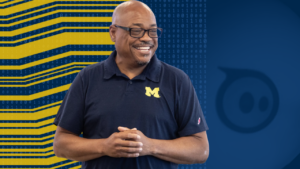
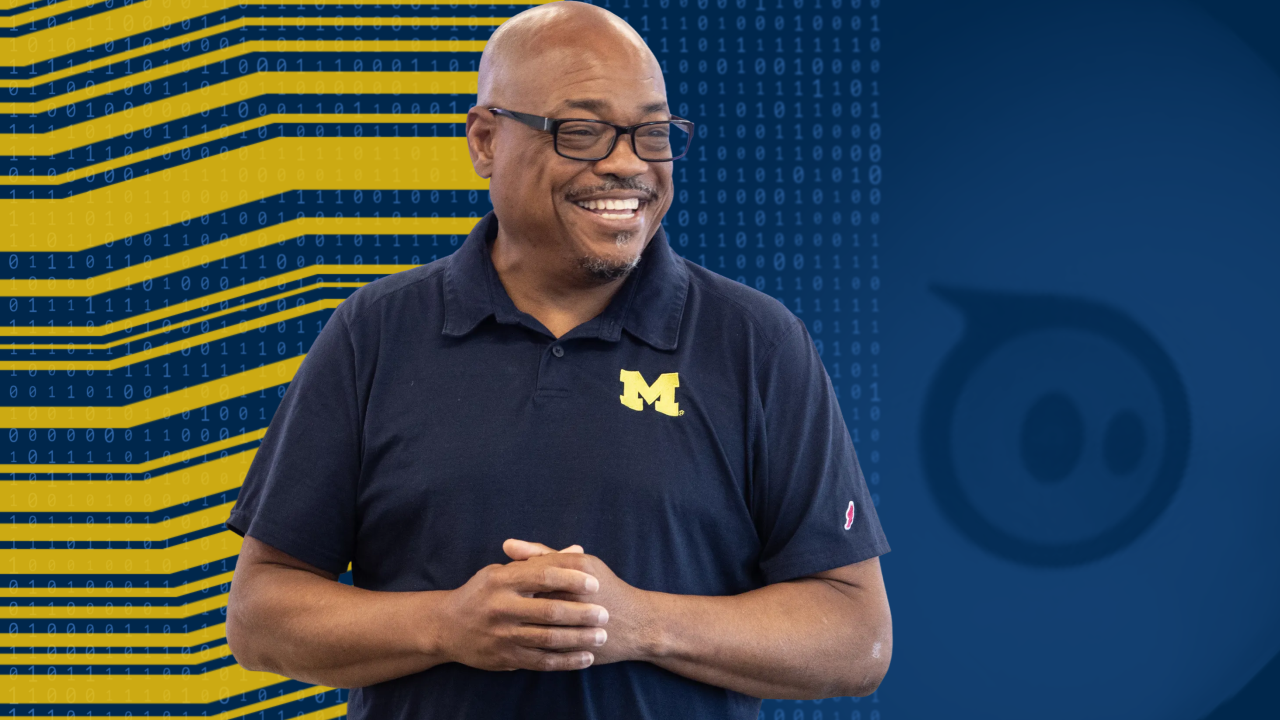
Watching the exercise is Tim Bates, a clinical professor of cybersecurity at the University of Michigan-Flint’s College of Innovation & Technology, better known in industry circles as the Godfather of Tech. For Bates, that very moment marks the transition from casual play to applied computer engineering for students.
“He went around the square table completely. He measured it out, did the numbers, and was able to do it.”
Bates uses the Sphero robotics platform not as a toy, but rather as an instructional approach designed to deconstruct the assumption that programming is an obscure discipline reserved for a specialized few. Instead, by making learning more fun, it ultimately shows how working with technology is fun, too.
The Career Behind the Classroom Philosophy
Why Industry Experience Matters at CIT
Bates’ approach to education is informed directly by how technology is put together, deployed, and scaled in the real world. Raised in Detroit, his journey into technology began early, leading to senior executive, advisory, and technical positions across major global organizations, such as General Motors, Lenovo, and Deloitte.
Throughout his career, Bates observed a consistent pattern: complex systems are rarely inaccessible because of their underlying logic; more often, it’s because their entry points are needlessly intimidating.
It becomes even more complicated when faced with the reality that higher education often struggles with connecting theoretical instruction with the current rapidly changing industries. Bates wants to bridge that gap, and with his appointment at CIT, he applies his knowledge and experience with systems engineering and enterprise leadership in his teaching.
Rethinking How Students Interact with Software
Measuring, Calculating, and Pushing Real-Time Code

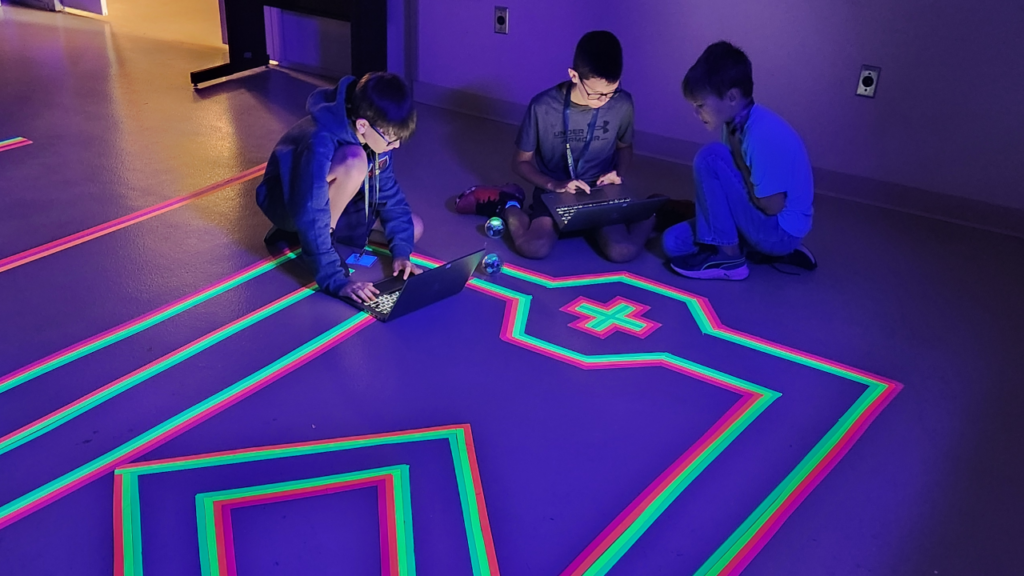
The instructional sequence begins with making the content more accessible. When middle and high school students first interact with the Sphero units during campus outreach activities, they are not asked to write syntax or debug code.
Instead, they interact with a graphical smartphone or tablet interface, using a direct drive joystick, or they draw its path on the screen. Controlling a rolling sphere feels familiar, akin to operating a remote-controlled vehicle.
Once students feel comfortable dictating the robot’s movement, Bates gives them a challenge. Manual control is removed, replaced by tasks that cannot be accomplished through simple touch-screen steering, such as navigating a multi-turn course or keeping a unit on a precise trajectory across variable surfaces.
“That’s where they jump from the radio control car from drawing to actually writing code, because they saw the reason that the code would give them more capabilities to control the ball better,” Bates shared.
Back on the Annex floor, the Sphero completes its final turn, rolling parallel to the table’s fourth edge before coming to a stop at its exact starting position. To get there, it took more than just the joystick. In reality, it followed an array of parameters calculated, written, and verified by a student.
Interactive Robotics as an Entry Point to Low-Code
Changing Perceptions of Computer Science
A central goal of Bates’ youth events is overcoming self-selection out of these kinds of technical fields, specifically STEM pathways. With working through iterative trial, error, measurement, and recalculation, students learn the fundamentals of algorithmic thinking without the initial intimidation of a blank text editor.
During these sessions, students also receive feedback through this testing and playing with the code and seeing how the robots respond to them. When a student programs a workaround for a hardware limitation, such as calculating acceleration parameters to mimic a jump across a gap, they can immediately see if the robot responds correctly.
“Initially, some of the kids in the room would think they’re not smart enough to program, but at the end of the workshop, instead, they walk out knowing how to program.”
With content that is more approachable, the self-imposed belief that the field is out of reach suddenly becomes a myth. By replacing barriers with concrete and physical feedback, the activity demonstrates that the tools of modern technology are truly not out of reach. They are simply systems waiting to be measured, programmed, and understood.
Connecting Community Workshops to College Degrees
Foundations for Robotics, AI, and Cybersecurity
Of course, a workshop does not produce a finished software engineer overnight. For the College of Innovation & Technology, outreach activities like these increase community access to applied technology education and establish pathways into rigorous degree programs.
The core concepts taught in the Sphero workshops provide a starting foundation for multiple high-growth technical fields. Bates successfully achieves his dream of destigmatizing the field, proving that coding is not a closed domain but rather a system waiting to be understood and programmed.