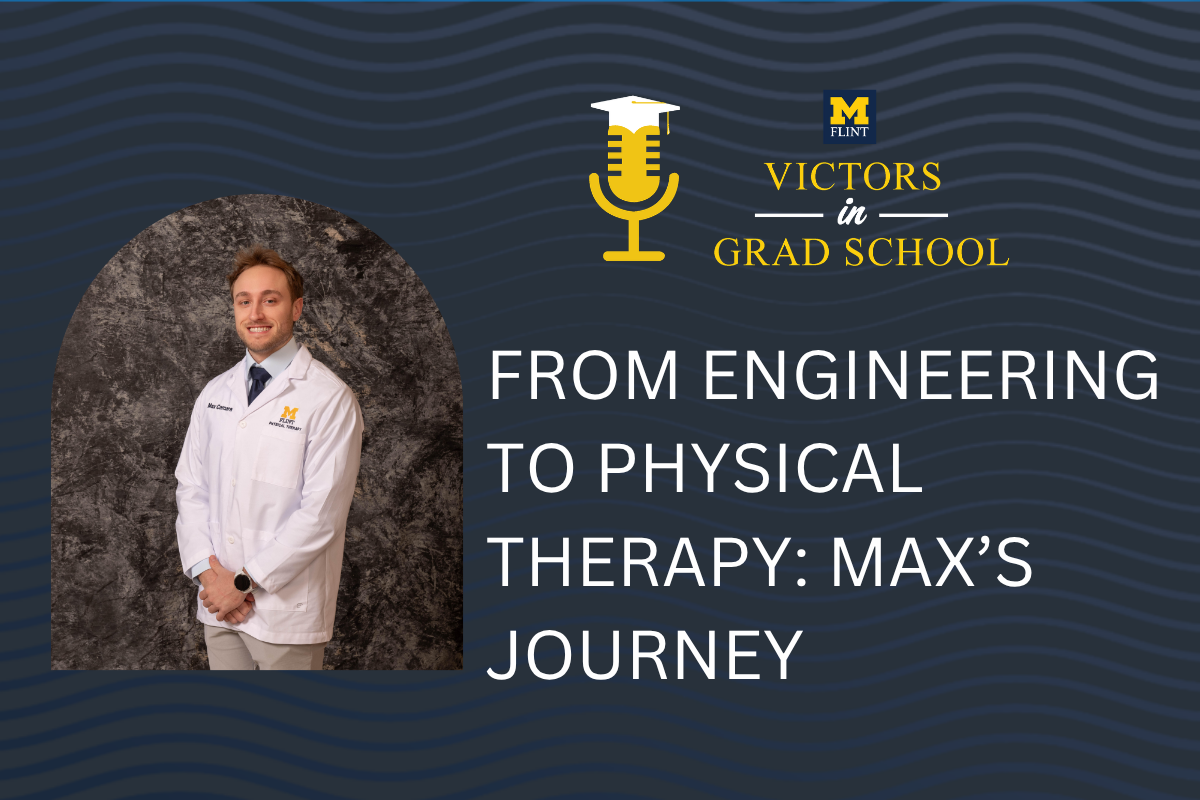
For many students, the decision to pursue graduate school is not a straight path. It is a journey filled with uncertainty, exploration, self-discovery, and growth. In this episode of the podcast, listeners meet Maxwell Camara, whose story perfectly captures what it means to embrace the process of finding your purpose.
Max’s journey did not begin in physical therapy. In fact, he originally started in engineering before eventually transitioning into kinesiology and discovering a passion for helping others heal through movement and rehabilitation. One of the strongest themes throughout this conversation is that it is okay not to have everything figured out right away. Max openly shares that even after applying to physical therapy school, he still was not completely certain it was the right fit. It was not until he became immersed in clinical experiences and hands-on patient care that he truly found confidence in his path.
Another key theme in the episode is the power of experiential learning. Max discusses how opportunities like the HEART Clinic at the University of Michigan-Flint helped shape his professional identity. Through direct patient interaction, leadership experiences, mentoring younger students, and even participating in research projects involving wearable technology, he was able to connect classroom knowledge to real-world impact. His experiences demonstrate that graduate school is about far more than lectures and exams—it is about applying what you learn to make a difference in people’s lives.
The conversation also dives deeply into balance and resilience. Max speaks honestly about the challenges of transitioning from undergraduate coursework to the demands of doctoral-level education. He explains how treating graduate school like a full-time job, developing consistent routines, prioritizing exercise, and building a strong support system helped him maintain both academic success and personal well-being. His reflections on imposter syndrome are especially relatable, reminding listeners that self-doubt is common, but growth often happens when you push beyond your comfort zone.
For anyone considering graduate school, this episode offers practical advice and encouragement. Max emphasizes the importance of getting involved early, talking to professionals in the field, exploring hands-on opportunities, and truly understanding the profession before committing to a graduate program.
Whether you are considering physical therapy, another healthcare field, or graduate education in general, this episode is packed with authentic insights that will help you think more intentionally about your future. Max’s story is a reminder that success is not always about having all the answers from the beginning—it is about being willing to learn, adapt, and keep moving forward.
TRANSCRIPT
1
00:00:03.310 –> 00:00:18.379
Christopher Lewis: Welcome back to Victors in Grad School. I’m your host, Dr. Christopher Lewis, Director of Graduate Programs at the University of Michigan, Flint. Really excited to have you back again this week. As always, every week, I love being able to have an opportunity to talk with you every week.
2
00:00:18.520 –> 00:00:23.449
Christopher Lewis: on this journey that you’re on. And I call it a journey because it truly is a journey.
3
00:00:23.750 –> 00:00:30.120
Christopher Lewis: Whether you’re at the very beginning, just starting to think about, is grad school right for me? Or maybe you’ve…
4
00:00:30.560 –> 00:00:37.740
Christopher Lewis: decided, yep, I’m applying, or maybe you did apply, it got accepted, maybe you’re in graduate school. No matter where you are.
5
00:00:37.940 –> 00:00:40.050
Christopher Lewis: You are truly on a journey.
6
00:00:40.450 –> 00:00:47.830
Christopher Lewis: And as you’re going through this journey, there are things that you can do to be able to find success in that journey that you’re on.
7
00:00:47.980 –> 00:01:02.529
Christopher Lewis: And that’s why this podcast exists. Every week, I love being able to have this conversation with you, to walk with you, to provide you with some tips and tricks and things that you can put into that toolbox that you bring with you everywhere.
8
00:01:03.210 –> 00:01:07.099
Christopher Lewis: That’s why every week I also love being able to introduce you to new people.
9
00:01:07.380 –> 00:01:20.450
Christopher Lewis: New people with different experiences that have all gone through what you’re going through, and can provide you with some perspective, some things for you to think about, and maybe some things to implement for yourself.
10
00:01:21.410 –> 00:01:23.589
Christopher Lewis: Today we’ve got another great guest.
11
00:01:24.170 –> 00:01:26.190
Christopher Lewis: Today, we’ve got another great guest.
12
00:01:26.780 –> 00:01:29.190
Christopher Lewis: Is it Max or Maxwell? Which would… what do you go by?
13
00:01:29.360 –> 00:01:30.359
Maxwell Camara: Max is good.
14
00:01:32.650 –> 00:01:36.910
Christopher Lewis: Today, we’ve got another great guest. Max Kamara is with us today.
15
00:01:37.130 –> 00:01:39.230
Christopher Lewis: Max is a…
16
00:01:40.210 –> 00:01:58.709
Christopher Lewis: Max is just finishing up his second year in the physical therapy program at the University of Michigan, Flint, working into his third year, gonna be finishing off this year. I’m really excited to be able to talk with him about the journey that he’s been on, and to share that with you. Max, thanks so much for being here today.
17
00:01:59.100 –> 00:02:00.220
Maxwell Camara: Thank you for having me.
18
00:02:01.670 –> 00:02:13.849
Christopher Lewis: So, Max, one of the things that I love doing as we start these conversations is really turning the clock back in time. And I know you did your undergraduate work at the University of Michigan, and at some point in that journey.
19
00:02:13.850 –> 00:02:23.960
Christopher Lewis: you made the decision. You made the decision that you wanted to go further, you wanted to continue your education, and you wanted to become a physical therapist. Bring it back to that point, and what was going through your head?
20
00:02:24.330 –> 00:02:25.300
Maxwell Camara: Sure.
21
00:02:25.730 –> 00:02:36.020
Maxwell Camara: So actually, before I was a student at U of M Ann Arbor, I was a student at the University of Colorado my freshman year, and I studied engineering.
22
00:02:36.160 –> 00:02:40.730
Maxwell Camara: So, physical therapy was definitely not on the radar for quite some time.
23
00:02:41.080 –> 00:02:59.470
Maxwell Camara: So I think for me deciding to go to physical therapy school, a graduate school, it really was more of a slow burn, more of a process, and that really started once I was in Ann Arbor. So, once COVID had happened in 2020, I moved back to Michigan, so I went back to Michigan.
24
00:02:59.660 –> 00:03:10.739
Maxwell Camara: to finish out my school, I went into kinesiology knowing that I really enjoyed exercise, I had some good mentors, that taught me about the great things the body can do on its own to heal.
25
00:03:11.210 –> 00:03:18.059
Maxwell Camara: So… Physical therapy was one of those options, so I ended up joining the pre-PT club.
26
00:03:18.690 –> 00:03:31.689
Maxwell Camara: I was in that for a year, and then I became the service member, so I talked with a lot of the employers around the area, a lot of PTs, in Michigan, and then I eventually became the president of that club.
27
00:03:32.130 –> 00:03:33.909
Maxwell Camara: Interestingly, I would say.
28
00:03:34.190 –> 00:03:43.090
Maxwell Camara: even at that point, I was still pretty unsure if physical therapy was something I wanted to do, especially after finding more and more about it, so…
29
00:03:43.420 –> 00:03:52.019
Maxwell Camara: I think as we go through the conversation, maybe we can talk more about, you know, who should choose graduate school, maybe PT school specifically.
30
00:03:52.240 –> 00:03:58.700
Maxwell Camara: But I ended up choosing it because I really love the exercise component, I wanted more out of,
31
00:03:58.860 –> 00:04:08.760
Maxwell Camara: my knowledge base, rather than just being, you know, a personal trainer or an exercise physiologist, I really saw value in helping people heal from these really
32
00:04:08.880 –> 00:04:12.189
Maxwell Camara: Bad, severe conditions,
33
00:04:12.510 –> 00:04:18.640
Maxwell Camara: And then I end up applying, and here we are today, almost done graduating in a couple months here, so…
34
00:04:21.720 –> 00:04:26.800
Christopher Lewis: Did I… did I mess up? Are you already in your third year? Didn’t I said you were finishing your second?
35
00:04:27.590 –> 00:04:29.150
Maxwell Camara: I am in my third year, yes.
36
00:04:29.840 –> 00:04:30.570
Maxwell Camara: Okay.
37
00:04:30.720 –> 00:04:38.719
Christopher Lewis: So, I’m gonna… I’m gonna have to go back and post, and I’ll fix that. So, let me just… I’m gonna say something right now that I’m going to then…
38
00:04:39.350 –> 00:04:40.779
Christopher Lewis: put back. So…
39
00:04:42.210 –> 00:04:55.559
Christopher Lewis: Max is in his third year of physical therapy school at the University of Michigan, Flint, almost there, almost at the end, and gonna be graduating before we know it, and I’m really excited to be able to have him here, and to have him share his journey with you.
40
00:04:58.050 –> 00:05:08.420
Christopher Lewis: So, Max, one of the things you just said was that you didn’t know. You didn’t know whether or not physical therapy was really the right place for you. You started in engineering, very different path.
41
00:05:09.000 –> 00:05:14.890
Christopher Lewis: Very different types of courses that you have to take, different way of thinking in that regard as well.
42
00:05:15.680 –> 00:05:19.889
Christopher Lewis: So talk to me about… journey for yourself. And…
43
00:05:20.330 –> 00:05:26.009
Christopher Lewis: You mentioned the fact that you really liked some of the sports aspect and the healing aspects.
44
00:05:26.190 –> 00:05:30.530
Christopher Lewis: But what was the tipping point for you, where you said to yourself, Yep.
45
00:05:30.660 –> 00:05:33.950
Christopher Lewis: I’m going to grad school, I’m doing physical therapy, versus…
46
00:05:34.300 –> 00:05:38.199
Christopher Lewis: I’m gonna finish at the Bachelor’s, and I’m gonna go and do something else.
47
00:05:40.320 –> 00:05:45.749
Maxwell Camara: I think the tipping point… I decided that if I was gonna do it.
48
00:05:45.850 –> 00:05:47.390
Maxwell Camara: I was gonna do it now.
49
00:05:47.840 –> 00:05:56.610
Maxwell Camara: And I still, at that point, wasn’t sure if it was the right decision. I wouldn’t say I knew it was the right decision until probably about…
50
00:05:56.870 –> 00:06:08.189
Maxwell Camara: I would say, like, a year ago, so my second year of physical therapy school, once I had really started to get more involved in our pro bono clinic and finished my first clinical, was when I really knew
51
00:06:08.570 –> 00:06:09.460
Maxwell Camara: So…
52
00:06:09.940 –> 00:06:20.379
Maxwell Camara: that tipping point, I don’t… I wouldn’t say it was necessarily, you know, I knew in undergrad that I was gonna be a physical therapist. I knew that I was gonna give it a try and, you know.
53
00:06:21.130 –> 00:06:24.709
Maxwell Camara: I was gonna give it a try and be my best at it, no matter what I did.
54
00:06:25.290 –> 00:06:31.480
Maxwell Camara: But I knew I had this theoretical framework of what PT could, like, look like for me.
55
00:06:31.650 –> 00:06:43.250
Maxwell Camara: I had really dove into what PT was through the club, talking to a bunch of different schools and therapists, so I had a pretty good idea of what PT could be.
56
00:06:43.360 –> 00:06:47.350
Maxwell Camara: But I still wouldn’t say I was… I’m 100% sure.
57
00:06:47.600 –> 00:06:53.790
Maxwell Camara: that PT was the right direction until I was actually in PT school, like, a couple years later.
58
00:06:55.480 –> 00:07:01.049
Christopher Lewis: Now, I know that as you did decide to apply to graduate school.
59
00:07:01.260 –> 00:07:04.930
Christopher Lewis: I’m sure that you went through your own process of trying to figure out
60
00:07:05.210 –> 00:07:19.070
Christopher Lewis: what’s the right program, what’s the right fit, and where do I want to be? And with physical therapy being as competitive as it is, I’m sure you applied to numerous schools to be able to cover your bases and try to determine
61
00:07:19.520 –> 00:07:21.479
Christopher Lewis: Ultimately, where you would end up.
62
00:07:22.030 –> 00:07:25.240
Christopher Lewis: Now, you ended up coming to the University of Michigan, Flint.
63
00:07:25.480 –> 00:07:36.910
Christopher Lewis: And I guess I want to go back to that point. Talk to me about that final decision process for yourself, and how did you decide that the University of Michigan Flint was the right program for you?
64
00:07:38.020 –> 00:07:44.460
Maxwell Camara: Yeah, so when I was applying, I applied to, I think, 6 schools, U of M Flint being one of them.
65
00:07:44.580 –> 00:07:55.709
Maxwell Camara: Obviously I was biased towards U of M Flint, because it had the U of M name. But I also applied to, I believe, 3 or 4 other schools in Michigan, and then 2 out of state.
66
00:07:56.140 –> 00:07:59.359
Maxwell Camara: So… I think that gave me more…
67
00:07:59.640 –> 00:08:12.479
Maxwell Camara: options to consider, as I was applying and just receiving, decisions through, I think it was December, so you apply around July, August, then you usually know where you’re going by December.
68
00:08:12.860 –> 00:08:17.400
Maxwell Camara: So… What I was really looking for was a place where I…
69
00:08:17.500 –> 00:08:20.049
Maxwell Camara: I enjoyed the people that were there.
70
00:08:20.210 –> 00:08:22.629
Maxwell Camara: And then I thought I could…
71
00:08:22.810 –> 00:08:27.060
Maxwell Camara: Really thrive in terms of… there were a lot of hands-on opportunities.
72
00:08:27.480 –> 00:08:44.759
Maxwell Camara: So U of M Flint checked off both those boxes, and when I received the decision, they gave me a call. It was actually one of my mentors, that I ended up working with through my second and third year, and she… she kind of sealed the deal. I didn’t receive any sort of call or, like, any sort of…
73
00:08:44.860 –> 00:08:50.310
Maxwell Camara: I would say personalized message from any other school. So that kind of really is what sold me.
74
00:08:50.500 –> 00:08:53.440
Maxwell Camara: And then I also was able to visit,
75
00:08:53.630 –> 00:09:05.429
Maxwell Camara: with one of the students that was there at the time, and she kind of took me through the school, introduced me to everybody, I got to meet a lot of the students and actually talk to them. So I think that’s what really…
76
00:09:05.550 –> 00:09:07.350
Maxwell Camara: Made the decision easier.
77
00:09:07.800 –> 00:09:13.489
Maxwell Camara: And then I also considered other things, like the location, so I could live at home and save money.
78
00:09:13.780 –> 00:09:18.170
Maxwell Camara: I considered things like the cost. It was one of the cheapest in the state.
79
00:09:18.400 –> 00:09:22.839
Maxwell Camara: And then I could also be more hands-on, so they had a really robust
80
00:09:23.100 –> 00:09:34.250
Maxwell Camara: clinical experience within the school that you could work at every Friday, which is something that I end up really taking advantage of, and I think has helped me be very successful in PT school.
81
00:09:35.440 –> 00:09:48.289
Christopher Lewis: Now, you just talked about the hands-on experience, and you were talking about… we have a clinic called HEART, for those of you that don’t know, and it is a pro bono clinic that is run by students, with faculty.
82
00:09:48.420 –> 00:10:00.110
Christopher Lewis: being there as well. Talk to me about that experience for yourself, and why was it so important for you to get involved with it, and why did you continue to stay involved with it throughout your experience at the University of Michigan-Flint?
83
00:10:00.770 –> 00:10:14.420
Maxwell Camara: Yeah, so I think a lot of students might take… take it for granted, that we have this clinic that has around 40 patients every week that we treat, and that’s every week, so a lot of schools, I think, around half.
84
00:10:14.520 –> 00:10:21.510
Maxwell Camara: have some sort of clinic that they can work with, but it’s not nearly as robust, it’s not… it’s not weekly, usually.
85
00:10:21.670 –> 00:10:37.939
Maxwell Camara: So we really have this cool opportunity to work with patients. And I really got involved, I think it was my first couple weeks, in something called Move More Walking. I just kind of went as that, you know, new student trying to figure out what was happening. A lot was happening, there’s a lot of patients, there’s paperwork, there’s…
86
00:10:38.210 –> 00:10:49.109
Maxwell Camara: you know, you’re working in groups with these patients with hard conditions to deal with, so most of them had strokes or traumatic brain injuries, spinal cord injuries, and you’re trying to figure out what’s happening, how can I even help?
87
00:10:49.580 –> 00:10:58.969
Maxwell Camara: So, eventually by… I believe it was my second or third semester, I talked to Dr. Amy York about potentially becoming a leader of that clinic.
88
00:10:59.440 –> 00:11:00.650
Maxwell Camara: So I went…
89
00:11:01.050 –> 00:11:07.519
Maxwell Camara: most of the weeks to… to that class to help these patients out. I really got close to a couple of them.
90
00:11:07.680 –> 00:11:11.540
Maxwell Camara: So I decided to take on more of that leadership position.
91
00:11:11.770 –> 00:11:20.599
Maxwell Camara: So I worked with two other guys in my class to help lead this part of the clinic, and we… we really got to dive deep into how the…
92
00:11:20.710 –> 00:11:34.590
Maxwell Camara: the treatment works, so how do we standardize the treatment for every patient with new students coming in? So whether it’s first year or second years, how can we maximize both the student experience and the patient experience? So that was something we worked on.
93
00:11:35.100 –> 00:11:45.930
Maxwell Camara: We also worked on a documentation system that was really easy to use, but also it was helpful in determining what was good for the following week for all the new students.
94
00:11:46.030 –> 00:11:48.809
Maxwell Camara: And then we also worked on research projects, so…
95
00:11:49.070 –> 00:11:50.670
Maxwell Camara: one of the ones that I…
96
00:11:50.880 –> 00:12:09.740
Maxwell Camara: lead was called Active Hearts, so we gave all of our stroke patients active, wearable technology, so things like Fitbits or Apple Watches they could wear outside of the clinic. So we could really track and maximize our outcomes with our patients trying to get better.
97
00:12:10.040 –> 00:12:18.689
Maxwell Camara: So, a lot of research I was doing, something I never considered doing, something I probably would have said I didn’t want to do at the beginning of PT school.
98
00:12:18.760 –> 00:12:36.400
Maxwell Camara: But it really opened a lot of doors in terms of meeting people, working on these really cool projects, traveling, presenting, working and mentoring the younger students. And I think that’s what really has helped me grow into the PT that I’ll become in, like, 14 weeks from now.
99
00:12:39.230 –> 00:12:58.650
Christopher Lewis: So, Max, I know that as you go into graduate school, whether it’s physical therapy, business, whatever it might be, there’s a transition that you make. There’s a transition from undergrad and the way that you’re taught in your undergraduate experience, and what you experience as a student in graduate school. And you’ve been able to find success in that journey.
100
00:12:58.940 –> 00:13:06.359
Christopher Lewis: Talk to me about… The things that you had to do as you were transitioning into graduate school.
101
00:13:07.200 –> 00:13:14.410
Christopher Lewis: That helped you find success. But also, what did you have to do to maintain that success throughout your entire graduate school journey?
102
00:13:15.660 –> 00:13:25.059
Maxwell Camara: I would say it’s definitely a transition from undergrad to graduate school, especially as you’re trying to get a doctoral degree. And in undergrad, I was able to…
103
00:13:25.250 –> 00:13:29.869
Maxwell Camara: Kind of passed by my classes studying, you know, in the last two weeks before an exam.
104
00:13:30.010 –> 00:13:31.960
Maxwell Camara: That does not work in PT school.
105
00:13:33.040 –> 00:13:41.090
Maxwell Camara: So I definitely had to transition into thinking more, you know, it’s something you have to do weekly, almost every day, reviewing your stuff.
106
00:13:41.200 –> 00:13:43.450
Maxwell Camara: Trying to be ready for the next day.
107
00:13:43.660 –> 00:13:45.410
Maxwell Camara: So, in terms of…
108
00:13:46.010 –> 00:13:52.160
Maxwell Camara: either studying, or homework or projects, I said I would treat it more as a full-time job.
109
00:13:52.350 –> 00:14:00.510
Maxwell Camara: So 40 hours a week, so around half that would be classes, and then the other half would be preparing for the next day, preparing for the week.
110
00:14:00.920 –> 00:14:10.680
Maxwell Camara: doing homework, working on projects, and then once I was at that, you know, 40-ish hours a week, I would… I gave myself other time to do other things, so…
111
00:14:10.860 –> 00:14:16.320
Maxwell Camara: Exercising, getting outside, just doing anything else that I enjoyed.
112
00:14:16.640 –> 00:14:23.300
Maxwell Camara: So, still finding that balance, but really making sure I put in the specific time to review stuff.
113
00:14:24.000 –> 00:14:34.650
Maxwell Camara: In different ways, too, so I would do a lot of whiteboarding in grad school, something I never did in undergrad. So things like drawing out the big ideas, so what’s your diagnosis? What sort of…
114
00:14:34.740 –> 00:14:48.320
Maxwell Camara: Signs and symptoms are you going to see? What sort of tests are you using? What’s the intervention look like? What does the actual person look like? Rather than just memorizing certain facts like you might do in a lot of your classes in undergrad.
115
00:14:52.680 –> 00:14:54.759
Christopher Lewis: Now, you just talked about the fact that
116
00:14:55.130 –> 00:14:59.050
Christopher Lewis: There’s a lot of hats that you wear when you’re in graduate school.
117
00:14:59.420 –> 00:15:16.610
Christopher Lewis: Not only are you a student, you’re a friend, you’re a family member, you are… as I said, you’re wearing lots of hats. And as you said earlier, one of the things that you thought of when you thought of looking… working… or when you thought of going to the University of Michigan-Flint was that you could live at home.
118
00:15:16.940 –> 00:15:21.020
Christopher Lewis: And then there’s that draw from your family of, hey, come on back.
119
00:15:21.860 –> 00:15:37.639
Christopher Lewis: So talk to me about balance, and how did you find that balance for yourself? What did you have to do to find that balance for yourself, where you were balancing school, work, family, or other personal responsibilities while you were going through this graduate school experience?
120
00:15:39.840 –> 00:15:56.290
Maxwell Camara: Balance is hard. It took me a while to figure it out. I would say maybe even two to three semesters in wasn’t until I really figured out how to have that balance. So I think it’s okay to not really understand, you know, where… how to do it, how to balance jobs and family and school.
121
00:15:56.390 –> 00:16:01.129
Maxwell Camara: But the way I found it was really framing it as that 40-hour work week.
122
00:16:01.310 –> 00:16:10.009
Maxwell Camara: And then making sure I had the routine in place. So something I knew I wanted to always have through PT school was a consistent exercise schedule.
123
00:16:10.350 –> 00:16:11.810
Maxwell Camara: So, going to the gym.
124
00:16:12.220 –> 00:16:20.950
Maxwell Camara: two to four times a week, and not making any excuses not to go. So that really helps to, you know, reset my mind, and be ready for…
125
00:16:21.060 –> 00:16:23.360
Maxwell Camara: The other hours that I had to put in that day.
126
00:16:23.860 –> 00:16:31.409
Maxwell Camara: So just having that routine helped shape that balance. Also having a good support system, so I was able to find some great
127
00:16:31.610 –> 00:16:39.740
Maxwell Camara: friends, and I have good family that were able to support me in terms of, you know, if I’m struggling, I can ask them questions. If they’re struggling, I can help them.
128
00:16:39.900 –> 00:16:41.169
Maxwell Camara: I also…
129
00:16:41.540 –> 00:16:49.479
Maxwell Camara: you know, can talk to people about other things going on. So just making sure I had that community in place, and then still having…
130
00:16:49.650 –> 00:16:56.190
Maxwell Camara: my routine, and then once I had that set, I could build on top of that as I went through school, is what really…
131
00:16:56.460 –> 00:16:58.430
Maxwell Camara: Made it a little bit easier.
132
00:17:00.410 –> 00:17:08.460
Christopher Lewis: Now, I talk to graduate students all the time, and as they typically go into graduate school, they’re…
133
00:17:08.800 –> 00:17:17.739
Christopher Lewis: Many times is that feeling of imposter syndrome that creeps in, that self-doubt that rears its head.
134
00:17:18.040 –> 00:17:23.389
Christopher Lewis: Talk to me about how that impacted you in graduate school, and how did you handle it?
135
00:17:25.520 –> 00:17:35.980
Maxwell Camara: Yeah, I think it’s one of those tough subjects where we work really hard to be, you know, the best we can at this job, but there’s still that doubt of if we’re actually helping anybody.
136
00:17:36.580 –> 00:17:41.729
Maxwell Camara: So, I think… I’m lucky, I really love what I do.
137
00:17:42.000 –> 00:17:47.159
Maxwell Camara: Because I’ve been able to see the change that it makes for people, just as a student.
138
00:17:47.330 –> 00:17:48.320
Maxwell Camara: So…
139
00:17:48.800 –> 00:17:58.239
Maxwell Camara: I’d really encourage anybody going into grad school or PT school to take advantage of these real opportunities in their field. So, for me, it was more…
140
00:17:58.360 –> 00:18:03.010
Maxwell Camara: Of those heart opportunities, so doing the research, being in the clinic,
141
00:18:03.180 –> 00:18:07.600
Maxwell Camara: That’s what really helped me see the big changes for people.
142
00:18:07.990 –> 00:18:13.300
Maxwell Camara: So, being able to see the change, plus really putting in the hard work, and really…
143
00:18:13.770 –> 00:18:17.150
Maxwell Camara: Going beyond what was expected of me was…
144
00:18:17.340 –> 00:18:21.390
Maxwell Camara: Kind of helped me get past that idea of imposter syndrome.
145
00:18:21.790 –> 00:18:26.360
Maxwell Camara: You know what, even in the clinic today, as I’m still…
146
00:18:26.550 –> 00:18:33.169
Maxwell Camara: trying to graduate, I still have some of those days where it’s, you know, starts to creep in and I feel like I’m not really helping them.
147
00:18:33.580 –> 00:18:35.220
Maxwell Camara: And I think the best way that…
148
00:18:35.370 –> 00:18:38.920
Maxwell Camara: I’ve been able to get over that, is that things just take time.
149
00:18:39.550 –> 00:18:46.060
Maxwell Camara: We’re only seeing these patients for a really small percentage of their entire week, so there’s other things happening.
150
00:18:46.340 –> 00:18:50.930
Maxwell Camara: But if you give it patience and time, and you put in the, you know, your best effort.
151
00:18:51.210 –> 00:18:56.920
Maxwell Camara: A lot of the time, you’re gonna see these really cool changes, and they’re gonna come at the least expected time.
152
00:18:57.360 –> 00:18:59.950
Maxwell Camara: So I think that’s what has really helped me with
153
00:19:00.350 –> 00:19:04.239
Maxwell Camara: imposter syndrome and feel like I just can’t, or I wouldn’t be able to do it.
154
00:19:07.550 –> 00:19:13.149
Christopher Lewis: And one of the things that I know when you go through a program like physical therapy is one of the
155
00:19:13.600 –> 00:19:21.059
Christopher Lewis: One of the things that really allows for you to be able to take everything that you’re learning and putting it into
156
00:19:21.210 –> 00:19:24.250
Christopher Lewis: Reality is going out on those clinicals.
157
00:19:24.880 –> 00:19:29.190
Christopher Lewis: And I know you’re currently in clinicals right now, in your third year.
158
00:19:29.950 –> 00:19:32.600
Christopher Lewis: Talk to me about… the…
159
00:19:33.070 –> 00:19:40.479
Christopher Lewis: What those clinicals have done for you to be able to help you to see the future that you see for yourself in this profession?
160
00:19:41.900 –> 00:19:50.430
Maxwell Camara: Yeah, so I was pretty intentional with the choices I made for my clinicals. The first one I did was in the hospital.
161
00:19:50.760 –> 00:19:53.949
Maxwell Camara: And I’ll admit, it wasn’t something I was super interested in.
162
00:19:54.140 –> 00:19:59.050
Maxwell Camara: Because I know it’s a little bit more of a challenger, or a challenging setting.
163
00:19:59.260 –> 00:20:09.950
Maxwell Camara: But I ended up enjoying it more than I thought I would. So just being able to see PT work in all these different settings and different populations is very… it’s very cool to see.
164
00:20:10.310 –> 00:20:14.430
Maxwell Camara: So I encourage any graduate student to really
165
00:20:14.640 –> 00:20:22.510
Maxwell Camara: you know, branch out. So I enjoy orthopedic settings, but I also wanted to see every other setting while I was a student.
166
00:20:22.620 –> 00:20:27.880
Maxwell Camara: to get the best mentoring I could, in this short 9-month period.
167
00:20:28.100 –> 00:20:36.070
Maxwell Camara: So I had the hospital setting, I’m at one now that’s more of an outpatient neuro setting, then I have one that’s a sports setting.
168
00:20:36.300 –> 00:20:38.930
Maxwell Camara: And that was set up so that I could keep building.
169
00:20:39.140 –> 00:20:41.820
Maxwell Camara: Off of what… off of the last one.
170
00:20:42.340 –> 00:20:50.710
Maxwell Camara: And really challenged myself with different populations and things that I saw, even if it wasn’t something I was necessarily super interested in.
171
00:20:51.150 –> 00:20:55.910
Maxwell Camara: So, setting yourself up for success. So, I did an interview for my last one.
172
00:20:56.200 –> 00:20:59.689
Maxwell Camara: I was able to talk to faculty, And figure out which…
173
00:20:59.900 –> 00:21:14.079
Maxwell Camara: clinicals they thought were… might be better than others, maybe if they had known some of the clinical instructors. So just getting an idea of what would… might work for me before I actually selected these clinicals was very helpful.
174
00:21:14.540 –> 00:21:16.390
Maxwell Camara: And then in terms of after.
175
00:21:16.500 –> 00:21:18.580
Maxwell Camara: It just gives you a really big…
176
00:21:19.490 –> 00:21:26.879
Maxwell Camara: You know, more experience to draw from as you’re either getting a job, looking for jobs, or maybe, you know, starting something on your own.
177
00:21:27.030 –> 00:21:33.230
Maxwell Camara: So, trying the thing, and if you don’t like it, move on, but maybe you do like it, and it’s just another option for you.
178
00:21:36.370 –> 00:21:45.209
Christopher Lewis: Now, as you think about other individuals that are thinking about graduate school, whether it’s physical therapy, or business, or something completely different.
179
00:21:45.930 –> 00:21:48.539
Christopher Lewis: And you think back to the experience that you’ve had.
180
00:21:49.070 –> 00:21:54.890
Christopher Lewis: What are some tips that you might offer others considering graduate education that would help them find success sooner?
181
00:21:58.060 –> 00:22:02.879
Maxwell Camara: That’s a tough one, because graduate school’s becoming more expensive.
182
00:22:03.120 –> 00:22:07.539
Maxwell Camara: And a lot of the jobs maybe aren’t necessarily matching that with salary.
183
00:22:07.970 –> 00:22:15.380
Maxwell Camara: So I would say really get involved in undergrad with… if you’re thinking about grad school in that, you know, specific field.
184
00:22:15.540 –> 00:22:21.519
Maxwell Camara: So for me, PT, I would join the pre-PT club and learn as much as you can through that club.
185
00:22:21.880 –> 00:22:29.809
Maxwell Camara: Maybe if you’re thinking of other professions, join the PA club, join the, you know, any sort of medical club, so if you’re thinking about med school.
186
00:22:29.920 –> 00:22:33.359
Maxwell Camara: So just learn about as many things as you can while you’re an undergrad.
187
00:22:33.490 –> 00:22:41.790
Maxwell Camara: shadow all these different settings before you go into PT school, make sure it’s something that you think you’d really thrive in before you sign up for it.
188
00:22:42.060 –> 00:22:56.379
Maxwell Camara: And talk to the people that are actually doing it. So, maybe that’s a student, maybe that’s the faculty, and just see, is this, you know, something I would enjoy? Are the students enjoying what they’re doing? Is it, you know, could I see myself here in 2 years?
189
00:22:59.450 –> 00:23:14.989
Christopher Lewis: Well, Max, I just want to say thank you. Thank you for sharing your story today, and I’m really looking forward to seeing you as you get ready to finish up here, and the future that it holds for you as well, and I truly wish you all the best.
190
00:23:15.240 –> 00:23:16.509
Maxwell Camara: Great, thanks for having me.