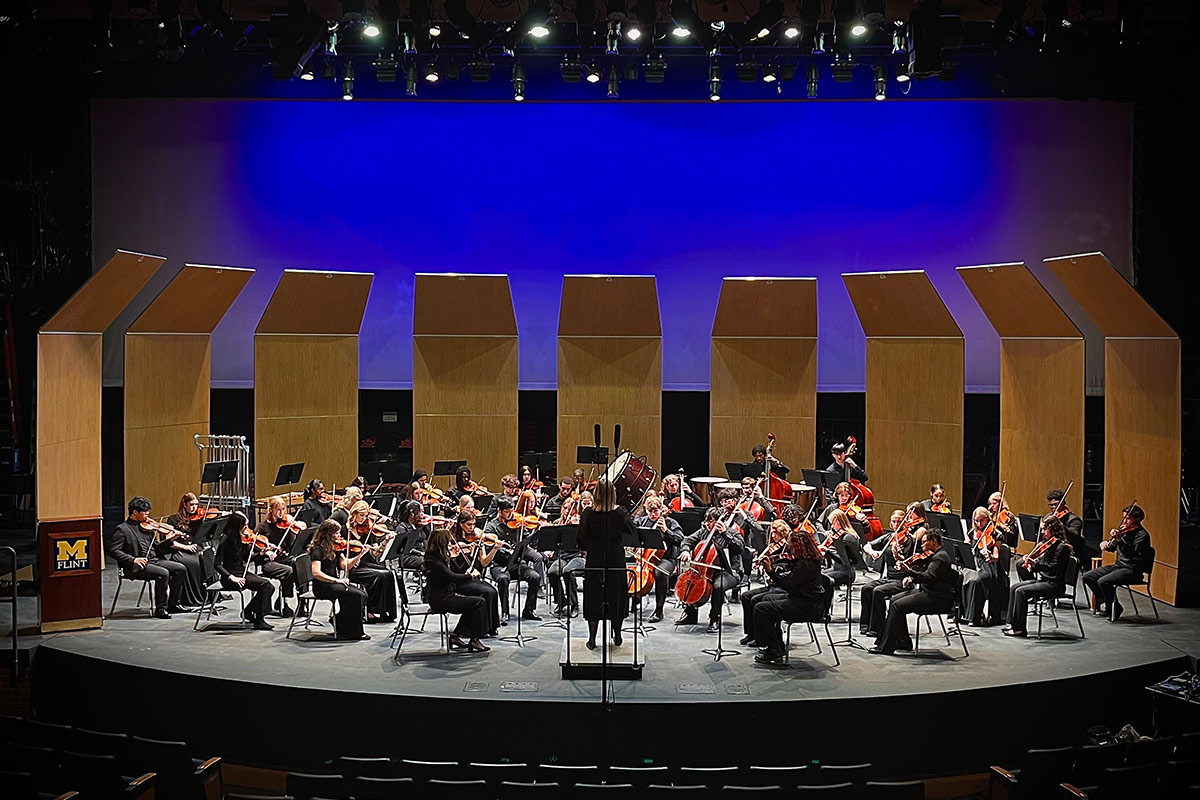
Something remarkable happened on the University of Michigan–Flint campus this spring. For three days, the halls buzzed with the sound of hundreds of instruments, the excitement of young performers, and the pride of communities coming together — all for the Michigan State Band and Orchestra Association’s District Festival.
And the numbers tell only part of the story.
2,146
total attendees
47
ensembles
1000+
student musicians
This year’s event was the biggest yet. UM-Flint hosted not one but two MSBOA districts — District 3 and District 9 — welcoming 47 bands and orchestras, along with more than 1,000 middle and high school musicians, their teachers, families, and supporters to campus. For many of these students, it was their very first time setting foot on a university campus.
“The MSBOA District Festival is one of the most important musical events for school programs across Michigan,” says Doug Burtch, assistant professor of music, director of bands, and music education coordinator at UM-Flint. “Hosting it on our campus strengthens the connection between the University of Michigan–Flint and the communities we serve.”
Behind the scenes, UM-Flint’s own Wind Symphony members and music education students made it all run smoothly. They managed logistics, welcomed ensembles, assisted directors, and guided hundreds of visitors across campus — all during their spring break.
Burtch couldn’t be prouder of them. “Giving up part of their spring break to serve this festival speaks volumes about their commitment — not only to their own education, but to the broader music community. They represented the University of Michigan–Flint with professionalism, warmth, and pride.”
It’s a sentiment that goes to the heart of what the music program at UM-Flint is all about. “Being a musician — and especially being a music educator — is about more than individual performance,” Burtch said. “It is about service, leadership, collaboration, and building musical communities.”
This festival wasn’t just a competition. It was a bridge between a university and its region, between seasoned educators and the next generation of young artists, between the music being made today and the musicians who will carry it forward tomorrow.
“University music programs do not exist in isolation — we are deeply connected to the teachers, students, and communities that make up the broader music education landscape.”
Doug Burtch
The crescendo has been building year after year — 14 ensembles in 2024, 18 in 2025, and 47 in 2026. If this trajectory is any sign, UM-Flint’s stage is only getting bigger. And the music is just getting started.