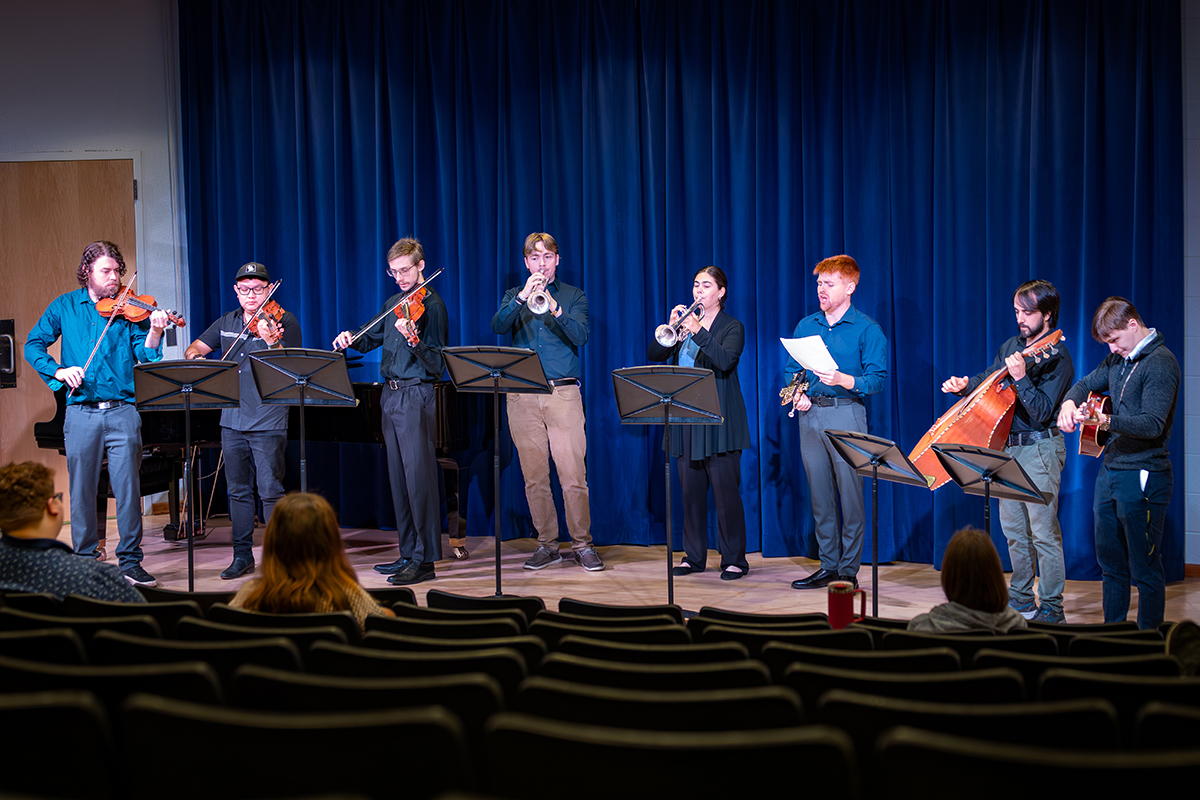
As part of UM-Flint’s weekly Music Performance class, Flint’s El Ballet Folklórico Estudiantil performed an original composition written by student Braeden Burger. Braeden is pursuing a degree in computer science with a minor in music composition.
“Ahora Sé is arranged for a mariachi ensemble of three violins, two trumpets, a vihuela/guitar, and a guitarrón (large six-string acoustic bass guitar),” Braeden explained. “The piece is a blend of the mariachi Bolero and Son Joropo styles. The bolero is a form that originated in Cuba during the 19th century, but gained worldwide popularity during Mexico’s Golden Age of Cinema.
“The lyrics of the bolero often focus on themes of ‘bittersweet, unrequited, betrayed, or eternal love.’ The bolero sound traditionally consists of steady strums from the guitar or vihuela as well as emphasized patterns of the bass guitarron. While a complete bolero usually has an intro, two parts consisting of 16 measures each, and an ending, Ahora Sé uses the bolero intro to lead into the faster son joropo section,” he continued.
“The son joropo (which literally means ‘party song’) is a style originating in Venezuela, with African and other South American influences. It has been described as ‘the music of the working-class, rural people, ranchers, and cattle herders, who celebrate with as much fervor as they work.’
“While the bolero always contains vocals, the son joropo can be vocal or instrumental. One of the most common elements of son joropo is the apagón, which is a percussive muting/striking technique on the guitar or vihuela. In the son joropo, you’ll hear this in the form of a ‘strum, strum, hit, strum, strum hit’ sound, which contrasts the melody as it shifts between time feels.”
In terms of the song’s lyrical inspiration, Braeden focused on traditional themes.
“Keeping in line with the common lyrical themes of both the bolero and son joropo genres, Ahora Sé tells a story of innocence and heartbreak. A boy starts by remembering a time when he thought love wasn’t for him, only to later experience it and be hurt more deeply than before.
“The repeated ‘Niño’ chorus paints him almost as a childlike figure who naively believed in love and fell for a lie. By the end, he has learned that love is not meant for him, because what felt real was only an illusion.
“I chose these genres as the focus of my composition because, after playing in El Ballet Folklórico Estudiantil’s Mariachi for over a year, I realized most of my favorite Mariachi pieces, such as La Bikina, La Fuente, La Barca, and Nunca Jámas, usually come from the son joropo or bolero styles.”
Performers:
- Violin: Gean Almendras, Dustin Burns, James Skellett
- Trumpet: Braeden Burger, Amber Villalpando
- Trumpet/Lead Vocal: Brandon Sexton
- Vihuela: Lucas Perro
- Guitarrón: Mikey Abasspour