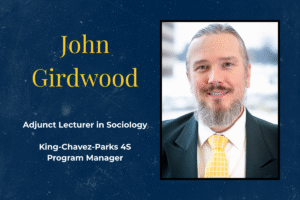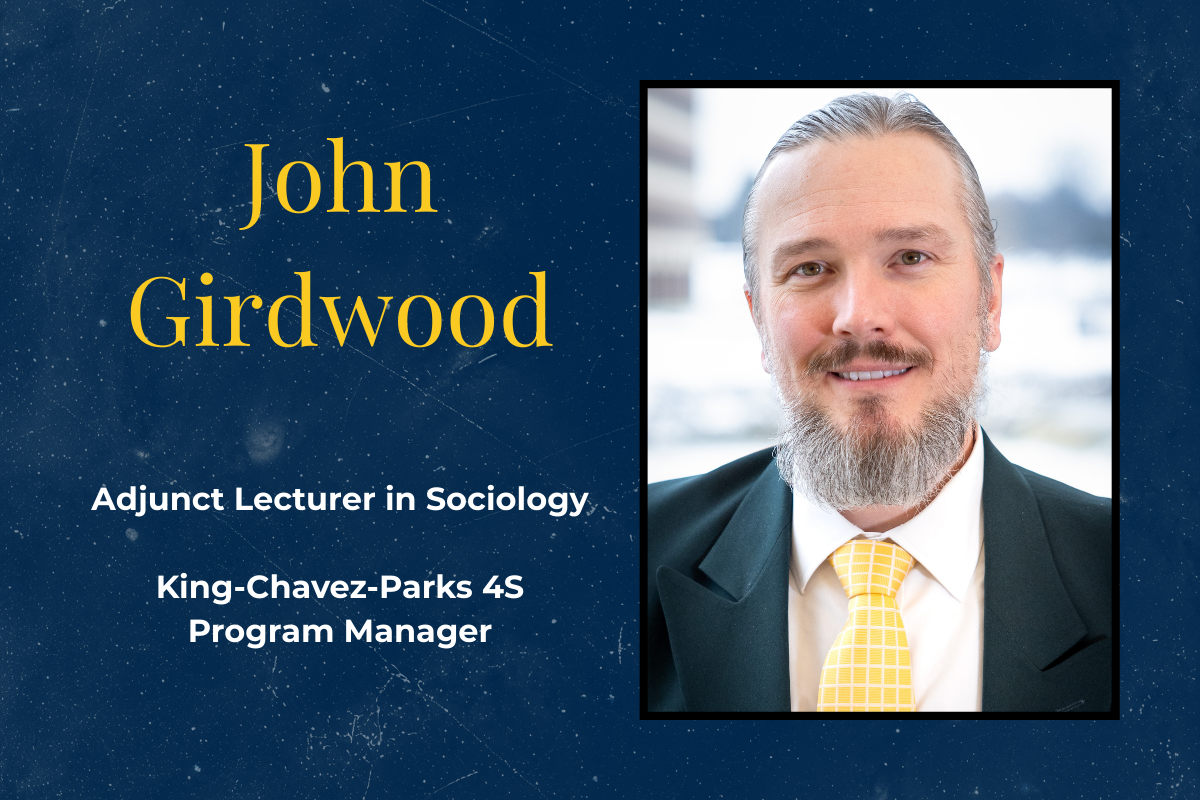
Adjunct Lecturer in Sociology
Manager of the King-Chavez-Parks 4S Program
John Girdwood’s office in the UCEN at the University of Michigan-Flint tells a story. A vintage turntable sits proudly among the usual academic trappings—a piece of the building’s original 1979 equipment that he painstakingly restored. It’s a fitting metaphor for John himself: someone who takes what others might overlook and finds new ways to make them work.

For the past five years, John has served as manager of the King-Chavez-Parks Select Student Support Services (4S) Program at UM-Flint, but his journey to this role was anything but traditional. Born and raised in Holt, a town south of Lansing, he describes his younger self as someone who “sailed in the wind,” making choices based on what seemed interesting rather than following a prescribed path.
“I do things that I enjoy, not life scripted out,” he said. “After every experience I have, I try to think—was that fun, was that worth it? Was that worth the breath?”
For all intents and purposes, John was a first-generation college student navigating higher education without a roadmap. While his mother did graduate from Michigan State University, she passed away during John’s first year of college, and his working-class, car mechanic father couldn’t really guide him.
“If I’d had career guidance earlier in life, I likely would have become a teacher sooner, or maybe a social worker,” he reflected. “We didn’t have case workers growing up, so I didn’t even know that was a job you could have; I wasn’t exposed to it.”
He graduated from Western Michigan University in 2002 with a degree in religion and philosophy, earning a 2.6 GPA. “I was broke as a joke,” he laughed. Without family resources and technically homeless after graduation, he found stability through his partner, Jaime, a Flint native who had inherited a home from her grandparents.
“I wouldn’t have anything without that one fork in the road,” he said. That fork led him to Flint, where he’s now lived for 20 years—the longest he’s lived anywhere.
After briefly attempting law school (“not for me!”), Girdwood earned a master’s degree in administration from Central Michigan University’s Global Campus in Flint, writing his thesis on Bridge Card participation. He then pursued a doctorate in sociology at Michigan State University.
“I probably chose sociology because I heard it was the easiest doctorate to get,” he admitted. “But after I started taking classes, I was really excited by it. In grad school, I didn’t realize I could pick whatever to write my dissertation on.” He chose homelessness—an experience not far from his own reality just years earlier.
John’s path to his current position at UM-Flint wound through multiple institutions. As a graduate student, he taught classes to fund his education. He worked as an adjunct at Saginaw Valley State University (and MSU, Alma, Adrian, Wayne State, CMU, Ann Arbor, and Delta College), then picked up courses at UM-Flint in 2012—first subbing for a faculty member on sabbatical, then teaching a DEEP section, then Promise Scholars sections of Sociology 100.
“I kept teaching all over the place, but I didn’t realize I was getting farther and farther away from becoming a professor because I didn’t know that was a thing,” he said. “No one ever told me this stuff.”
When the King-Chavez-Parks position opened in 2020, he’d already been teaching the Promise Scholars sociology course. “I interviewed and said, ‘I teach your kids—you should hire me!’” It was the second time he’d interviewed for the same manager position in the Office of Educational Opportunity Initiatives (EOI). This time, it worked.
Outside of work, John’s interests reveal his commitment to community. He and his partner maintain three ponds with 14 koi fish on an acre of land they purchased from the land bank near their condo. For John, who grew up “super poor,” koi ponds represented luxury—a dream he’s now turned into a community asset.
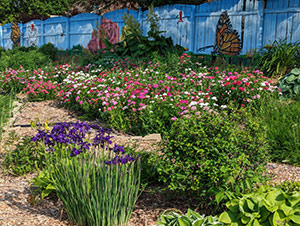
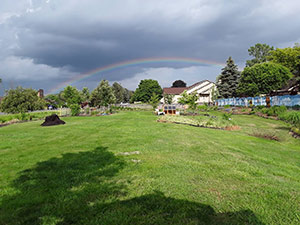

“We have a food dispenser for the community kids to feed the fish,” he explained. The property also includes community garden space, reflecting his belief in creating shared resources.
He’s equally invested in his hometown of Holt, where he founded the Holt Community Foundation. What started with scholarships expanded to include community gardening and the construction of an outdoor classroom with stadium seating at the high school campus. “There are so many restrictions in education, in budget,” he noted. “We wanted to create something special.”

At UM-Flint, John sees himself as part of something larger. “For the first time since I’ve been here, it really feels like our leadership—the chancellor, the provost, the new dean at CASE, the Vice Chancellors for Student Affairs and Enrollment Management, the chair of SACJ—are aligned in their values and goals for the university,” he said. “It feels like this is the time.”
His goals are ambitious but grounded in community impact. “Fifteen percent of Flint residents have college degrees,” he said. “By the time I leave here, I need 100% of Flint residents to have a college degree—actually, make that a sociology degree!’ He wants to see more sociology majors, increase the four-year graduation rate from 12% to 70%, bring more sports to campus, and hire more Flint residents as faculty.
“I could have my job for the rest of my life. I’m happy, I’m content. I’ll be here when I’m 70,” he said.
He’s particularly excited about Flint’s potential transformation. With the planned renovation of Central High School on Mott Community College’s campus and the chancellor’s commitment to athletics, Girdwood envisions UM-Flint evolving “from a commuter school to a community university.”
“I want to see a kid who played basketball in high school come to UM-Flint and continue playing the game that she loves,” he said. “That central location—it’s going to change things.”
When asked what he wished he’d known at 18, Girdwood laughed. “I should have gone to a career fair. All my friends went to career fairs. I thought when I graduated with a diploma someone was going to hand me a job—that’s not how it works!”
But perhaps his unconventional journey is precisely what makes him effective in his current role, working with students who, like him, are navigating higher education without a clear roadmap.
“I’m proud of my students,” he said. “They’re the best.”
And that vinyl record player in his office? It’s not just nostalgia. It’s a reminder that sometimes the best things come from taking what’s broken and finding a way to make it sing again.