Associate Professor of Anthropology
“I love seeing a student really grow throughout the semester. This past semester, I had one particular student I was concerned about. I wasn’t sure if they were getting it; they were too quiet and not engaging very much. But by the end of the semester, they were participating a lot and regularly sharing. Things seemed to click for them, which gives me a lot of satisfaction,” shared Daniel Birchok, associate professor of anthropology at the University of Michigan-Flint. “I also love when I can help a student expand their perspective. I had a student in the business school take my Culture and Economy class, and at the beginning, she seemed to have this attitude like, ‘You can’t teach me anything.’ Still, by the end of it, she was excited and thanked me for the tools — it’s incredibly exciting to see that kind of growth.”
Hailing from a family of teachers, Daniel always knew this would be his career path. He began his studies focused on history, graduating from John Carroll University in Cleveland, OH, with a degree in history and a certification to teach secondary education.
“One of my professors, Susan, who became a mentor and I consider, truly, like a godmother to my children, told me, ‘You think like an anthropologist,” Daniel recalled. “My girlfriend at the time, who is now my wife, was leaving to spend two years in Micronesia, so I took a year off of school and spent it there, teaching at a Jesuit high school and ultimately writing my undergraduate thesis on a Kava ritual and how it has changed over time. I found that I did take an anthropological perspective, and had to admit that Susan was right! So that set the stage for grad school.”
After graduating, Daniel taught high school for another year in Cleveland while he applied to graduate schools. He eventually landed at the University of Michigan, earning his Master’s in Southeast Asian Studies in 2004 and a PhD in anthropology and history in 2013. Daniel joined the faculty at UM-Flint in 2016.
“Before joining UM-Flint, I was doing postdoctoral research at Vanderbilt and commuting to Nashville. My wife was the executive director of a non-profit in Ann Arbor, and we had two small children at the time,” Daniel explained. “When the opportunity to join UM-Flint came up, it was exciting, as it meant we could truly settle in Michigan.”
Growing up outside of Pittsburgh, Daniel felt an immediate affinity for Flint. “We’re both rust belt towns — sure, there’s a difference in history and scale, but I connect to the history here intuitively, it feels like home to me,” he said. “I also really appreciate Flint’s union history; I was recently part of bringing a tenure-track faculty union to UM-Flint, and so union politics is really close to my heart. I love that Flint has a deep history in unionization.”
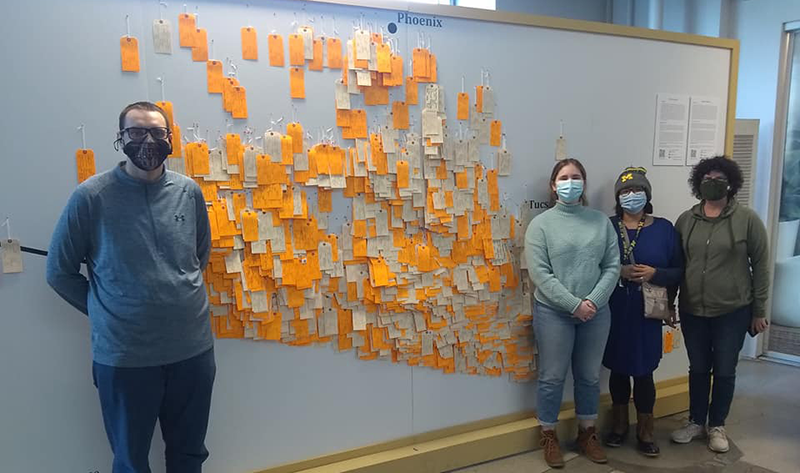
One of Daniel’s favorite experiences at UM-Flint was facilitating an installation of the Hostile Terrain 94 participatory art project.
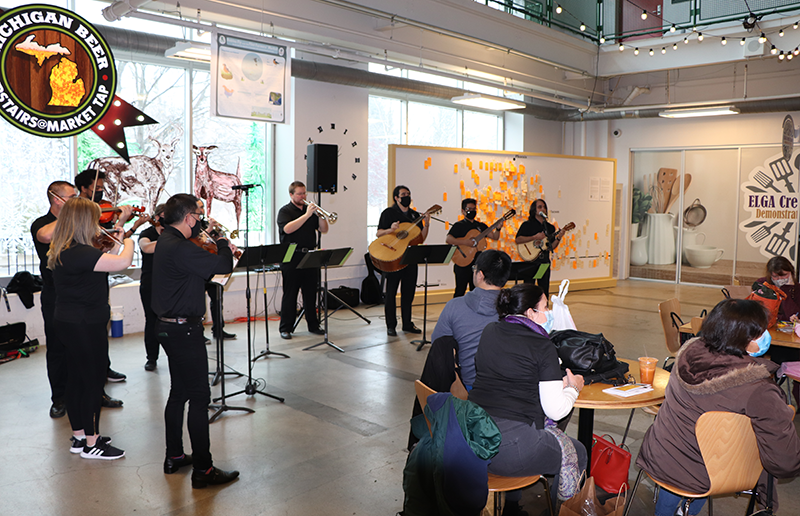
“Anthropologist Jason De León wrote a book called ‘The Land of Open Graves’ which documents the journey of migrants across the Sonoran desert, using both archeological and cultural methods of anthropology. I developed a unit of my introductory course that focused on his book and the public art project, and students and community members created a giant wall map of the desert, filled out toe tags, and pinned them to map coordinates, visually representing all the migrants who have died trying to cross the desert,” Daniel shared. “I helped to host Jason as a speaker, and he met with a couple of student organizations – LUNA and the Anthropology Club. Together, we decided to bring the project to Flint. It took us months to put it together, and then it was on display at the Flint Farmers’ Market for about two months. During the closing weekend, we invited El Ballet Folklórico to perform. These interdisciplinary projects, where students can engage with a particular topic through various lenses, are one of the things that make UM-Flint special.”
Regarding future projects and goals, Daniel looks forward to delving more deeply into Flint’s ethnographic history.
“I’m hoping to develop a project that my students can engage in undergraduate research, where we explore and map the houses of worship in Flint, the area’s religious history as it relates to things like the development of the auto industry, the civil rights and other social movements, and contemporary immigration to the area,” he said. “It would be cool to create an interactive map online, and for students to learn skills around developing that.
“Overall, I feel privileged to have the opportunity to help students develop a broad set of conceptual tools for understanding the world, and I am hopeful that we’ll emphasize that more. These skills help them be successful in the long haul and have a better quality of life,” Daniel noted. “All of the faculty here give our students different lenses to view fundamental problems, and it’s a gift to be part of that.”
I wish I had known that I have both more and less time than I think I do!
Daniel’s Insights
I study time and the ways that people think about it, and it’s fascinating how our sense of time is socialized in us, and so we have both internal and external pressure related to it.
I tend to get anxious about everything I want to get done, and while I think that’s served me well in all that I have achieved, I think I sometimes rushed things or wasn’t as present in them as I could have been.
Ultimately, time doesn’t do what we expect — and then it’s gone.
Daniel Loves
- Playing Hoops. “I am an avid basketball player, I play 2-3 times per week, but it hurts more now than it used to!”
- Pittsburgh Sports. “If you’re from Pittsburgh, you’re from “the ‘Burgh” for life! I love watching all of my hometown teams — Steelers, Penguins, and yes, even the Pirates.”
- Hanging With His Kids. “We love going to outdoor festivals, music festivals, stuff like that. But I feel lucky that my teenagers still want to hang with me.”
- Travel. “I love it in general, but my favorites include Indonesia because I do research there, especially the city of Yogyakarta; Hawaii, because it reminds me a bit of the time I spent in Micronesia; and Seattle, which has great food, the city has a nice vibe, and there always seems like there is something to see and do there.”
- Vegetarian Food. “A family fave is deep-fried tempe with sambal (a red chili sauce) and some kind of greens, watercress, and garlic over white rice. We probably eat this at least once a week at home!”
Flint Faves
- Walking the Flint River. “I love walking the river, both on our campus and off. There are great little pockets all along it, and it’s got a great feel. I particularly like areas where the river intersects with more busy areas, such as Saginaw, because you can feel that there’s a lot of activity happening near you, but you’re somewhat separated and it feels peaceful.”
- My Former Students. “Flint is slowly revitalizing, and while there is some individual agency in how we’re rebuilding, a lot of systems and structures need to be addressed to allow for that. So I love to see my former students out in the community, working in jobs that are really making a difference. Some are working in businesses along Saginaw, some are working in social work or political organizing, others are teaching English at the Latinx Tech Center — it’s exciting to see what my students are doing to change the context and structures in and around Flint, and how they’re handling what comes back to them. It’s inspiring.”
Flint in Three Words
Honest
Underestimated
Looking-out-for-each-other
“There’s a real sense of solidarity in Flint.”